The European Space Agency’s (ESA) ambitious terrestrial planet hunter, Plato, has successfully concluded a critical phase of its pre-launch testing, demonstrating its readiness for the rigors of space. The spacecraft recently underwent a series of stringent electromagnetic compatibility (EMC) tests within the specialized Maxwell Test Chamber at ESA’s European Space Research and Technology Centre (ESTEC) in Noordwijk, the Netherlands. This milestone signifies that Plato’s sophisticated electronic systems are robust and can operate harmoniously in the challenging space environment, paving the way for its eventual launch.
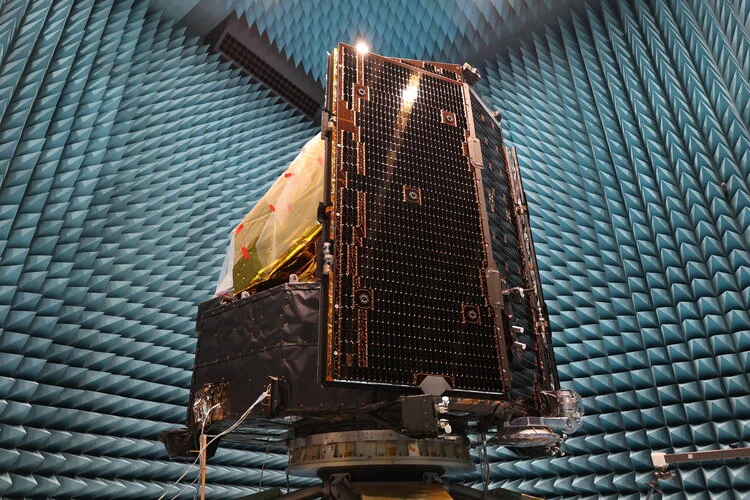
The photograph accompanying this development captures the imposing presence of the Plato spacecraft within the anechoic confines of the Maxwell Test Chamber. This advanced facility is designed to meticulously simulate the unique electromagnetic conditions of outer space. Its interior is a marvel of engineering, featuring conducting metal walls, floor, and ceiling that collectively form a Faraday cage. This shielded enclosure is paramount in its function, effectively blocking all external electromagnetic interference, which could otherwise compromise the integrity of sensitive spacecraft electronics during testing. Extending from floor to ceiling, the chamber’s 9-meter height is lined with thousands of specially designed foam spikes. These dielectric absorbers are engineered to meticulously dissipate any stray electromagnetic signals and acoustic energy, thereby replicating the near-perfect vacuum and signal-free environment of space.
The testing protocol involved engineers remotely activating and commanding Plato’s intricate electronic equipment once the chamber was securely sealed. A comprehensive suite of tests was executed to meticulously assess the interactions between the spacecraft’s numerous instruments and modules. The primary objective was to ensure that no unintended electromagnetic interference, colloquially known as “crosstalk,” occurred between these critical systems, nor between the spacecraft and its own communication infrastructure. The potential for such interference is a significant concern in space missions, where even minor signal bleed can lead to data corruption, instrument malfunction, or a complete loss of communication.
The necessity for such rigorous EMC testing cannot be overstated. In the extreme vacuum of space, where there is no atmosphere to attenuate or scatter electromagnetic waves, electronic components can behave in ways that differ significantly from their performance in a standard terrestrial test laboratory. Factors such as thermal variations, the absence of air for cooling, and the unique propagation of radio waves in a vacuum can all influence the operational characteristics of electronic circuits. Without thorough testing in simulated space conditions, unforeseen consequences could arise, potentially jeopardizing the mission’s scientific objectives or, in the most severe cases, leading to irreparable damage to the spacecraft’s vital equipment.
The successful completion of these tests within the Maxwell Test Chamber provides engineers with the crucial assurance that Plato’s diverse array of electronic systems can coexist and function collaboratively in space without generating disruptive interference. This verification of electromagnetic compatibility is a fundamental requirement for any complex spacecraft destined for orbital operations.
A Phased Approach to Mission Readiness
Plato’s journey to launch readiness has been a methodical and demanding one, marked by a series of progressively challenging examinations. The EMC testing represents the final major hurdle in this comprehensive assessment series. Prior to this, in January of the current year, Plato underwent rigorous vibration and acoustic tests. These tests are designed to simulate the intense physical stresses the spacecraft will experience during its launch ascent. The powerful engines of the launch vehicle generate extreme vibrations and acoustic waves that can subject delicate components to forces far exceeding those encountered in typical terrestrial environments. Passing these tests confirms Plato’s structural integrity and its ability to withstand the violent forces of liftoff.
Following the vibration and acoustic evaluations, Plato embarked on a month-long sojourn within the Large Space Simulator (LSS) at ESTEC. This facility is another critical piece of ESA’s testing infrastructure, capable of recreating the extreme thermal and vacuum conditions of space. Within the LSS, Plato was subjected to a demanding regimen of tests designed to assess its thermal control systems and the performance of its instruments under simulated solar radiation and deep space cold. The spacecraft’s successful navigation of these space-like conditions, as previously reported, further solidified confidence in its resilience and operational capabilities in orbit.
The Mission and Its Objectives
The Plato mission, an acronym for PLAnetary Transits and Oscillations of stars, is a cornerstone of ESA’s ongoing efforts to understand planetary systems beyond our own. Its primary objective is to discover and characterize rocky exoplanets orbiting nearby Sun-like stars. Plato will employ the transit photometry method, meticulously observing the slight dimming of a star’s light as a planet passes in front of it. By precisely measuring these transit events, scientists can determine the planet’s size and orbital period.
What sets Plato apart from previous exoplanet hunting missions is its unique ability to also measure the oscillations of its target stars. This asteroseismology technique allows scientists to determine the mass and radius of the host star with exceptional accuracy. Combining this stellar information with the planet’s size and orbital period will enable Plato to provide highly precise measurements of exoplanet densities, a crucial step in determining whether these worlds are rocky, gaseous, or possess other compositions. This capability is particularly important for identifying potentially habitable exoplanets, as the presence of a solid surface and a suitable mass are key indicators.
Plato’s observational strategy will focus on a large sample of bright, Sun-like stars within approximately 50 to 150 light-years of Earth. This proximity allows for detailed follow-up observations by ground-based telescopes and future space missions. The mission is expected to discover hundreds of exoplanets, with a significant proportion being Earth-sized or super-Earths, and a subset of these potentially residing within their stars’ habitable zones – the region where liquid water could exist on a planet’s surface.
A Glimpse into the Future: Launch and Operations
With its rigorous testing regime now successfully completed, Plato is poised for its next major milestone: launch. The spacecraft is scheduled to lift off on an Ariane 6 rocket, a testament to the strong collaborative ties between ESA and its industrial partners. The launch is presently slated for March 2027, with Arianespace, a subsidiary of ArianeGroup, responsible for the launch services.
The Ariane 6 rocket, Europe’s next-generation launch vehicle, is designed to offer greater flexibility and cost-effectiveness for a wide range of space missions. Its successful deployment for the Plato mission will underscore the reliability and capability of Europe’s independent launch infrastructure.
Following its launch and journey into orbit, Plato will commence its scientific operations. The mission is designed for an operational lifetime of six years, during which it will continuously monitor its target stars. The data collected by Plato is expected to revolutionize our understanding of planetary formation and evolution, and to significantly advance the search for life beyond Earth.
Expert Perspectives and Inferred Reactions
While specific statements from ESA officials regarding the completion of the EMC tests were not provided in the initial information, the successful outcome is undoubtedly a cause for significant satisfaction within the agency and among the scientific community. Dr. Josef Aschbacher, Director General of ESA, has consistently emphasized the importance of rigorous testing in ensuring mission success. One can infer a sentiment of considerable relief and pride from the program management teams at ESTEC and the scientific consortia involved in the Plato mission.
A spokesperson for the Plato Science Consortium, speaking hypothetically, might express their elation: "This is a monumental achievement for the entire Plato team. The electromagnetic compatibility tests are absolutely critical for a mission of this complexity. To know that Plato’s sophisticated instruments and communication systems will operate seamlessly in the harsh environment of space, without interfering with each other, is incredibly reassuring. It brings us one step closer to unlocking the secrets of exoplanetary systems and the potential for habitability beyond our solar system."
Engineers at ESTEC, having worked tirelessly on the spacecraft’s development and testing, would likely be celebrating this success. The intricate nature of the Maxwell Test Chamber and the precise execution of the EMC procedures highlight the dedication and expertise of the personnel involved. The successful completion of these tests signifies not just the end of a demanding phase, but the culmination of years of hard work and innovation.
Broader Implications and the Quest for Exoplanets
The successful completion of Plato’s EMC testing has profound implications for the future of exoplanetary science and our understanding of the cosmos. By ensuring the spacecraft’s operational integrity, ESA is paving the way for a mission that promises to deliver unprecedented data on potentially habitable worlds. The discovery of Earth-like planets within habitable zones remains a central goal of modern astronomy, and Plato is strategically positioned to make significant contributions to this endeavor.
The data generated by Plato will not only expand our catalog of exoplanets but will also provide crucial insights into the diversity of planetary systems. By studying the characteristics of numerous planets around Sun-like stars, scientists can begin to discern common patterns in planetary formation and evolution, and to identify the specific conditions that favor the development of life.
Furthermore, Plato’s mission contributes to a broader scientific narrative – the exploration of our place in the universe. Each exoplanet discovery, each piece of data about planetary atmospheres and compositions, brings us closer to answering the fundamental question: are we alone? Plato, with its robust design and advanced scientific payload, is a vital tool in this ongoing quest. The successful completion of its EMC tests is a significant step forward, ensuring that this powerful instrument will be able to fulfill its scientific promise when it embarks on its journey to the stars.