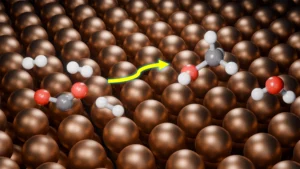
The enduring allure of gold has shaped human civilization for millennia, serving as a standard for currency, a symbol of divine status, and a cornerstone of global jewelry markets. Unlike silver, which blackens over time, or iron, which succumbs to rust, gold maintains a brilliant, untarnished luster that persists even after centuries of burial or immersion in seawater. While scientists have long attributed this "nobility" to gold’s inherent chemical stability, researchers at Tulane University have recently uncovered a more complex and fascinating reality. Their study reveals that gold’s resistance to the elements is not merely a product of its elemental properties but is actively maintained by a sophisticated rearrangement of atoms on its surface. This discovery, published in the prestigious journal Physical Review Letters, provides the first detailed look at the atomic-scale defense mechanisms that allow gold to defy the natural process of oxidation.
The research team, led by Matthew Montemore, an associate professor of Chemical Engineering at Tulane’s School of Science and Engineering, alongside postdoctoral fellow Santu Biswas, utilized advanced computer simulations to probe the behavior of atoms and electrons on gold surfaces. Their findings indicate that gold atoms naturally shift into specific protective patterns, creating an environment where it is energetically unfavorable for oxygen molecules to react with the metal. This atomic restructuring reduces the rate of oxygen reactions by a factor of a billion to a trillion, effectively creating a permanent shield against the atmospheric forces that degrade other metals.
The Atomic Architecture of Resistance
To understand the significance of the Tulane study, one must first consider the nature of oxidation. In most metals, when surface atoms come into contact with oxygen, the oxygen molecules split and form chemical bonds with the metal, creating an oxide layer. In the case of iron, this results in porous rust that eventually consumes the entire material. In the case of silver, a thin layer of sulfide or oxide creates a dull tarnish. Gold, however, has always been the outlier.
The traditional scientific consensus held that gold is simply "inert"—meaning it lacks the chemical "desire" to share electrons with oxygen. However, Montemore and Biswas discovered that for the two most common types of gold surface structures, the story is more dynamic. When gold is exposed to the environment, its surface atoms do not remain static. Instead, they reorganize into a specific geometric configuration that increases the energy barrier required for oxygen molecules to break apart.
Without this spontaneous rearrangement, the simulations showed that oxygen could actually react with gold much more readily. By shifting its own "skin," the gold creates a barrier that makes it nearly impossible for oxidation to begin. This finding shifts the narrative from gold being a passive, inert element to being a material with a highly effective, naturally occurring structural defense.
A Chronology of Human Obsession and Scientific Inquiry
The quest to understand gold’s unique properties spans the entirety of recorded history. To appreciate the context of the Tulane discovery, it is necessary to look at the timeline of our relationship with this precious metal:
- 4000 B.C.: Gold is first used for decorative objects in Eastern Europe and the Middle East, prized specifically because it does not lose its color or shine over time.
- 600 B.C.: The first gold coins are struck in Lydia (modern-day Turkey), establishing gold as a permanent store of value due to its durability.
- 18th & 19th Centuries: The development of modern chemistry identifies gold as a "noble metal" on the periodic table, grouping it with platinum and palladium.
- 1980s: Scientists discover that while bulk gold is inert, gold at the nanoscale (nanoparticles) can actually be a powerful catalyst for chemical reactions, sparking a surge in industrial research.
- 2000s-2010s: Gold becomes essential in high-end electronics, as its resistance to corrosion ensures reliable electrical connections in smartphones and aerospace technology.
- Present Day: The Tulane study identifies the specific atomic-scale mechanisms—surface rearrangement—that explain the underlying physics of gold’s legendary durability.
Supporting Data: The Trillion-Fold Barrier
The quantitative impact of this atomic rearrangement is staggering. According to the data derived from the researchers’ simulations, the reorganized surfaces reduce the probability of oxygen dissociation—the process where O2 molecules split into individual atoms to bond with the metal—by 10 to the power of 9 or 12.
In practical terms, this means that if a standard metal surface were to oxidize in one second, a gold surface with this protective atomic arrangement would take millions of years to undergo the same level of reaction. This explains why gold artifacts recovered from ancient shipwrecks, such as the Spanish galleons of the 1700s, appear as bright and yellow as the day they were minted, even after three centuries of exposure to salt water and dissolved oxygen.
The simulations focused on two primary surface types: the (111) and (100) facets of the gold crystal lattice. These are the most stable and common arrangements of atoms in gold. The study found that both surfaces undergo "reconstruction," where the top layer of atoms packs more tightly or shifts into a hexagonal pattern that differs from the bulk of the crystal below. This reconstruction is the key to the metal’s "atomic-scale protective barrier."
Industrial Implications: Rethinking the Gold Catalyst
While the discovery provides a satisfying answer to a historical mystery, its primary value lies in the future of industrial manufacturing and clean energy. Gold is currently used as a catalyst in several critical processes, but its natural resistance to oxygen is often a double-edged sword.
In chemical engineering, a catalyst is a substance that speeds up a reaction without being consumed. For a catalyst to work with oxygen, it must be able to "grab" oxygen molecules, break them apart, and then "hand" them over to another molecule. Because gold is so good at preventing oxygen from breaking apart on its surface, it is often less efficient than other metals like palladium or platinum for certain tasks.
"If you can trick gold into dissociating oxygen, it can actually become a very effective catalyst for certain reactions," Professor Montemore explained. "Our work suggests a new strategy for potentially doing that by preventing or reversing these surface rearrangements."
The Economic and Environmental Stakes
The implications for the chemical industry are vast. Currently, gold-palladium catalysts are used to produce vinyl acetate monomer (VAM), a precursor for many polymers, paints, and adhesives found in billions of dollars’ worth of consumer products. By understanding how to manipulate the surface geometry of gold, engineers could potentially design more efficient catalysts that require less precious metal to achieve the same result, lowering costs and reducing the environmental footprint of mining.
Furthermore, the research points toward breakthroughs in clean energy:
- Carbon Monoxide Removal: Gold catalysts are highly effective at converting toxic carbon monoxide into carbon dioxide, even at room temperature. This is vital for air purification systems and fuel cell technology, where CO can "poison" and degrade expensive platinum components.
- Propylene Oxide Production: This chemical is used in the creation of polyurethanes (foams and plastics). Current production methods can be environmentally hazardous; gold catalysts offer a "greener" pathway, and the Tulane findings could optimize this process.
- Green Hydrogen: As the world moves toward a hydrogen economy, finding ways to manage oxygen reactions on metal surfaces is crucial for the efficiency of electrolyzers and fuel cells.
Expert Reactions and Future Directions
The scientific community has reacted to the Tulane study with significant interest. Dr. Santu Biswas noted that the research provides a roadmap for "surface engineering." By controlling the environment in which gold nanoparticles are prepared, or by introducing specific "dopant" atoms that prevent the protective rearrangement, scientists can essentially "turn on" the reactivity of gold when needed and "turn it off" when durability is the priority.
Industry analysts suggest that this could lead to a new generation of "smart materials." If a material could be designed to switch between a protective state and a reactive state, it would open doors to self-cleaning surfaces or more durable sensors in extreme environments, such as deep-sea drilling or space exploration.
Conclusion: A New Chapter for the Noblest Metal
The Tulane University study serves as a reminder that even the most familiar materials still hold secrets. Gold has been studied for thousands of years, yet it was only through modern computational physics that we could finally understand the "why" behind its eternal shine.
By proving that gold’s durability is a result of active atomic-scale defense rather than passive indifference, Montemore and his team have provided a new lens through which to view metallurgy. The transition from understanding why gold stays shiny to learning how to "trick" it into being more reactive marks a significant milestone in chemical engineering. As the world seeks more efficient ways to produce energy and materials, the secrets held within the top few layers of gold atoms may provide the key to the next great leap in industrial innovation. The "noble" metal, it seems, is not just a symbol of wealth, but a masterclass in structural engineering at the smallest possible scale.