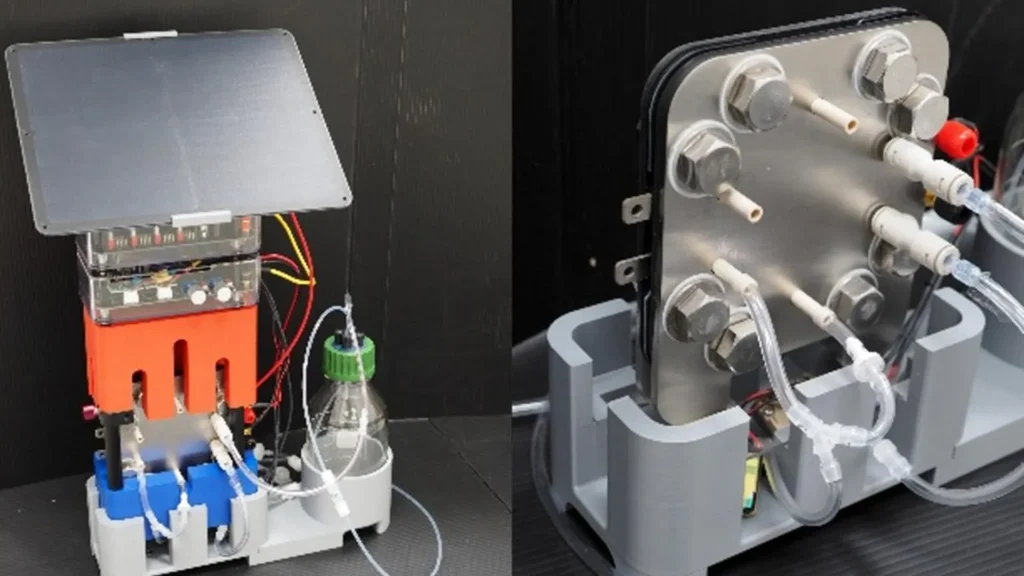
Researchers at Osaka Metropolitan University have achieved a significant breakthrough in renewable energy technology, unveiling a novel artificial photosynthesis system capable of generating solar fuel with unprecedented consistency, all while eliminating the traditional reliance on battery-based control equipment. This pivotal advance stems from the ingenious integration of a self-regulating chemical component directly into the electrolyzer, a design choice that promises to dramatically reduce both system complexity and overall cost, paving the way for more accessible and efficient solar fuel production.
The global imperative to transition towards sustainable energy sources has intensified research into methods that can harness the sun’s abundant power more effectively. Inspired by the natural process through which plants convert sunlight, water, and carbon dioxide into energy-rich compounds, artificial photosynthesis seeks to replicate and industrialize this miraculous transformation. One of the most promising products of this technology is formic acid, a versatile chemical that holds immense potential as a clean fuel and a compact medium for energy storage. The challenge, however, has always been to maintain stable production, given the inherent intermittency of sunlight.
The Foundational Principles of Artificial Photosynthesis and Its Challenges
At its core, artificial photosynthesis involves an electrolyzer, a device central to converting electrical energy, typically derived from solar cells, into chemical energy. This chemical energy is then stored in the bonds of fuels like formic acid, methanol, or hydrogen. While the concept is elegantly simple, its practical application has been fraught with difficulties, primarily stemming from the fluctuating nature of solar irradiance. Sunlight levels vary dramatically throughout the day due due to factors such as cloud cover, time of day, seasonal changes, and geographical location. This variability poses a significant hurdle for chemical processes that require a stable and consistent energy input to operate at optimal efficiency.
To counteract these fluctuations, many conventional artificial photosynthesis systems employ a technique known as Maximum Power Point Tracking (MPPT). MPPT is a sophisticated algorithmic control method designed to continuously adjust the voltage and current output of solar panels to ensure they deliver the highest possible power, even as environmental conditions change. While highly effective in maximizing solar energy capture, traditional MPPT setups typically necessitate a suite of additional electronic components, including DC-DC converters, inverters, and, crucially, battery storage systems. These components serve to smooth out the energy flow, providing the stable power required by the electrolyzer. However, their inclusion invariably leads to increased capital expenditure, greater system complexity, additional maintenance requirements, and potential energy losses within the control circuitry itself. This added complexity and cost have been significant barriers to the widespread adoption and commercial viability of artificial photosynthesis technologies.
A Paradigm Shift: The Self-Regulating Electrolyzer
Recognizing these limitations, a dedicated team of researchers at the Research Center for Artificial Photosynthesis at Osaka Metropolitan University embarked on a mission to fundamentally redesign the electrolyzer. Led by Associate Professor Yasuo Matsubara and Professor Yutaka Amao, the team collaborated with Iida Group Holdings Co., Ltd., a strategic partnership that underscores the commercial potential and industrial relevance of their work. Their innovative approach bypasses the need for external electronic control systems by embedding the MPPT function directly into the electrolyzer itself.
The core of this innovation lies in a specially designed solid electrolyte built intrinsically into the device. This novel material, through its inherent thermal and impedance properties, allows the electrolyzer to automatically adjust its electrical characteristics in response to changes in solar input. The mechanism is elegantly simple and self-sustaining: as the intensity of sunlight increases, the electrolyzer naturally experiences a rise in temperature. The system is meticulously engineered so that this warming effect causes a corresponding drop in the electrical resistance of the solid electrolyte. This reduction in resistance, in turn, allows electricity to flow more freely and efficiently, effectively enabling the electrolyzer to draw optimal power from the solar cells without external intervention.
Professor Amao elaborated on this ingenious design, stating, "As sunlight increases, the electrolyzer naturally heats up. The system is designed so that this warming causes the electrical resistance to drop, allowing electricity to flow more freely. This makes the system automatically adjust its electrical behavior." He further emphasized the broader implications: "This self-regulating behavior helps keep fuel production more stable throughout the day and automates the system, while reducing dependence on batteries and costly external components." This integrated self-regulation not only streamlines the system but also enhances its robustness and reliability by removing vulnerable external parts.
Formic Acid Production: Stability Under Real-World Conditions
To validate their groundbreaking design, the researchers subjected the technology to rigorous testing under actual outdoor conditions. The results were highly encouraging: the system consistently produced formic acid from water and carbon dioxide, maintaining stable output even as ambient sunlight levels fluctuated significantly throughout the testing period. This practical demonstration underscores the real-world applicability and resilience of their self-regulating electrolyzer.
The success of these trials was not entirely unforeseen. Professor Matsubara noted, "We were confident that it would be successful, as we previously showcased this research at the ‘Joint Pavilion Iida Group × Osaka Metropolitan University’ exhibition as part of the Osaka Kansai Expo 2025." This early public demonstration, which successfully generated enough formic acid to power a miniature diorama within the pavilion, provided compelling evidence of the system’s potential. The exhibition served not only as a proof-of-concept but also as a powerful visualization of how such efficient artificial photosynthesis systems could potentially be scaled to charge various applications, from industrial processes to household devices, in a sustainable manner. The findings of this landmark research were formally published in the esteemed scientific journal EES Solar, making the details available to the global scientific community.
Broader Context: The Urgency of Solar Fuel Development
The development of efficient and cost-effective solar fuel technologies is critical in the global pursuit of carbon neutrality and energy security. The Intergovernmental Panel on Climate Change (IPCC) and numerous national governments have highlighted the urgent need to drastically reduce greenhouse gas emissions, with renewable energy playing a central role. While solar photovoltaic (PV) technology has seen remarkable advancements in efficiency and cost reduction, the challenge of energy storage remains a bottleneck for its widespread, continuous application. Batteries, while improving, still face issues of material scarcity, environmental impact, cost, and limited lifespan for large-scale grid applications.
Solar fuels offer an attractive alternative or complement to electrical battery storage. By converting intermittent solar energy into chemical bonds, they allow for long-duration, high-density energy storage that is easily transportable and can be used as a direct replacement for fossil fuels in many industrial and transportation sectors. Formic acid, specifically, is a promising candidate due to its relatively high energy density, liquid state at ambient temperatures, and its ability to be safely handled and transported. It can be directly used in fuel cells, or catalytically decomposed to produce hydrogen, making it a versatile chemical carrier. The global market for formic acid is substantial, driven by its use in livestock feed preservation, leather tanning, textile dyeing, and as a chemical intermediate. A sustainable, solar-powered production method could revolutionize these industries and open new avenues for its application as a clean fuel.
Timeline and Chronology of a Decades-Long Endeavor
The journey towards viable artificial photosynthesis systems has spanned decades, with its conceptual roots going back to the oil crises of the 1970s. Initial research focused on understanding the complex mechanisms of natural photosynthesis and mimicking its key components, particularly light-harvesting systems and catalysts for water splitting and CO2 reduction.
- 1970s-1980s: Early fundamental research into photoelectrochemical cells and CO2 reduction using various catalysts.
- 1990s-2000s: Increased focus on developing more efficient and stable catalysts, leading to the identification of promising materials. The concept of "solar fuels" gained traction.
- 2010s: Significant investment from governments and private entities worldwide, including Japan’s national energy strategies, pushing for breakthroughs in large-scale artificial photosynthesis. Research intensified on system integration and efficiency improvements, alongside the growing recognition of MPPT as a critical component.
- Early 2020s: The Osaka Metropolitan University team, leveraging years of collective expertise within its Research Center for Artificial Photosynthesis, focused on addressing the system integration and cost complexities associated with conventional MPPT setups. This led to the conceptualization and development of the self-regulating electrolyzer.
- 2024 (Pre-Expo): Initial lab-scale successes and optimization of the solid electrolyte and its thermal properties.
- April 2025 (Osaka Kansai Expo): Public showcase of the technology at the "Joint Pavilion Iida Group × Osaka Metropolitan University," demonstrating its practical capability by powering a diorama. This marked a crucial validation point and garnered early attention.
- Late 2025 (Post-Expo): Publication of the findings in EES Solar, formally introducing the innovation to the global scientific and engineering community. This publication provides the detailed technical information necessary for peer review and further development.
Strategic Collaboration and Industrial Implications
The collaboration with Iida Group Holdings Co., Ltd. is a critical element in accelerating the transition of this academic research into practical, market-ready solutions. Iida Group Holdings, a prominent Japanese conglomerate with diverse interests including housing and energy solutions, brings invaluable industrial expertise, manufacturing capabilities, and market access. This partnership signifies a clear path toward potential commercialization, focusing not just on the scientific novelty but also on the scalability, cost-effectiveness, and real-world applicability of the technology.
From an industrial perspective, the elimination of batteries and complex electronic control systems offers several compelling advantages:
- Reduced Capital Expenditure (CapEx): Batteries and advanced power electronics are significant cost drivers. Removing them substantially lowers the initial investment required for deploying artificial photosynthesis systems.
- Lower Operational Expenditure (OpEx): Fewer components mean less maintenance, fewer points of failure, and potentially longer system lifespans, translating to reduced operational costs over time.
- Simplified System Design and Installation: A less complex system is easier to design, manufacture, transport, and install, accelerating deployment timelines.
- Enhanced Robustness and Reliability: Fewer sensitive electronic parts make the system more resilient to harsh environmental conditions, which is particularly advantageous for outdoor solar applications.
- Smaller Footprint: The absence of bulky batteries and control cabinets reduces the physical space required for the system, making it more suitable for diverse installations, including urban environments or decentralized energy hubs.
For Iida Group Holdings, this technology could unlock new opportunities in sustainable construction, smart homes, and potentially in developing localized energy ecosystems where solar fuels can complement or replace traditional energy sources. Imagine homes or communities where rooftop solar panels not only generate electricity but also produce formic acid on-site for heating, local transportation, or industrial processes, all without the need for large, expensive battery banks.
Broader Impact and Future Outlook
The implications of Osaka Metropolitan University’s self-regulating electrolyzer extend far beyond mere technical elegance. This innovation represents a significant leap forward in making solar fuel production more accessible, affordable, and robust.
- Decentralized Energy Production: By simplifying the technology, it becomes more feasible to deploy small to medium-scale solar fuel production units in remote areas, developing countries, or for specific industrial applications, thereby fostering energy independence and reducing reliance on centralized grids.
- Accelerated Carbon Dioxide Utilization: The direct conversion of CO2 into a valuable fuel like formic acid provides a tangible pathway for carbon capture and utilization (CCU), transforming a greenhouse gas into a resource. This contributes directly to climate change mitigation efforts.
- Enhanced Grid Stability and Energy Security: Solar fuels can act as a buffer for renewable energy, storing excess solar power during peak generation for later use, thus improving grid stability and reducing curtailment of renewable energy sources. This contributes to national energy security by diversifying fuel sources.
- New Economic Opportunities: The reduced cost and complexity could catalyze the development of new industries around solar fuel production, distribution, and utilization, creating jobs and fostering economic growth in the green energy sector.
- Inspiration for Further Research: This breakthrough is likely to inspire researchers worldwide to explore similar self-regulating mechanisms in other renewable energy technologies, driving further innovation in materials science, electrochemistry, and system engineering.
While the current demonstration focuses on formic acid, the underlying principle of a self-regulating electrolyzer could potentially be adapted for the production of other solar fuels, such as hydrogen or methanol, further expanding its versatility and impact. The next steps will likely involve scaling up the system, optimizing its long-term performance and durability, and conducting life-cycle assessments to fully quantify its environmental and economic benefits.
In conclusion, the Osaka Metropolitan University team, in collaboration with Iida Group Holdings, has not merely refined an existing technology; they have introduced a fundamentally new approach to artificial photosynthesis. By imbuing the electrolyzer with intrinsic self-regulating capabilities, they have effectively circumvented a major cost and complexity barrier, bringing the dream of sustainable, consistent solar fuel generation significantly closer to reality. This innovation holds the promise of transforming how we produce and store energy, marking a critical stride towards a truly carbon-neutral future.