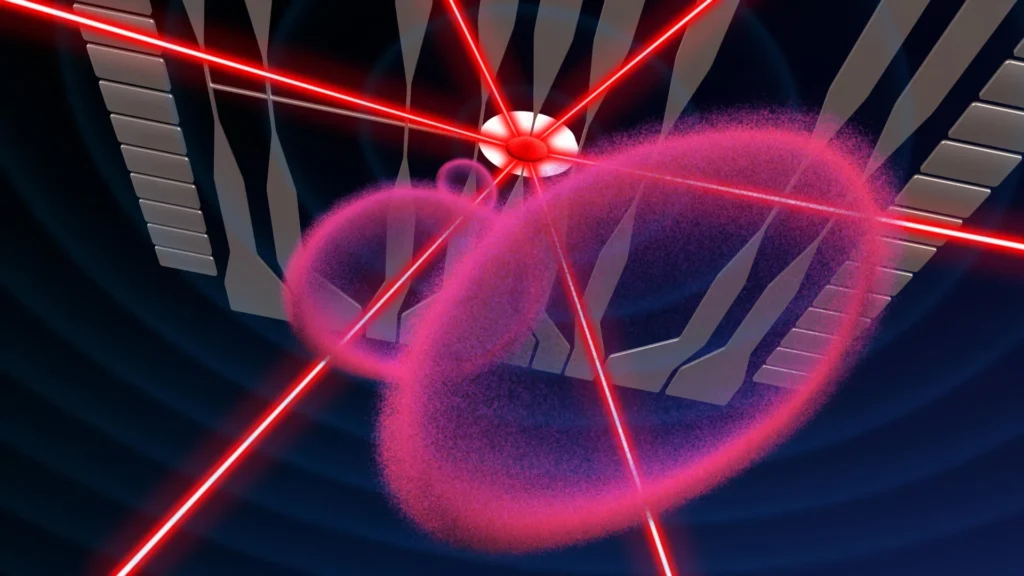
NASA’s upgraded Cold Atom Lab (CAL) is now fully operational aboard the International Space Station (ISS), marking a significant stride in humanity’s quest to understand the fundamental nature of matter and accelerate the development of future quantum technologies. This advanced facility, leveraging the unique microgravity environment of low Earth orbit, enables groundbreaking experiments that are simply not feasible on Earth, promising to unlock secrets of the universe at its most minute scales. The latest enhancement, a sophisticated science module that arrived on April 11, expands the lab’s capabilities, allowing researchers to delve deeper into the enigmatic world of ultracold atoms and Bose-Einstein condensates (BECs).
The Dawn of a New Quantum Era in Orbit
The re-activation of CAL with its enhanced features represents a pivotal moment for quantum science. By chilling atoms to temperatures mere fractions of a degree above absolute zero – the theoretical point at which all atomic motion ceases – CAL creates exotic quantum states of matter. These conditions allow scientists to observe and manipulate quantum phenomena with unprecedented precision and duration, free from the perturbations of terrestrial gravity. The implications extend far beyond basic research, holding the potential to revolutionize fields from navigation and timing to materials science and our understanding of gravity itself.
Understanding the Quantum Realm: A Primer
Quantum science investigates the behavior of matter and energy at the smallest possible scales, encompassing atoms, electrons, and photons (particles of light). While our macroscopic world operates under classical physics, the quantum realm reveals a far stranger reality. Atoms, often visualized as miniature planetary systems, can behave like waves, exist in multiple locations simultaneously through superposition, and even tunnel through seemingly impenetrable barriers. These counterintuitive properties, first theorized in the early 20th century by pioneers like Max Planck, Albert Einstein, Niels Bohr, and Erwin Schrödinger, underpin much of modern technology, including lasers, transistors, and medical imaging techniques like MRI. The challenge for scientists is to harness and control these quantum effects for practical applications, a pursuit often referred to as "Quantum 2.0."
The Genesis of Cold Atom Lab: From Theory to Orbit
The concept of Bose-Einstein Condensates (BECs), a key area of study for CAL, dates back to 1924 when Albert Einstein, building on the work of Indian physicist Satyendra Nath Bose, predicted that at extremely low temperatures, a group of atoms could coalesce into a single quantum state, behaving as one "super-atom." This fifth state of matter, distinct from solids, liquids, gases, and plasma, wasn’t experimentally realized until 1995, earning Eric Cornell, Carl Wieman, and Wolfgang Ketterle the Nobel Prize in Physics in 2001.
Recognizing the profound advantages of a microgravity environment for studying BECs, NASA embarked on the development of CAL. The project was conceived to overcome Earth’s gravitational limitations, which cause ultracold atom clouds to quickly fall and disperse, restricting observation times to mere milliseconds. The Cold Atom Lab, about the size of a mini-refrigerator, was designed and built by NASA’s Jet Propulsion Laboratory (JPL) in Southern California, which also remotely controls its operations from Earth. CAL was launched to the ISS aboard a SpaceX Dragon capsule on May 21, 2018, and became the first facility to produce BECs in Earth orbit later that year. Its successful deployment and initial operations demonstrated the feasibility of performing complex quantum experiments in space, paving the way for sustained, long-duration research.
Precision Engineering: How CAL Achieves Near Absolute Zero
The process of cooling atoms to temperatures just above absolute zero (minus 459.67 degrees Fahrenheit or minus 273.15 degrees Celsius) is a marvel of precision engineering. CAL begins by heating small strips of rubidium or potassium metal to temperatures as high as 750°F (400°C), generating a gas of these atoms inside an ultra-high vacuum chamber. This vacuum is crucial to prevent the cooled atoms from colliding with other particles and heating up.
The subsequent cooling stages are meticulously orchestrated:
-
Laser Cooling: Researchers employ carefully tuned lasers to bombard the atom gas. As an atom absorbs a photon from the laser, it receives a slight "kick" in the opposite direction of its motion, slowing it down. This process, known as Doppler cooling, is repeated millions of times per second. By tuning the laser frequency slightly below the atomic resonance (red-detuning), only atoms moving towards the laser source absorb photons, effectively "braking" them. Additional techniques like Sisyphus cooling can further reduce atomic motion. This stage significantly reduces the atoms’ energy, dramatically cooling them to microkelvin temperatures.
-
Magnetic Trapping: After laser cooling, the atoms are still moving too fast to form a BEC. Magnetic fields are then used to trap the cooled atoms, forming a magneto-optical trap (MOT). These fields create a potential well that confines the atoms, preventing them from drifting away. The atoms are further cooled through evaporative cooling, where the most energetic atoms are allowed to escape the trap, leaving behind a colder, denser cloud of atoms that re-equilibrate at an even lower temperature.
These combined techniques bring the atomic cloud to an almost complete standstill, creating the conditions necessary for Bose-Einstein condensation and maximizing the amount of time scientists can study these delicate quantum states in microgravity.
The Microgravity Advantage: Why Space is Crucial for Ultracold Research
While terrestrial laboratories can produce ultracold gases, the microgravity environment of the ISS offers profound advantages that are indispensable for advancing quantum research:
-
Extended Observation Times: On Earth, gravity constantly pulls the ultracold atomic clouds downward. This gravitational sag causes the clouds to quickly expand and disperse, limiting observation times to milliseconds. In microgravity, this constraint is virtually eliminated, allowing scientists to observe BECs and other quantum gases for several seconds, or even longer. These extended observation periods are critical for studying subtle quantum phenomena, such as weak interactions between atoms, phase transitions, and the coherent evolution of quantum states.
-
Lower Temperatures: Without the need to counteract gravity, researchers can implement more aggressive cooling techniques without losing the atomic cloud. This allows CAL to achieve even lower temperatures than typically possible on Earth, bringing atoms closer to absolute zero. At these extreme temperatures, quantum effects become more pronounced and easier to study, revealing new behaviors of matter.
-
Larger Quantum Waves: BECs are essentially macroscopic quantum objects, where the wavelike nature of matter becomes dominant. In microgravity, the absence of gravitational acceleration allows these matter waves to expand to much larger sizes without being distorted or collapsing. Larger, more stable quantum waves provide a better platform for precision measurements and for investigating fundamental physics questions, such as the equivalence principle or the nature of dark energy.
-
Reduced Decoherence: Quantum states are notoriously fragile and easily lose their coherence (their wavelike properties) due to environmental interactions. The stable, isolated environment of the ISS, with its significantly reduced vibrational noise and electromagnetic interference compared to ground-based labs, helps preserve the coherence of ultracold atoms for longer durations, enabling more robust experiments.
To achieve this in orbit, engineers successfully compressed what would typically be a room-sized atomic physics laboratory, replete with lasers, optical equipment, and vacuum systems, into a compact, robust system designed to fit within a standard ISS experiment rack. This miniaturization itself is a technological feat with potential terrestrial applications.
The Latest Enhancement: Expanding Experimental Horizons
The recent upgrade marks the fourth major enhancement to the Cold Atom Lab since its installation in 2018, demonstrating NASA’s commitment to maintaining and expanding its cutting-edge space-based research capabilities. The new science module, which arrived on April 11 aboard a Commercial Resupply Services mission, brings several significant improvements:
-
Redesigned Magnetic Trap: One of the most impactful upgrades is a completely redesigned magnetic trap. This new trap offers enhanced control over the shape and confinement of quantum gas clouds. Researchers can now manipulate the geometry of the BECs with greater precision, allowing them to investigate how the shape of the trap influences the properties and behavior of ultracold atoms. This capability is crucial for exploring exotic quantum phases and for optimizing quantum sensors.
-
Improved Metal Atom Sources: The new module also incorporates redesigned metal atom sources. These sources are responsible for generating the initial gas clouds of rubidium or potassium atoms used in experiments. The improved design promises greater stability, longer operational lifetimes, and potentially higher atom fluxes, leading to more reliable and longer-duration experiments. This directly translates to more data and deeper insights for the five international research teams currently utilizing CAL.
These enhancements collectively expand the range and complexity of experiments scientists can perform, pushing the boundaries of what is possible in quantum research in space.
Statements from the Forefront of Quantum Discovery
The scientific community has reacted with enthusiasm to the upgraded CAL’s return to operation. Jason Williams, project scientist for Cold Atom Lab at NASA’s Jet Propulsion Laboratory, articulated the profound implications: "At the coldest temperatures, matter behaves drastically different from anything we have experienced. The wavelike nature of matter dominates, and ultracold matter can behave in ways that are not only unexpected, but that also enable extremely precise measurements of time, gravity, and motion. The lab has lots of tools – especially with this latest upgrade – to let us probe the nature of the universe." His statement underscores the fundamental nature of the research and its potential for paradigm-shifting discoveries.
Ethan Elliott, deputy project scientist for Cold Atom Lab at JPL, highlighted the historical context and future promise: "As the first project to create Bose-Einstein condensates in orbit, we’re demonstrating that we can make quantum technology work reliably in space. In the previous century, there was a quantum revolution that led to lasers, cellphones, and MRIs for medical imaging. We’re performing quantum 2.0 – direct manipulation of large quantum states – and we hope for similar gains in quantum tech by advancing this science in orbit." Elliott’s remarks emphasize the transition from simply observing quantum phenomena to actively controlling and engineering them, a hallmark of the burgeoning "second quantum revolution."
Kamal Oudrhiri, project manager of Cold Atom Lab at JPL, pointed to the direct impact of the upgrades: "It’s the closest thing we have to controlling the boundary of the quantum world. This new upgrade pushes that boundary even further." Oudrhiri also stressed the broader strategic importance: "This new hardware demonstrates NASA’s ability to maintain U.S. leadership in space-based quantum technologies while maturing future quantum instruments, such as matter-wave interferometers for fundamental physics missions, positioning, navigation, timing, and gravity sensing of Earth, the Moon, and beyond." These statements collectively paint a picture of a scientific endeavor that is both deeply rooted in fundamental physics and highly forward-looking in its technological aspirations.
Quantum 2.0: Paving the Way for Future Technologies
The research conducted aboard CAL is not merely an academic exercise; it has profound implications for a wide array of future technologies and scientific understanding:
-
Fundamental Physics Investigations: By creating and manipulating BECs in microgravity, scientists can perform exquisitely sensitive tests of fundamental theories. This includes searching for ultra-light dark matter candidates, probing for violations of the equivalence principle (a cornerstone of general relativity), and exploring theories of quantum gravity. The extended observation times and larger quantum clouds enable unprecedented precision in these experiments.
-
Advanced Quantum Sensors: The stability and coherence of ultracold atoms in space make them ideal candidates for next-generation quantum sensors.
- Atomic Clocks: Space-based ultracold atom clocks could achieve unprecedented accuracy, far surpassing current atomic clocks. This would lead to more precise GPS and navigation systems, enhance deep-space communication, and enable new tests of relativistic effects.
- Gravimeters and Accelerometers: Highly sensitive matter-wave interferometers, developed from CAL research, could be used for precise measurements of Earth’s gravitational field. This data is critical for monitoring changes in ice sheet mass, sea levels, and groundwater, contributing to climate science. In space, they could provide ultra-precise navigation for autonomous spacecraft and sensitive measurements of planetary gravitational fields during exploration missions.
- Inertial Measurement Units: For future deep-space missions, quantum inertial sensors could provide highly accurate navigation independent of external signals, crucial for missions beyond the reach of GPS or Earth-based tracking.
-
Quantum Computing and Information Science: While CAL doesn’t directly build quantum computers, the understanding gained about controlling and manipulating large quantum states is foundational for advancing quantum computing research. The ability to maintain coherence and entangle atoms in a stable environment is a key challenge for quantum computer development.
-
Materials Science: Insights into the behavior of matter at extreme temperatures and quantum states could inform the design of novel materials with extraordinary properties, such as superconductors or new types of semiconductors.
A Collaborative Endeavor: The Teams Behind CAL
The success of the Cold Atom Lab is a testament to extensive collaboration and expertise. The facility was designed, built, and is operated by NASA’s Jet Propulsion Laboratory, which is managed by Caltech in Pasadena, California. The project receives sponsorship from the Biological and Physical Sciences division within NASA’s Science Mission Directorate in Washington. This division’s mandate is to support scientific discovery by utilizing the unique conditions of space to conduct experiments that cannot be replicated on Earth. By studying biological and physical processes in extreme environments, researchers gain invaluable knowledge that not only helps humans travel farther and remain in space longer but also yields tangible benefits for life on Earth. The involvement of five international research teams further highlights the global scientific importance and collaborative spirit of the CAL mission.
Looking Ahead: The Enduring Legacy of Space-Based Quantum Research
The upgraded Cold Atom Lab on the ISS is more than just a scientific instrument; it is a trailblazer. It is demonstrating the feasibility and immense value of conducting advanced quantum physics research in space, solidifying U.S. leadership in space-based quantum technologies. The ability to reliably create and manipulate BECs and other ultracold quantum gases in orbit opens up an entirely new frontier for scientific exploration. As the facility continues its operations, it promises to deliver unprecedented insights into the fundamental laws governing our universe and to seed the next generation of revolutionary technologies that will impact everything from our daily lives to humanity’s farthest reaches of exploration. The enduring legacy of CAL will be its contribution to our understanding of reality itself and its role in ushering in a new era of quantum innovation from the vantage point of space.