The fundamental nature of water, a substance that covers the majority of the Earth’s surface and constitutes the bulk of living organisms, continues to surprise the scientific community. While the macroscopic properties of water—such as its boiling point, surface tension, and solvent capabilities—are well-documented, its behavior at the molecular level, particularly when trapped in extremely small spaces, has remained a subject of intense academic friction. A collaborative research effort, recently detailed in the journal Science Advances, has finally provided a definitive explanation for the anomalous chemical behavior of water when it is squeezed into "nanoconfined" environments only a few molecules wide.
For over a decade, experimentalists and theorists have been at odds regarding whether the act of confinement itself fundamentally alters water’s chemical reactivity. Some studies suggested that water becomes significantly more reactive when trapped in nanopores, while others found little to no change. This new research, led by scientists from the University of Cambridge and the Cavendish Laboratory, suggests that the perceived changes in reactivity are not an intrinsic property of confinement, but are instead driven by intense internal pressures and specific surface interactions that had previously been overlooked or miscalculated.
The Mechanics of Water Splitting and the Nanoscale Mystery
To understand the breakthrough, one must first look at the "auto-ionization" of water. In any volume of liquid water, a tiny fraction of molecules spontaneously split into two charged particles: a positively charged hydronium ion (H3O+) and a negatively charged hydroxide ion (OH-). This process, known as water splitting or dissociation, is the foundation of acid-base chemistry. The concentration of these ions determines the pH of a solution, which in turn dictates the speed and outcome of countless chemical reactions, from the metabolic processes within human cells to the movement of ions within a lithium-ion battery.
When water is confined to spaces measured in billionths of a meter—such as the protein channels in biological membranes or the microscopic pores in soil and synthetic filters—its physical environment changes drastically. For years, scientists hypothesized that the close proximity of confining walls might force water molecules to split more frequently. However, the results of these experiments were notoriously inconsistent. Some researchers observed a massive increase in ion production, while others reported that the water remained chemically stable.
The new study identifies the "missing piece" of this puzzle: the distinction between the physical act of confinement and the thermodynamic conditions—specifically pressure and chemical potential—that confinement induces.
A Chronology of Scientific Contradiction
The debate over nanoconfined water has evolved over several distinct phases of research. In the early 2010s, the rise of nanotechnology allowed for the creation of artificial channels using materials like carbon nanotubes and graphene. Initial observations suggested that water inside these channels moved with surprisingly low friction and exhibited unusual phase changes, such as forming "square ice" at room temperature.
By the mid-2010s, attention shifted to the chemical reactivity of this confined water. Some experimental data indicated that the dissociation constant of water (Kw) could increase by several orders of magnitude in nanopores. This led to theories that the "confinement effect" was a new frontier in chemistry, where the reduced dimensionality of the space itself lowered the energy barrier for chemical bonds to break.
However, replication proved difficult. Different laboratories using slightly different materials or pore sizes produced wildly different results. The timeline of the last five years has been characterized by a search for a unifying theory that could reconcile these disparate findings. The University of Cambridge team set out to provide this unification by utilizing advanced computational tools that were unavailable to researchers a decade ago.
Leveraging Machine Learning for Quantum Accuracy
The primary challenge in studying nanoconfined water is the scale. Direct observation of water splitting in a single nanopore is nearly impossible with current imaging technology. Conversely, traditional computer simulations faced a "speed versus accuracy" trade-off. Quantum mechanical simulations are accurate but can only handle a few dozen molecules for a few picoseconds. Simpler "classical" simulations can handle thousands of molecules but fail to capture the complex electron-sharing that occurs during a chemical reaction.
To overcome this, lead author Xavier R. Advincula and his team employed machine learning-based simulations. These models are trained on quantum mechanical data to recognize the "fingerprints" of atomic interactions. Once trained, the machine learning algorithms can simulate thousands of atoms with quantum-level precision at a fraction of the computational cost.
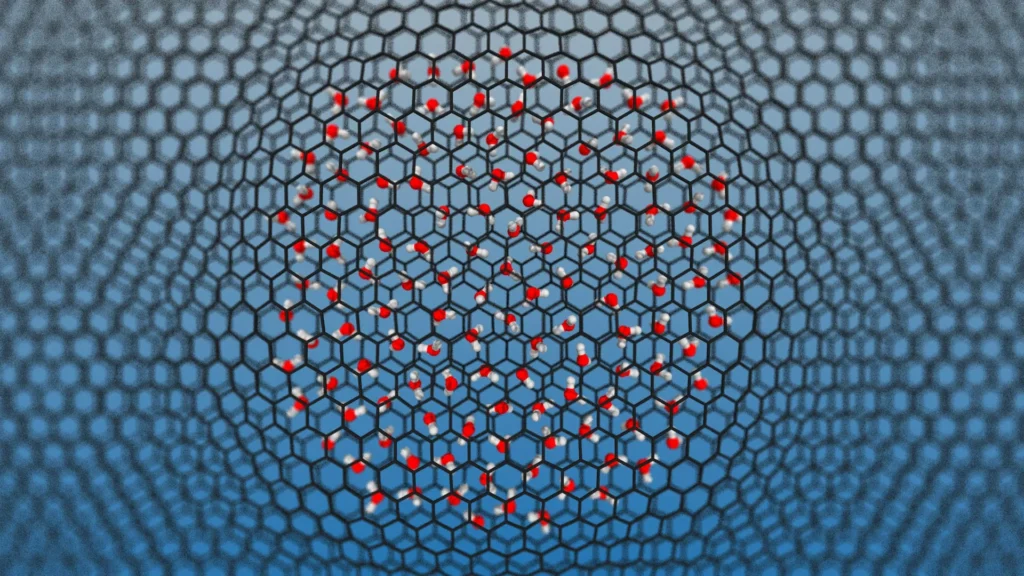
This approach allowed the researchers to simulate water trapped between two-dimensional sheets of graphene and hexagonal boron nitride (hBN). While these two materials look nearly identical at the atomic level—both forming a flat, honeycomb-like lattice—their chemical properties are vastly different. Graphene is composed entirely of carbon and is chemically inert, while hBN consists of alternating boron and nitrogen atoms, creating a "polar" surface that interacts more strongly with charged particles.
The Invisible Force: Van der Waals Pressure
One of the most striking findings of the study was the discovery of the extreme pressures generated within these nanoscale gaps. Even without any external force being applied, water droplets trapped between sheets of graphene or hBN were found to be under pressures reaching several gigapascals. For context, one gigapascal is roughly 10,000 times atmospheric pressure—comparable to the conditions found deep within the Earth’s mantle.
This pressure arises from van der Waals forces. While the attraction between individual atoms is weak, the cumulative force across the large surface area of 2D materials is powerful enough to pull the sheets together, violently compressing the thin layer of water between them.
The researchers discovered that this pressure is the primary driver of increased water reactivity. When they compared the confined water to "bulk" (unconfined) water at the same extreme pressure, the rates of water splitting were nearly identical. This proved that the "confinement" itself—the mere presence of walls—was not changing the water’s chemistry. Instead, the walls were acting as a molecular vice, and it was the resulting pressure that forced the molecules to dissociate.
Reconciling the Data: Why Previous Studies Conflicted
The study’s most significant contribution to the field is its explanation of why previous experiments yielded such different results. "The contradictions in the literature were largely because scientists were comparing systems at different effective pressures or densities without realizing it," Advincula noted.
In previous decades, researchers often measured water reactivity in different types of pores and assumed that the pore size was the only variable. However, the Cambridge team demonstrated that different materials (like carbon vs. silica vs. hBN) exert different amounts of van der Waals attraction. Furthermore, the flexibility of the confining walls plays a role; if the walls can bulge or flex, the internal pressure drops, and the water reactivity decreases.
By normalizing for "chemical potential"—the thermodynamic measure of the energy available for a reaction—the researchers showed that the "confinement effect" largely disappears. This framework provides a universal yardstick that allows scientists to compare water behavior across vastly different environments, from the interior of a carbon nanotube to the gaps between mineral layers in the Earth’s crust.
The Role of Surface Chemistry in hBN vs. Graphene
While pressure was the dominant factor, the study also highlighted that the choice of material is not entirely irrelevant. Surface chemistry acts as a secondary, yet crucial, modifier.
In simulations involving hexagonal boron nitride (hBN), the researchers observed that hydroxide ions (OH-) formed during water splitting would "stick" to the boron atoms on the surface. This chemical bonding stabilized the ions, making it energetically "easier" for the water molecules to split in the first place. In contrast, graphene’s surface is chemically inert; it does not bond with the ions, so it does not provide this extra boost to reactivity.
This finding suggests that if engineers want to create a highly reactive environment—for example, to speed up a catalytic reaction—they should choose a confining material that actively interacts with the reaction products.
Implications for Energy and Environmental Technology
The ability to predict and control the reactivity of water at the nanoscale has profound implications for several "green" technologies:
- Hydrogen Fuel Cells: These devices rely on the movement of protons (H+) through thin membranes. Understanding how confinement and pressure affect the production of these protons could lead to more efficient membranes.
- Next-Generation Batteries: Many high-capacity batteries use aqueous electrolytes. The behavior of water near the electrode surfaces (which are essentially nanoscale gaps) determines the battery’s lifespan and charging speed.
- Desalination and Water Purification: As water passes through the nanoscale pores of a filtration membrane, its chemical reactivity changes. This study provides a blueprint for designing membranes that can better resist "fouling" or more effectively strip contaminants from the water.
- Catalysis: By tailoring the pressure and surface chemistry of nanocatalysts, scientists could potentially drive chemical reactions that are currently too energy-intensive to be commercially viable.
Future Research Directions
Following this breakthrough, the research team plans to move toward more complex, "real-world" scenarios. The current study focused on perfect, defect-free sheets of graphene and hBN. However, in industrial applications, materials often have "rough" surfaces, atomic defects, and edges.
Dr. Christoph Schran of the Cavendish Laboratory emphasized that the goal is to create a "practical design principle." The team is currently screening large libraries of other 2D materials to see how different atomic compositions influence water chemistry. They also intend to validate their computational models through advanced spectroscopy, which can "see" the vibration of molecules at the nanoscale to confirm the predicted ion concentrations.
As Prof. Angelos Michaelides summarized, "Once pressure and chemical potential are properly accounted for, a great deal of the complexity simply falls into place." This shift from viewing nanoconfinement as a "mysterious" phenomenon to a predictable thermodynamic process marks a turning point in fluid physics, promising a new era of precision engineering at the molecular level.