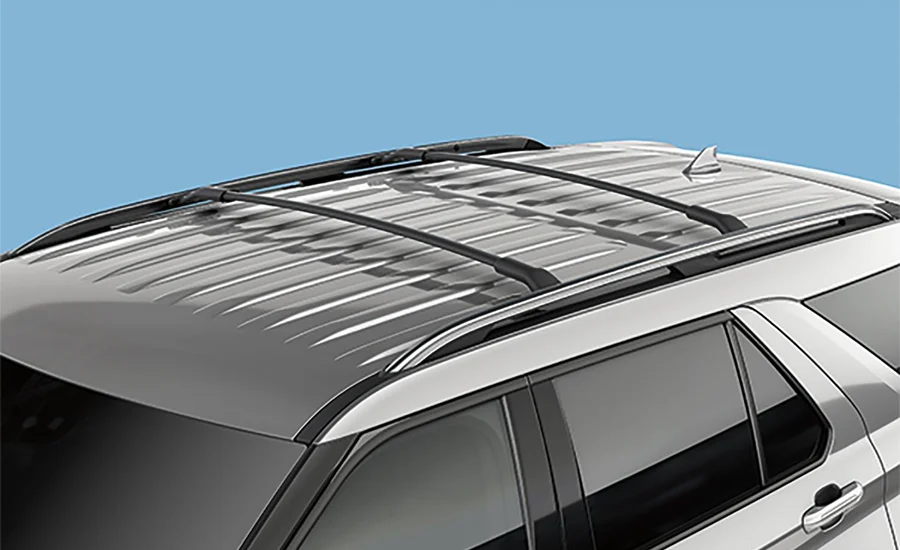
DEARBORN, MI – Ford Motor Co. has initiated a significant safety recall impacting 288,314 Explorer SUVs across various model years, citing a critical defect where exterior roof rail covers may loosen and detach while the vehicle is in motion. This widespread action comes after a renewed and thorough investigation into persistent complaints regarding loose, rattling, or entirely missing roof trim components on these popular family vehicles. The potential for a separated trim piece to become road debris poses a substantial hazard, compelling other motorists to execute sudden braking or directional changes, thereby increasing the risk of collisions.
The current recall specifically targets certain Ford Explorer SUVs manufactured between September 19, 2014, and March 3, 2019, encompassing select units from the 2016, 2017, 2018, and 2019 model years. The National Highway Traffic Safety Administration (NHTSA) has officially designated this campaign as 26V448, while Ford identifies it internally as recall 26S54. While NHTSA’s preliminary estimates suggest that approximately 1 percent of the total recalled population may exhibit this particular defect, the sheer volume of vehicles involved underscores the seriousness of the issue and Ford’s commitment to addressing potential safety risks proactively. It is crucial for owners to understand that owning an Explorer within these model years does not automatically mean their vehicle is included; the specific Vehicle Identification Number (VIN) must be checked against Ford’s recall database to confirm eligibility.
The Genesis of the Problem: A Recurring Design Flaw
The root of the issue lies with the decorative covers affixed over the Explorer’s roof rails, components designed not only for aesthetics but also to protect the underlying structure. This is not the first instance of Ford attempting to rectify problems with these roof rail covers. Previously, some of these vehicles were subject to a customer satisfaction program, identified as 20N11, which involved an adhesive-based repair. However, Ford’s subsequent, in-depth investigation revealed critical shortcomings in the execution and efficacy of this prior repair effort.
The original adhesive-based solution, it was discovered, was heavily reliant on precise technician action and adherence to specific application protocols. In numerous instances, damaged retention clips—the primary mechanical fasteners designed to secure the covers—may not have been properly identified or replaced during the 20N11 program. Furthermore, the adhesive itself may have been applied incorrectly, in insufficient quantities, or under environmental conditions (such as temperature and humidity) that were unsuitable for proper curing and bonding. Over time, the cumulative effects of years of exposure to varying heat cycles, UV radiation, and normal vehicle vibrations and wear have proven sufficient to weaken the retention clips and compromise the adhesive bond, leading to the loosening and eventual detachment of the covers.
A History of Explorer and Its Market Presence
The Ford Explorer has long been a cornerstone of the American automotive landscape, establishing itself as one of the best-selling SUVs for decades. Introduced in 1990, it quickly became a symbol of suburban utility and adventure, helping to popularize the SUV segment in the United States. Its reputation as a reliable family vehicle, capable of handling daily commutes and weekend excursions, has cemented its place in millions of households. Given this extensive history and significant market penetration, any safety recall involving the Explorer carries substantial weight, impacting a vast number of consumers and potentially influencing brand perception. The specific model years affected by this recall fall within the fifth generation of the Explorer (2011-2019), a period during which the model transitioned to a unibody platform, emphasizing comfort and refinement while retaining its utility. This background underscores the importance of maintaining the vehicle’s integrity and safety standards, especially for a model so deeply integrated into the daily lives of its owners.
Chronology of Concerns and Remedial Actions
The timeline of this issue can be pieced together from the information provided, illustrating a progressive understanding of the defect:
- September 2014 – March 2019: Production period for the affected Explorer models.
- Post-Production (likely 2019-2020): Initial customer complaints regarding loose, rattling, or missing roof trim pieces begin to surface, prompting Ford to launch the customer satisfaction program 20N11. This program aimed to address the issue with an adhesive-based repair.
- Ongoing (2020-Present): Despite the 20N11 program, complaints persist, indicating the previous repair was not a definitive solution. This signals that the underlying problem was either misdiagnosed or inadequately addressed.
- Recent Investigation: Ford initiates a "renewed investigation" into these continued complaints, delving deeper into the failure mechanisms of the roof rail covers and the efficacy of the 20N11 repair. This investigation likely involved engineering analysis, field data review, and examination of failed components.
- Official Determination: Ford’s investigation concludes that the retention clips weaken over time due to environmental factors and normal wear, and that the previous adhesive repair was often insufficient due to execution variability.
- June 2024 (Inferred from NHTSA campaign ID 26V448, typically year-based): Ford officially issues recall 26S54 (NHTSA 26V448), acknowledging the safety risk and committing to a more robust, permanent solution.
- Upcoming Weeks/Months: Owners of affected vehicles will be notified by mail with instructions on how to proceed with the recall repair.
Warning Signs and Owner Responsibilities
Ford has identified several distinct warning signs that drivers may experience before a roof rail cover completely detaches. These indicators are crucial for owners to recognize and act upon promptly. They include:
- Increased Wind Noise: A noticeable increase in aerodynamic noise originating from the roof area, particularly at higher speeds.
- Squeaking or Rattling: Auditory cues indicating a loose component, which may become more pronounced over rough terrain or at certain speeds.
- Visible Gap: A discernible gap or separation between the roof rail cover and the vehicle’s roofline.
- Misalignment: The roof rail cover appearing visibly out of alignment or skewed relative to its intended position.
Anyone observing these symptoms should immediately contact an authorized Ford or Lincoln dealership for an inspection. It is strongly advised against attempting any temporary adhesive repairs or DIY solutions, as these are unlikely to be effective and could potentially exacerbate the problem or mask the underlying defect, delaying a proper, permanent fix. The dealership will perform a thorough inspection, and if the vehicle is identified as part of the recall, the necessary repairs will be conducted free of charge to the owner.
The Recall Process and Ford’s Commitment
For affected owners, the recall process is designed to be straightforward and comprehensive. Ford will notify registered owners by mail, providing detailed instructions on how to schedule an appointment at an authorized service center. Upon arrival, technicians will inspect the roof rail covers, specifically examining the integrity of the retention clips and the surrounding mounting points. The repair will involve replacing any damaged retention clips and applying a new, more robust adhesive or securing mechanism designed to withstand environmental stresses and ensure long-term attachment. This approach aims to rectify the failures observed in the previous 20N11 program by addressing both the mechanical and adhesive aspects of the attachment.
The cost associated with these repairs, including parts and labor, will be borne entirely by Ford Motor Co., in line with federal recall regulations. This commitment is standard practice for safety-related recalls, ensuring that vehicle owners are not penalized for manufacturing or design defects. Ford’s decision to issue a full safety recall, rather than another customer satisfaction program, signals a more definitive and widespread commitment to resolving the issue for all potentially affected vehicles.
Broader Implications for Automotive Safety and Manufacturing
This recall, while specific to the Ford Explorer, highlights broader themes pertinent to the automotive industry. The scale of the recall – nearly 300,000 vehicles – underscores the challenges of maintaining consistent quality control across millions of manufactured units, even for established models. The fact that an initial "customer satisfaction program" proved insufficient also points to the complexities of diagnosing and effectively remedying design or manufacturing defects, particularly when environmental factors and long-term wear play a role. It emphasizes the critical importance of rigorous validation and testing, not just at the design phase but also through post-production monitoring and analysis of field data.
From a regulatory perspective, NHTSA’s role in overseeing and facilitating such recalls is paramount. Their proactive engagement, often spurred by consumer complaints and subsequent investigations, serves as a vital safeguard for public safety. The estimate that only 1 percent of recalled vehicles may have the defect, while seemingly low, still translates to nearly 3,000 vehicles with a potentially dangerous flaw, reinforcing the necessity of broad-scope recalls to identify and mitigate risks.
For Ford, this recall carries not only financial implications in terms of repair costs but also potential reputational impacts. While recalls are a routine part of the automotive industry, repeat issues on a key model like the Explorer can erode consumer confidence. Maintaining transparency and efficiently executing the recall process will be crucial for Ford to reassure its customer base of its dedication to safety and product quality. As vehicle designs become increasingly complex, incorporating a multitude of materials and fastening methods, the lessons learned from incidents like the Explorer roof rail cover recall will undoubtedly inform future engineering and manufacturing practices across the industry, aiming for enhanced durability and safety from the outset.
In conclusion, the Ford Explorer roof rail cover recall represents a significant effort by Ford Motor Co. to address a safety defect with potentially serious consequences. By understanding the nature of the problem, recognizing warning signs, and adhering to the prescribed recall process, owners can ensure their vehicles are safely and effectively repaired, contributing to safer roads for everyone.