In a significant development for the field of high-energy physics, researchers at the European Organization for Nuclear Research (CERN) have reported a substantial discrepancy between experimental observations and theoretical predictions regarding the behavior of subatomic particles. The findings, derived from the Large Hadron Collider beauty (LHCb) experiment, focus on the decay patterns of particles containing "beauty quarks," also known as b-quarks. The analysis, published in the journal Physical Review Letters, reveals a four-sigma deviation from the Standard Model of particle physics, a result that further intensifies the search for "New Physics" beyond our current understanding of the universe.
The Standard Model has served as the bedrock of particle physics for over half a century, successfully describing the fundamental particles—such as quarks, leptons, and bosons—and the forces that govern their interactions. However, the model is notoriously incomplete. It offers no explanation for dark matter, which constitutes approximately 27% of the universe, nor does it account for dark energy or the profound imbalance between matter and antimatter. Furthermore, the Standard Model fails to integrate gravity at the quantum scale. Because of these omissions, physicists have long sought "cracks" in the theory—subtle deviations that might point toward the existence of undiscovered particles or forces.
The Significance of the Beauty Quark Decay
The recent study focused on a specific and rare decay process: a B meson (a particle composed of a beauty antiquark and another quark) decaying into a K meson (an excited state of a kaon) and two muons. This particular transition, denoted as $B to K^ mu^+ mu^-$, is considered a "flavor-changing neutral current" process. In the Standard Model, this decay is forbidden at the simplest level and can only occur through complex, higher-order quantum processes involving "loops."
Within these quantum loops, virtual particles—particles that blink in and out of existence momentarily—interact with the decaying b-quark. If undiscovered particles exist, such as heavy Z’ bosons or leptoquarks, they would also participate in these loops, subtly altering the trajectory and angular distribution of the resulting decay products. This makes the $B to K^* mu^+ mu^-$ decay an exceptionally sensitive laboratory for detecting the influence of physics beyond the Standard Model.
The LHCb collaboration’s latest analysis finds that the angular distribution of the muons and the K* meson deviates from the Standard Model prediction by four standard deviations (4-sigma). In the language of statistics, a 4-sigma result indicates a probability of approximately 0.003 percent that the observed discrepancy is a mere statistical fluke. While the "gold standard" for a formal discovery in particle physics is 5-sigma (a 1 in 3.5 million chance of being a fluke), a 4-sigma result is a powerful signal that warrants intense scrutiny.
Collaborative Research and Independent Verification
To ensure the highest degree of accuracy and to eliminate potential biases, the LHCb collaboration employed a rigorous "blind" analysis. Two independent teams of researchers performed the study using different methodologies to see if they arrived at the same conclusion. One of these teams was led by Eluned Smith, an assistant professor of physics at the Massachusetts Institute of Technology (MIT) and a researcher at the Laboratory for Nuclear Science.
"This measurement shows that the overall angular pattern of the decay differs from Standard Model predictions," Smith noted in a recent briefing. "The fact that similar tensions have appeared in earlier measurements, as well as in other decay modes governed by similar underlying processes, makes the new result especially compelling."
The independent nature of the two analyses provides a safeguard against human error or systematic biases in the data processing. By comparing the results of both teams, the LHCb collaboration confirmed that the 4-sigma tension was a robust feature of the data, rather than an artifact of a specific analytical technique.
A Decade of Intriguing Anomalies
The recent findings do not exist in a vacuum; they are the latest in a series of "flavor anomalies" that have puzzled the physics community for over a decade. Since 2013, various measurements of b-quark decays at the LHCb, as well as at the Belle experiment in Japan and the BaBar experiment in the United States, have shown persistent hints of non-standard behavior.
One of the most famous of these is the "P5′ anomaly," a specific parameter in the angular distribution of the $B to K^* mu^+ mu^-$ decay. Previous datasets from 2011 and 2012, and later from 2016, consistently showed a discrepancy in this parameter. The new analysis incorporates a much larger dataset and more sophisticated theoretical calculations, yet the tension remains.
In addition to angular distributions, physicists have also investigated "Lepton Flavor Universality" (LFU). According to the Standard Model, the different "flavors" of leptons—electrons, muons, and taus—should interact with the fundamental forces with equal strength (accounting for their mass differences). However, several measurements have suggested that b-quarks might decay into muons less frequently than into electrons, a direct violation of LFU. While some recent LHCb updates have brought these LFU measurements closer back to the Standard Model, the angular distribution anomalies in the muon channels continue to persist, suggesting that if New Physics is present, its manifestation may be more complex than initially thought.
Theoretical Challenges: New Physics or Hadronic Effects?
While the 4-sigma discrepancy is statistically significant, the scientific community remains cautious. One of the primary challenges in interpreting these results lies in the complexity of the "strong interaction," the force that binds quarks together into hadrons like mesons and protons.
The theoretical predictions for the $B to K^* mu^+ mu^-$ decay rely on calculations of "hadronic form factors" and "charm-loop effects." These are notoriously difficult to calculate with absolute precision. Critics and some theorists suggest that the observed 4-sigma tension might not be caused by new particles, but rather by an incomplete understanding of how quarks interact within the B meson. If the theoretical uncertainties have been underestimated, the "discrepancy" might simply be a result of a more complex Standard Model calculation than previously realized.
To resolve this, theorists are working on more advanced simulations using Lattice QCD (Quantum Chromodynamics), a method that uses supercomputers to solve the equations of the strong force on a four-dimensional grid. Combining these improved theoretical models with the high-precision data from LHCb will be crucial in determining whether the 4-sigma result is a gateway to a new era of physics or a lesson in the complexities of the strong force.
The Technological Frontier: Run 3 and Beyond
The quest for a definitive answer is currently entering a new phase. The Large Hadron Collider began its "Run 3" in 2022, following a major multi-year upgrade. This new period of data collection features higher collision energies and significantly increased luminosity, meaning more collisions—and more rare decays—occur every second.
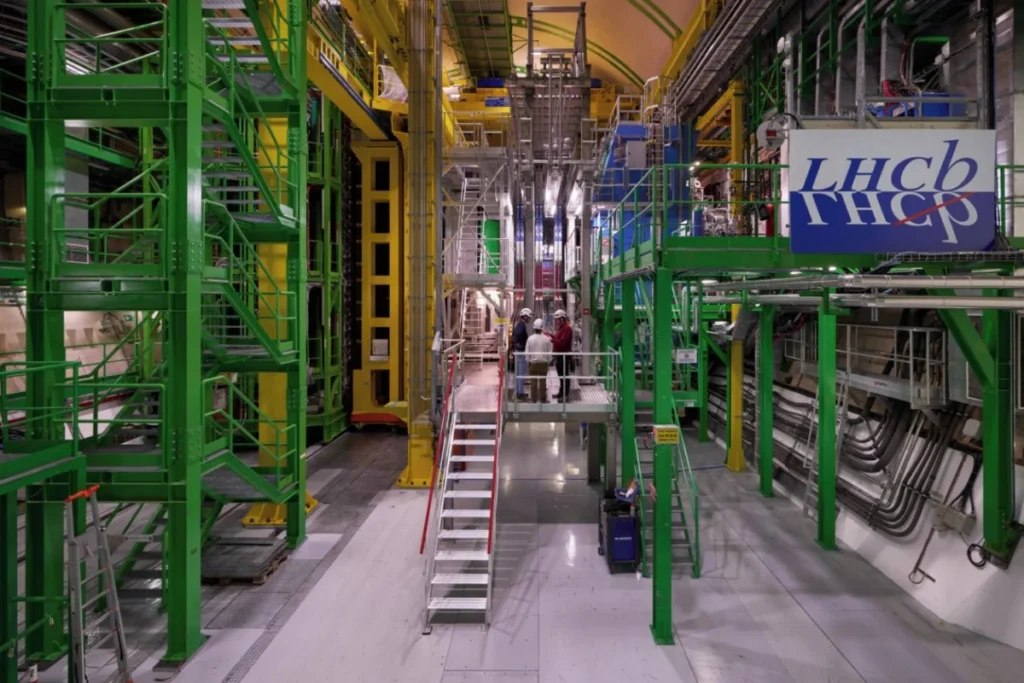
For the LHCb experiment specifically, the upgrades have been transformative. The detector now employs a "triggerless" readout system, where all data from the detector is processed in real-time by a massive farm of CPUs and GPUs. This allows researchers to filter through 40 terabits of data per second to identify the specific beauty-quark decays of interest.
Professor Eluned Smith and her colleagues are already looking toward the future, specifically the "Phase II Upgrade" of the LHCb, planned for the end of the decade. "I and others will be working on developing low-latency AI systems that can perform real-time data processing and compression directly in the radiation-intense front-end electronics of the detector readout," Smith explained. These technological leaps are expected to increase the experiment’s sensitivity to rare decays by a factor of five or more compared to the current system.
Broader Implications for the Scientific Community
If the 4-sigma discrepancy eventually crosses the 5-sigma threshold and is confirmed as New Physics, the implications for our understanding of the universe would be revolutionary. It would be the first direct evidence of a fundamental force or particle not accounted for in the Standard Model since the discovery of the Higgs boson in 2012.
Such a discovery could provide the necessary clues to solve the mystery of dark matter. Many proposed theories that explain the b-quark anomalies, such as the existence of "leptoquarks" (particles that would bridge the gap between quarks and leptons), are also linked to models that include dark matter candidates. Furthermore, finding a new source of CP violation (a difference between matter and antimatter) in these decays could help explain why the universe is made of matter today, rather than having vanished in a puff of radiation shortly after the Big Bang.
For now, the particle physics community remains in a state of "cautious excitement." The 4-sigma result is a landmark measurement that narrows the search area for New Physics. Whether it represents the first light of a new theoretical dawn or a challenging puzzle of conventional dynamics, the findings from LHCb ensure that the beauty quark will remain at the center of the scientific spotlight for years to come.
The coming years of data from Run 3, combined with the efforts of international teams at MIT, CERN, and other global institutions, will be decisive. As the statistical uncertainties shrink and the theoretical models sharpen, the "cracks" in the Standard Model will either seal shut or break wide open, potentially rewriting the textbooks of fundamental physics.