A groundbreaking study led by PhD researcher Louisa Mason from the University of Manchester posits a fundamental re-evaluation of humanity’s long-standing search for extraterrestrial intelligence (SETI). The research challenges the conventional wisdom that has historically constrained SETI efforts to a narrow band of radio frequencies, suggesting that astronomers may be overlooking potential alien signals by focusing too narrowly. Furthermore, Mason’s work introduces an innovative methodology that could dramatically expand the number of stars effectively analyzed from existing astronomical data, fundamentally altering how future searches are conducted and assessed.
For decades, the global scientific community, spurred by pioneering efforts in the mid-20th century, has directed its cosmic ear towards a specific segment of the electromagnetic spectrum. This focus was primarily on the "water hole," a quiet frequency range between 1.42 and 1.66 GHz. This particular band, nestled between the natural emissions of hydrogen (at 1.42 GHz) and hydroxyl (at 1.66 GHz), was theorized to be a universal beacon for interstellar communication. The logic was compelling: hydrogen and hydroxyl combine to form water, a molecule fundamental to life as we know it, and thus, an advanced extraterrestrial civilization would likely recognize its universal significance and choose this stable, low-noise channel for broadcasting its presence. This anthropocentric assumption has guided countless projects, from the pioneering Project Ozma in 1960 to more recent initiatives. However, Mason’s research, presented at the Royal Astronomical Society’s National Astronomy Meeting in Birmingham, dares to ask: what if this assumption has led us astray? What if the rest of the galaxy has evolved beyond, or simply never adopted, this terrestrial-centric communication channel, leaving humanity listening to cosmic silence while a vibrant galactic conversation hums away on higher, unexplored bands?
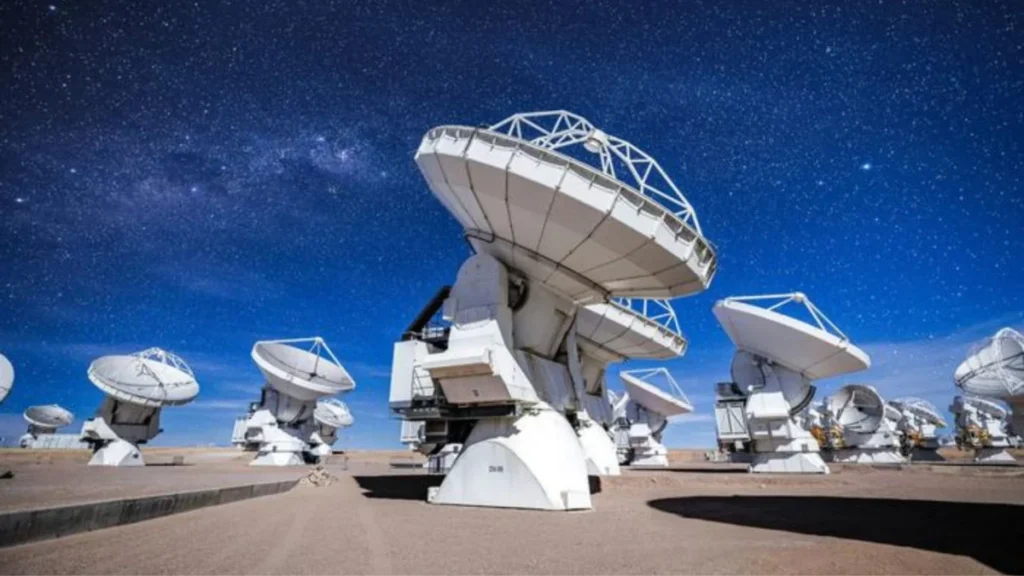
This critical question is driving a quiet but profound revolution within the SETI community. Mason’s study marks a significant departure from traditional methods, not only in its choice of frequency but also in its ingenious use of existing astronomical resources. Instead of dedicating expensive and often scarce telescope time specifically for SETI, she delved into the vast digital archives of the Atacama Large Millimeter/submillimeter Array (ALMA). ALMA, a colossal high-altitude observatory nestled in Chile’s Atacama Desert, is an international astronomy facility operated by a partnership of European, North American, and East Asian organizations in cooperation with the Republic of Chile. Comprising 66 high-precision antennas, ALMA operates at millimeter and submillimeter wavelengths, observing the universe with unprecedented sensitivity and resolution. Its primary mission involves studying the origins of galaxies, stars, and planets. Mason’s innovative approach involved sifting through raw data originally collected for entirely different astronomical investigations, repurposing it to search for the tell-tale "technosignatures" of alien civilizations – sharp, narrowband radio spikes that cannot be attributed to natural astrophysical phenomena.
Expanding the Search Spectrum: Beyond the Water Hole
The conventional "water hole" hypothesis, while elegant, has increasingly been challenged by the sheer breadth of the electromagnetic spectrum and the potential diversity of advanced civilizations. The universe is a vast canvas, and limiting our search to a single "cozy corner" of the radio spectrum might be akin to searching for a needle in a haystack while only examining a tiny fraction of the hay. Millimeter and submillimeter wavelengths, which represent significantly higher frequencies than the traditional radio bands, offer distinct advantages and opportunities for SETI. These bands are less susceptible to certain types of terrestrial interference and could potentially support higher data rates, making them attractive for advanced civilizations. As Mason articulated, "For decades, SETI searches have concentrated on a relatively small part of the radio spectrum. We wanted to ask what might happen if we looked somewhere very different." She further emphasized, "The millimetre and submillimetre radio bands remain almost completely unexplored for SETI, so this is really about opening up a new area of parameter space to search." This pioneering work with ALMA data represents the first-ever SETI survey conducted in these virtually untouched high-frequency domains, a bold step towards a more comprehensive galactic eavesdropping strategy.
Unlocking Stellar Bycatch: A New Method for Galactic Accounting
While Mason’s initial reconnaissance across two small frequency windows within ALMA’s extensive data archives did not yield any immediate signs of extraterrestrial technology, the true transformative power of her research lies in the novel methodology she employed for analyzing the data. This breakthrough addresses a critical oversight in how past SETI surveys have quantified their search efforts: the phenomenon of "stellar bycatch."
When a telescope points at a specific celestial target, its field of view inevitably encompasses a broader region of the sky, capturing signals from numerous other stars in the background. This "bycatch" represents a wealth of observational data that has often been underestimated or inadequately accounted for in previous SETI analyses. Historically, astronomers have estimated the number of stars covered in these background observations using relatively basic sky catalogs, such as those provided by the European Space Agency’s Gaia mission. While Gaia is revolutionary for mapping billions of stars with unprecedented precision, these catalogs can still miss faint, distant, or deeply obscured stars, particularly when considering the complex three-dimensional structure of the Milky Way.
Mason’s innovative approach circumvented this limitation by applying the Besançon Galactic Model. This sophisticated computer simulation, developed by astronomers at the Observatoire de Besançon, provides a detailed, three-dimensional representation of the Milky Way’s stellar population, including stars across various spectral types, ages, and distances, accounting for interstellar dust extinction and galactic structure. By integrating this model with the observational parameters of a telescope, researchers can generate a far more accurate census of all stars, both visible and hidden, residing within the instrument’s field of view during any given observation.
The results of applying the Besançon Galactic Model to a previously conducted SETI survey were nothing short of astonishing. A survey that was initially calculated to have examined 288,000 stars across 1,327 telescope pointings was revealed, through Mason’s rigorous re-analysis, to have actually swept past more than 6.1 million stars. This represents an increase of over 20 times the previously estimated coverage. "It turns out we’ve been auditing our own search area all wrong," Mason noted, highlighting the profound implications of this discovery. This recalculation doesn’t just revise numbers; it fundamentally alters our understanding of the scope and completeness of past SETI efforts. It suggests that while previous searches might have covered a significantly larger stellar population than initially believed, they may have done so at frequencies that extraterrestrial civilizations are not utilizing, or with sensitivities inadequate for detecting signals at those specific points.
Chronology and Context of SETI Evolution
The pursuit of alien intelligence has a rich history, evolving significantly since its formal inception.
- 1959: Physicists Giuseppe Cocconi and Philip Morrison publish a paper in Nature, proposing that the 21-cm hydrogen line (1.42 GHz) would be an ideal frequency for interstellar communication, laying the theoretical groundwork for the "water hole" concept.
- 1960: Frank Drake conducts Project Ozma, the first modern SETI experiment, using the 26-meter radio telescope at Green Bank, West Virginia, to listen for signals from the stars Tau Ceti and Epsilon Eridani at the 21-cm wavelength. Drake also formulates his famous equation, attempting to estimate the number of detectable extraterrestrial civilizations in the Milky Way.
- 1971: NASA establishes a dedicated SETI program, recognizing the scientific merit of the endeavor.
- 1974: The Arecibo Message, a pictographic message containing information about humanity and Earth, is beamed towards the M13 globular cluster from the Arecibo Observatory in Puerto Rico, marking humanity’s active attempt at interstellar communication.
- 1977: The "Wow! Signal," a strong narrowband radio signal, is detected by the Big Ear radio telescope at Ohio State University. Though it remains the strongest candidate for an extraterrestrial signal, it has never been confirmed or repeated.
- 1992: NASA’s SETI program is formally launched but quickly defunded by Congress in 1993, largely due to political skepticism and budget constraints.
- Mid-1990s onward: Private organizations, notably the SETI Institute and later Breakthrough Listen, take over much of the research, continuing the search across various frequencies, though still heavily weighted towards traditional radio bands. Projects like Project Phoenix continue comprehensive searches.
- 2015: Yuri Milner’s Breakthrough Listen initiative, a $100 million program, is launched to conduct the most comprehensive search for alien signals to date, using some of the world’s most powerful telescopes like Green Bank, Parkes, and the MeerKAT array. While expanding frequency ranges significantly, the primary focus remains on radio.
- Present Day: Mason’s research, presented at a major astronomical meeting in 2024, marks a pivotal moment, pushing the boundaries into millimeter/submillimeter wavelengths and refining the statistical assessment of search completeness, building upon decades of incremental progress and evolving methodologies.
Statements and Broader Community Reactions
The scientific community has largely welcomed Mason’s findings as a crucial step forward in the methodology and scope of SETI. While initial results from the high-frequency search were negative, the true value lies in demonstrating the feasibility and necessity of exploring new parameters.
Dr. Jill Tarter, co-founder of the SETI Institute and a veteran in the field, who was not directly involved in Mason’s study but represents the broader sentiment, has often advocated for expanding the search space. "We need to look in every direction, at every frequency, and with every type of detector we can imagine," she has frequently stated, echoing the sentiment that SETI must evolve beyond its initial assumptions. Mason’s work directly aligns with this call for diversification.
Representatives from the ALMA observatory, while not commenting directly on the SETI findings, emphasize the observatory’s commitment to supporting a wide range of scientific endeavors. "ALMA is designed to be a versatile instrument, pushing the boundaries of astronomical discovery across various scientific disciplines," an ALMA spokesperson might state. "The re-purposing of archival data for novel research questions, such as the search for technosignatures, exemplifies the broad scientific utility and collaborative spirit that drives this international facility."
This research is likely to be viewed by the broader SETI community as a validation of efforts to move beyond the "water hole" and an imperative to re-evaluate the statistical foundations of previous surveys. The implications for projects like Breakthrough Listen, for instance, are significant, as their extensive data sets could potentially be re-analyzed using Mason’s "stellar bycatch" methodology, leading to a much more accurate assessment of their true coverage and the effective number of stars they have surveyed.
Implications for the Future of SETI
The implications of Mason’s study are multifaceted and far-reaching for the future of SETI.
- Expanded Search Parameters: The successful demonstration of using ALMA data for SETI in millimeter/submillimeter bands opens up an entirely new, vast, and relatively quiet section of the electromagnetic spectrum for exploration. This diversification is crucial, as advanced civilizations might employ communication strategies vastly different from our own, possibly utilizing higher frequencies for more focused, directional, or high-bandwidth transmissions that are less susceptible to cosmic noise or interstellar scattering.
- Optimized Data Utilization: The methodology of mining existing astronomical archives for SETI signals represents a highly efficient and cost-effective approach. Instead of requiring dedicated and expensive telescope time, future SETI projects can leverage the enormous datasets continuously generated by observatories like ALMA, the James Webb Space Telescope (JWST), and others, effectively turning every astronomical observation into a potential SETI experiment. This dramatically increases the volume of data available for analysis without proportional increases in funding, democratizing the search.
- Refined Search Statistics and the Fermi Paradox: The revelation about "stellar bycatch" and the application of the Besançon Galactic Model is a game-changer for quantifying SETI efforts. By accurately accounting for the total number of stars observed, astronomers can now provide a more precise statistical basis for their searches. This directly impacts our understanding of the Fermi Paradox – the apparent contradiction between the high probability of extraterrestrial life and the lack of evidence for it. If we’ve searched more stars than we thought, but perhaps not at the right frequencies or with sufficient sensitivity, it refines the scope of the "silence" we observe. It allows for a more nuanced interpretation: perhaps the silence is not due to a lack of alien civilizations, but rather a limitation of our current and past search strategies.
- Interdisciplinary Collaboration: This research underscores the growing interdisciplinary nature of modern astronomy and astrobiology, combining radio astronomy, galactic modeling, and advanced data science. Future breakthroughs will likely emerge from such synergistic approaches, bringing together experts from diverse fields to tackle one of humanity’s most profound questions.
- Motivation for Broader Exploration: While the initial high-frequency search yielded no detections, Mason stresses that these negative results should not be seen as discouraging. Instead, they serve as a powerful motivation for future SETI searches to continue exploring broader radio spectra and to maximize the analytical potential of existing astronomical data. The universe is incomprehensibly vast, and the search for extraterrestrial intelligence is a monumental undertaking that demands constant innovation and adaptation.
In conclusion, Louisa Mason’s work represents a significant evolutionary step for SETI. By venturing into previously uncharted frequency territories with ALMA and by revolutionizing the way we account for the cosmic canvas we’ve already observed, her study provides a vastly sharper lens through which humanity can continue its profound quest. It reminds us that sometimes, the most fruitful discoveries come not just from looking for new things, but from looking at old things in entirely new ways, potentially bringing us closer to deciphering those elusive alien signals in the vast cosmic conversation.