In a landmark achievement for the field of material science, researchers at the University of Cambridge’s Cavendish Laboratory have successfully bypassed one of the most persistent obstacles in optoelectronics: the inability to conduct electricity through insulating materials. By utilizing a "molecular antenna" system, the team has developed a method to power lanthanide-doped nanoparticles (LnNPs), creating a new class of ultra-pure near-infrared (NIR) light-emitting diodes (LEDs). This breakthrough, recently published in the journal Nature, promises to revolutionize medical imaging, secure telecommunications, and the next generation of advanced sensors.
For decades, the scientific community has recognized lanthanide-doped nanoparticles as some of the most promising candidates for high-precision light emission. These materials are prized for their ability to produce exceptionally stable, "pure" light with a very narrow spectral width. However, because these nanoparticles are inherently electrical insulators, they cannot be powered by conventional electrical currents. Until now, they could only be activated by light (photoluminescence), which severely limited their practical application in electronic devices. The Cambridge team’s solution—an organic-inorganic hybrid system—effectively provides a "back door" for electrical energy, allowing these insulators to function as the core of high-performance LEDs.
The Challenge of Insulating Nanomaterials
To understand the magnitude of this breakthrough, one must look at the fundamental constraints of semiconductor physics. Traditional LEDs, such as those found in household bulbs or smartphone screens, rely on semiconducting materials like gallium nitride or organic polymers. These materials allow electrons and "holes" (the absence of an electron) to move through them, meeting at specific points to release energy in the form of photons.
Lanthanide-doped nanoparticles operate differently. Lanthanides, a series of chemical elements found in the f-block of the periodic table, possess unique electronic structures that allow for "sharp" transitions, resulting in light of a very specific color or wavelength. This is particularly useful in the second near-infrared window (NIR-II), spanning wavelengths from 1,000 to 1,700 nanometers. Light in this range can penetrate deep into biological tissue with minimal scattering, making it the "holy grail" for non-invasive medical diagnostics.
However, the very crystalline structure that makes these nanoparticles such excellent emitters also makes them insulators. They resist the flow of electricity, meaning that applying a voltage to a film of these particles typically results in no light emission or the catastrophic breakdown of the device. Consequently, while LnNPs have been used in research settings for bio-labeling using lasers, they remained "unpowerable" by the electrical grids of standard consumer and medical electronics.
The Breakthrough: Molecular Antennas and Triplet Energy Transfer
The research team at the Cavendish Laboratory, led by Professor Akshay Rao, took a radically different approach to solve the insulation problem. Instead of trying to force electricity through the nanoparticle itself, they sought a mediator—a bridge that could accept the electrical charge and then transfer the energy to the nanoparticle’s interior.
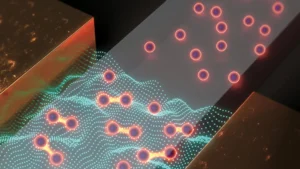
The researchers selected an organic dye molecule known as 9-anthracenecarboxylic acid (9-ACA) to serve as this mediator. By chemically bonding these 9-ACA molecules to the surface of the lanthanide nanoparticles, they created a hybrid interface. In the resulting "LnLED" device, the electrical current is directed into the organic molecules rather than the inorganic crystals.
Once the 9-ACA molecules receive the electrical charge, they enter what is known in quantum mechanics as a "triplet state." In most organic LEDs (OLEDs), triplet states are a nuisance; they are often "dark," meaning they do not emit light readily, and their energy is frequently lost as heat, reducing the device’s efficiency. However, the Cambridge team turned this liability into an asset.
The 9-ACA molecules act as molecular antennas. They capture the incoming electrical energy and, through a process called "triplet energy transfer," they "whisper" that energy to the lanthanide ions sitting just beneath the surface of the nanoparticle. The researchers found that this transfer process is remarkably efficient, with an energy transfer rate exceeding 98%. Once the energy reaches the lanthanide ions, they emit the characteristic, ultra-pure near-infrared light that makes them so valuable.
Quantitative Performance and Comparative Data
The performance of these first-generation LnLEDs has already set a high benchmark for the field. According to the data published in Nature, the devices operate at a relatively low driving voltage of approximately 5 volts. This is a significant finding, as it suggests the technology could be integrated into existing battery-powered mobile electronics without requiring complex power-management circuitry.
A key metric in LED research is External Quantum Efficiency (EQE), which measures the ratio of photons emitted by the device to the number of electrons injected into it. The Cambridge team reported a peak EQE of 0.6% for their NIR-II LEDs. While this may seem low compared to mature commercial visible-light LEDs, it represents a monumental leap for a first-of-its-kind device using insulating materials. For comparison, early-stage quantum dot (QD) LEDs and organic LEDs often struggled to reach even 0.1% efficiency in their initial iterations.
Furthermore, the spectral purity of the LnLEDs far exceeds that of current market leaders. While quantum dots and traditional semiconductors produce a "bell curve" of light wavelengths (spectral width), lanthanide emission is incredibly narrow. This "sharpness" ensures that the light does not bleed into other frequencies, a critical requirement for high-speed fiber-optic communications and high-resolution medical sensors where signal noise must be kept to an absolute minimum.
Chronology of the Research and Global Context
The journey toward the LnLED began several years ago as the Cavendish Laboratory sought to expand the "tool kit" of materials available for optoelectronics. The research was supported by the UK Research and Innovation (UKRI) Frontier Research Grant and the Marie Skłodowska-Curie Fellowship scheme, reflecting the high priority placed on developing "deep tech" solutions within the UK and EU.
The project moved from theoretical modeling of energy transfer at the nano-interface to the synthesis of stable hybrid materials. By 2022, the team had identified 9-ACA as a primary candidate for the antenna molecule due to its favorable triplet energy levels which align perfectly with the absorption bands of certain lanthanides like Erbium and Ytterbium. The final phase involved the engineering of a device architecture that could support these hybrid films while maintaining stability under continuous electrical operation.
The success of this research places the University of Cambridge at the forefront of a global race to dominate the NIR-II technology market, which is expected to grow exponentially as telecommunications move toward faster, light-based data transfer and healthcare shifts toward personalized, real-time internal monitoring.
Implications for Medical Science and Diagnostics
The most immediate and profound impact of this technology is expected in the medical field. The second near-infrared window (NIR-II) is often referred to as the "biological transparency window." Visible light is easily absorbed or scattered by skin, blood, and fat (which is why a flashlight held against a hand only produces a dull red glow). However, NIR-II light passes through these tissues with much greater ease.
With the development of LnLEDs, the medical industry could see the introduction of:
- Injectable Diagnostic Probes: Tiny, biocompatible LEDs that can be injected into the bloodstream to illuminate specific organs or tumors from the inside.
- Wearable Health Monitors: Sensors that can monitor deep-vein glucose levels or oxygenation without the need for invasive needles.
- Precision Photodynamic Therapy: Light-sensitive drugs used in cancer treatment could be activated with pinpoint accuracy by LnLEDs, minimizing damage to surrounding healthy tissue.
Dr. Zhongzheng Yu, a lead author of the study, emphasized that the purity of the light is the deciding factor. "In biomedical sensing, you need to be able to distinguish between very subtle signals. Because our light is so narrow and specific, it allows for a level of detail that was previously unattainable with broader light sources," Yu stated.
Impact on Communications and Advanced Sensing
Beyond healthcare, the telecommunications sector stands to benefit from the narrow spectral output of lanthanides. Modern internet infrastructure relies on fiber-optic cables that carry data as pulses of light. As the demand for data increases, the "lanes" of light become more crowded. The ultra-pure emission from LnLEDs could allow for more "channels" of data to be packed into the same fiber-optic strand without overlapping or interference, effectively increasing bandwidth.
In the realm of security, the unique spectral signatures of different lanthanides could be used to create unforgeable optical tags for currency, high-value goods, or sensitive documents. These tags would be invisible to the naked eye and only detectable by specialized sensors tuned to the exact frequency of the LnLED.
Expert Perspectives and Future Directions
The research team is optimistic about the scalability of this technology. Because the LnLEDs are fabricated using solution-processing techniques—similar to how high-end OLED screens are printed—there is a clear path toward mass production that does not require the multi-billion-dollar vacuum chambers used in traditional silicon chip manufacturing.
"This is a fundamental shift," said Dr. Yunzhou Deng, a postdoctoral research associate involved in the study. "We have unlocked a whole new class of materials. We aren’t just limited to the molecules and nanoparticles we used in this study. The principle of using organic antennas to power insulating cores can be applied to a vast array of combinations."
The next steps for the Cavendish team involve optimizing the interface between the molecular antenna and the nanoparticle to push the External Quantum Efficiency toward the 5% to 10% range. They are also exploring different lanthanide dopants to "tune" the LEDs to emit light at various specific wavelengths across the infrared spectrum.
Conclusion: A New Paradigm for Optoelectronics
The development of LnLEDs represents a triumph of interdisciplinary science, combining organic chemistry, quantum physics, and nano-engineering to solve a problem that was once thought to be a fundamental limitation of nature. By turning insulators into light sources, the researchers at the University of Cambridge have not only created a new device but have also provided a blueprint for future technologies that bridge the gap between the organic and inorganic worlds.
As this technology moves from the laboratory to the commercial sector, it is poised to become a cornerstone of 21st-century infrastructure, enabling us to see deeper into the human body, communicate faster across the globe, and sense the world around us with unprecedented clarity. The "whisper" of the molecular antenna has indeed started a conversation that will resonate across the scientific community for years to come.