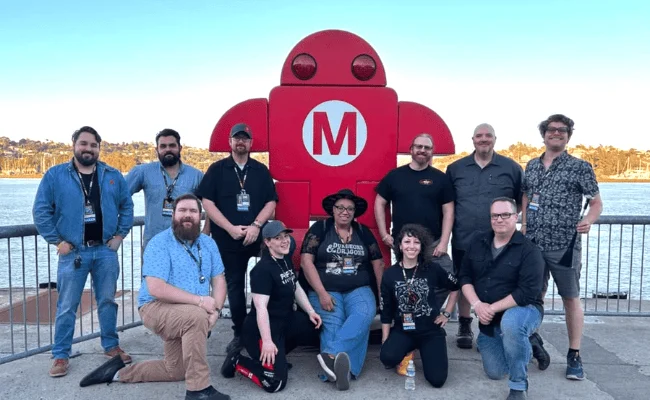
In an era increasingly dominated by computer-generated imagery (CGI), a compelling counter-narrative is unfolding in the world of practical effects, epitomized by the groundbreaking work of animatronics designer Jesse Velez. Velez, along with his team at Raptor House FX, has captivated global audiences by bringing to life one of the most memorable characters from recent television history: "Thing," the disembodied, sentient hand from Netflix’s hit series "Wednesday." Their innovative approach, blending off-the-shelf components with bespoke engineering, resulted in a fully wireless, portable animatronic that not only mirrored human movements in real-time but also embarked on a global promotional tour, interacting spontaneously with cast members and fans alike. This remarkable achievement, slated for a detailed presentation at Maker Faire Bay Area 2025 under the intriguing title "Thing Lives!", underscores a powerful resurgence of tangible spectacle in an otherwise digital landscape.
The Genesis of a Global Phenomenon: "Thing" Comes to Life
The journey to create "Thing" for live, interactive appearances began with a deceptively simple concept: a walking hand prototype. This initial iteration laid the groundwork for what would evolve into a sophisticated, performance-ready animatronic. The challenge was immense: to craft a prop that not only looked identical to its on-screen counterpart but could also perform complex, spontaneous interactions across diverse international settings, all without the cumbersome restrictions of wires or the lag of remote control. Velez and his team envisioned a portable, wireless animatronic hand that would grant a hidden performer real-time control, allowing for improvisation and genuine engagement with audiences.
The character of "Thing" itself holds a special place in the Addams Family canon, serving as a loyal, often mischievous, companion to Wednesday Addams. Its expressive movements and silent communication are central to its charm. For the live promotional events, merely replicating its appearance was insufficient; the animatronic needed to embody the character’s personality and responsiveness. This requirement pushed the boundaries of traditional animatronics, demanding a system capable of interpreting and executing human gestures with fluidity and speed, making it indistinguishable from the character audiences adored on screen.
Technical Ingenuity: Hacking Together "Thing’s" Core
Jesse Velez’s philosophy, deeply rooted in the maker movement, centers on creatively "hacking together" readily available and purpose-built components to achieve seamless functionality. While the specific list of ingredients for the animatronic hand remains a closely guarded secret of Raptor House FX, the general approach involves a sophisticated integration of several key technological elements.
At its heart, such a system typically relies on a complex interplay of microcontrollers, high-torque servo motors, and advanced wireless communication protocols. Miniature yet powerful servo motors would be meticulously arranged within the hand’s structure, controlling individual digit movements and articulation points. These would be connected to a central microcontroller (perhaps a custom PCB integrating an Arduino or Raspberry Pi-like processing unit) responsible for translating input signals into precise mechanical actions.
The "real-time mirroring of human movements" strongly suggests the incorporation of some form of motion capture or teleoperation system. This could involve a custom-designed glove worn by a puppeteer, equipped with flex sensors, accelerometers, and gyroscopes. As the puppeteer moves their own hand, these sensors transmit data wirelessly (via Bluetooth, Wi-Fi, or dedicated RF modules) to the animatronic hand’s microcontroller. The microcontroller then interprets this data, activating the corresponding servos to replicate the movements with minimal latency. Powering such a device for extended periods while maintaining portability would necessitate efficient, high-density battery packs, meticulously integrated to avoid adding excessive weight or bulk. The exterior would require custom-fabricated shells and flexible skin materials, carefully sculpted and painted to match the show’s aesthetic, ensuring durability for travel and convincing appearance under various lighting conditions.
The engineering challenge was not just about making the hand move, but making it move believably and autonomously within a live setting, free from visible wires or bulky external equipment. This required robust signal integrity, efficient power management, and a compact, resilient mechanical design capable of withstanding the rigors of global travel and countless public interactions.
A Global Tour: "Thing" Takes the Red Carpet
Following its meticulous construction and rigorous testing, the "Thing" animatronic was ready for its grand debut. The timing coincided with the global promotional push for "Wednesday," a series that quickly became a cultural phenomenon upon its release in November 2022. Starring Jenna Ortega as the titular character, the show captivated millions with its dark humor, supernatural elements, and a fresh take on the beloved Addams Family. "Thing," a character that often steals scenes with its silent expressiveness, was a natural fit for live appearances, offering a unique, tangible connection to the series.
The animatronic hand became an integral part of the show’s premiere events, traveling across major cities worldwide. From the glitz of Los Angeles to the bustling streets of New York, the historic ambiance of Istanbul, the vibrant energy of Seoul, and the iconic landscapes of London, "Thing" made its presence felt. At each stop, it interacted with the "Wednesday" cast – including Jenna Ortega, Gwendoline Christie, and Catherine Zeta-Jones – on red carpets, participating in interviews, striking poses for photographers, and, most importantly, engaging directly with enthusiastic fans.

These interactions were not merely static displays. Thanks to the real-time control system, "Thing" could wave, give high-fives, point, "sign" responses, and even playfully "scold" interviewers, mimicking the character’s personality perfectly. This spontaneous engagement created unforgettable moments, generating significant media buzz and delighting attendees. For fans, it was a rare opportunity to witness a piece of their favorite show come alive, transcending the screen and offering a visceral connection to the fictional world. For the production team, it was a highly effective and innovative marketing tool, leveraging the charm of practical effects to amplify the show’s appeal.
The Broader Context: Practical Effects in a CGI World
Velez’s work on "Thing" is more than just a clever prop; it represents a significant statement in the ongoing debate between practical effects and CGI in entertainment. For decades, CGI has reigned supreme, offering filmmakers unparalleled flexibility to create fantastical worlds and creatures that would be impossible or prohibitively expensive to build practically. However, a growing sentiment among audiences and creators alike suggests a renewed appreciation for the tangible.
Practical effects, whether animatronics, miniatures, or prosthetics, possess an inherent weight, texture, and physical presence that CGI, for all its advancements, sometimes struggles to replicate. The "uncanny valley" phenomenon, where highly realistic but imperfect CGI figures can evoke unease, is a constant challenge. In contrast, a well-executed practical effect offers a grounding reality. When an actor interacts with a physical prop or creature, their performance often feels more authentic because they are reacting to something physically present in their space.
Major productions like "The Mandalorian" have famously championed the blend of practical effects (such as the Grogu puppet) with cutting-edge virtual production techniques. The success of such ventures demonstrates that audiences often respond more viscerally to something they instinctively know is "real," even if manipulated by unseen forces. "Thing" from "Wednesday" perfectly embodies this principle. Its physical presence at premieres provided an authentic, tactile experience that no digital projection could fully replicate, creating a unique and memorable interaction.
The Maker Movement and Future Implications
Jesse Velez’s approach—creatively combining off-the-shelf components with custom-built elements—is a hallmark of the global maker movement. This movement emphasizes DIY innovation, open-source collaboration, and the democratization of technology, empowering individuals to create sophisticated projects outside traditional industrial pipelines. Velez’s presentation at Maker Faire Bay Area 2025, an event synonymous with this ethos, serves as a testament to the power of independent creativity and shared knowledge. It highlights how the principles of making—experimentation, iterative design, and resourceful problem-solving—can lead to professional-grade results that influence mainstream entertainment.

The success of the "Thing" animatronic carries significant implications for the future of the entertainment industry. It suggests a potential shift, or at least a rebalancing, in how productions approach special effects. While CGI will undoubtedly remain a crucial tool, projects like this demonstrate the enduring value and audience appeal of practical effects, particularly for character-driven elements that benefit from physical interaction. It underscores the importance of skilled animatronics designers and practical effects artists who can bring a unique dimension to storytelling.
Moreover, the interactive nature of "Thing" at promotional events points towards new avenues for fan engagement and marketing. By offering a live, responsive character experience, studios can create deeper connections with their audience, transforming passive viewership into active participation. This blend of art, engineering, and live performance sets a new benchmark for how iconic characters can transcend the screen and leave a lasting impression in the real world.
Jesse Velez’s work with Raptor House FX is more than just a technical marvel; it is a celebration of craftsmanship, ingenuity, and the enduring magic of tangible creation. In a world saturated with digital experiences, the visceral thrill of encountering something real, complex, and alive right in front of you remains a powerful and invaluable commodity. As technology continues to advance, the symbiotic relationship between digital tools and practical artistry will likely deepen, creating even more immersive and believable experiences. The "Thing" animatronic stands as a shining example of this synergy, proving that sometimes, the future is indeed tactile, one servo and line of code at a time. This project solidifies Velez’s position at the forefront of animatronics design, inspiring a new generation of makers and demonstrating the boundless possibilities when art and engineering converge.