The landscape of fundamental physics is undergoing a seismic shift as researchers at the University at Buffalo (UB) and the Johannes Gutenberg University of Mainz introduce a revolutionary quantum sensing method designed to identify a newly discovered class of magnetic materials. For nearly a century, the scientific community operated under the consensus that magnetism was divided into two primary categories: ferromagnetism and antiferromagnetism. However, the emergence of "altermagnets"—a third category that blends the advantageous properties of its predecessors—has sparked a global race to identify and harness these materials for the next generation of computing. The new study, published in the prestigious journal Physical Review Letters, proposes using microscopic defects in diamonds to detect the subtle, elusive signatures of altermagnetism, potentially clearing the path for electronics that are significantly faster and more energy-efficient than current silicon-based technologies.
The Evolution of Magnetic Understanding
To appreciate the significance of the University at Buffalo’s proposal, one must look at the history of magnetic classification. Ferromagnets, known to humanity since antiquity, are characterized by electron spins that align in a single direction. This alignment creates a macroscopic magnetic field, the kind that allows a magnet to stick to a refrigerator or enables the read-write heads in traditional hard drives to function. While ferromagnets are easy to manipulate and detect, they face physical limitations in terms of speed and the "stray fields" they produce, which can interfere with neighboring components in miniaturized circuits.
In the 1930s, physicist Louis Néel expanded the field by describing antiferromagnets. In these materials, neighboring electron spins point in opposite directions, effectively canceling each other out. Because they produce no external magnetic field, they are "invisible" to many traditional sensors. However, antiferromagnets possess a unique advantage: their internal spin dynamics are orders of magnitude faster than those of ferromagnets. The challenge has always been their stubbornness; because they lack a net magnetic field, they are incredibly difficult to control and measure for practical data storage.
The discovery of altermagnets within the last decade represents the "Goldilocks" find of condensed matter physics. These materials possess a net zero magnetization like antiferromagnets, but their internal symmetry allows electrons to behave as though they are in a ferromagnet. This means they could theoretically offer the ultra-fast switching speeds of antiferromagnets while retaining the electronic controllability that makes ferromagnets so useful for information processing.
The Quantum Solution: Diamond-Based Sensing
The primary hurdle facing altermagnets is identification. Because they do not produce a large-scale magnetic field, researchers cannot simply use a standard magnetometer to find them. This is where the University at Buffalo team, led by Assistant Professor Jamir Marino, PhD, has stepped in with a proposal for a quantum-grade diagnostic tool.
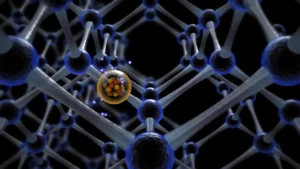
The team’s method utilizes Nitrogen-Vacancy (NV) centers in diamonds. An NV center is a point defect in a diamond’s crystal lattice where a nitrogen atom replaces a carbon atom, sitting next to an empty space or "vacancy." These defects act as isolated quantum systems that are incredibly sensitive to their magnetic environment.
"This could be the first building block of a new generation of experiments that determine whether a material is an altermagnet," says Dr. Marino. "Altermagnets could completely revolutionize the way we transport information, but to confirm if this elegant theory is true, we need experiments that identify altermagnets and confirm they behave the way scientists predict."
The proposed experiment involves placing a diamond sensor in close proximity to a candidate altermagnetic material. Researchers would use lasers and microwaves to manipulate the magnetic spin of the NV center, setting it in a specific direction. They would then monitor the "relaxation time"—the duration it takes for the spin to lose its orientation. In an altermagnet, the relaxation rate is expected to vary significantly depending on the direction in which the NV center’s spin is pointed. This directional dependence, or anisotropy, serves as a "smoking gun" signature that distinguishes an altermagnet from a standard antiferromagnet.
Chronology of a Scientific Breakthrough
The journey to this discovery began in 2019 at the Johannes Gutenberg University of Mainz. Researchers Libor Šmejkal and Jairo Sinova—who are co-authors on the current UB study—noticed anomalies in the behavior of ruthenium dioxide (RuO2). While the material appeared to be an antiferromagnet based on its lack of external magnetism, its electronic properties suggested otherwise. When an electric current was passed through it, the material exhibited a "spin-polarized" current, a trait typically reserved for ferromagnets.
Between 2020 and 2022, theoretical frameworks were developed to explain this phenomenon. Scientists realized that the crystal symmetry of certain materials allowed for a third magnetic state. By 2023, the term "altermagnetism" had gained traction in the global physics community, and initial experimental signatures began to emerge in specialized laboratories.
The 2024 UB proposal represents the next critical phase: moving from accidental discovery to systematic identification. While previous experiments required massive particle accelerators or complex spectroscopic setups, the diamond-defect method offers a more accessible and less invasive path forward.
Technical Analysis of Implications
The implications of altermagnetism for the tech industry are profound. Current computing relies heavily on the movement of electrical charge, which generates significant heat due to resistance. This heat is the primary barrier to making processors faster and smaller—a phenomenon that has slowed the progression of Moore’s Law.
Spintronics, or spin-transport electronics, seeks to solve this by using the "spin" of the electron rather than just its charge to carry information. Altermagnets are the ideal candidate for spintronics because they support spin-polarized currents without the baggage of stray magnetic fields.
Supporting data suggests that the class of altermagnets is not a rare anomaly. Theoretical models indicate that more than 200 materials could be classified as altermagnets. This is a staggering number when compared to the roughly 100 known ferromagnets that have been the backbone of magnetic technology for a century. The diversity of these 200+ materials means scientists can look for altermagnets that are abundant, non-toxic, and capable of operating at room temperature.
Expert Perspectives and Industry Reactions
The collaborative nature of this research highlights the bridge between theoretical prediction and experimental reality. Jairo Sinova, one of the original proponents of the altermagnet concept, believes the UB sensing technique will be a game-changer.
"This sensing technique could become a very important tool for exploring candidate altermagnetic materials," Sinova notes. "It offers advantages over conventional experimental techniques by detecting subtle directional magnetic patterns across different regions of a material without significantly disturbing it."
The "non-disturbing" aspect is vital. In quantum physics, the act of measurement often changes the state of the object being measured. By using the NV center as a remote probe, researchers can observe the material’s "natural" state, ensuring the data collected is an accurate reflection of the material’s inherent properties.
While the tech industry has not yet integrated altermagnets into consumer products, major semiconductor manufacturers are closely watching the field. The ability to switch magnetic states at terahertz speeds (trillions of times per second) while consuming minimal power could lead to smartphones with weeks of battery life and data centers that require a fraction of the cooling currently needed.
The Path Forward: From Theory to Laboratory
Despite the excitement, Jamir Marino is careful to note that the sensing system is currently a theoretical blueprint. The UB team used sophisticated quantum dynamics simulations to prove the concept, but the physical implementation will require high-precision laboratory work.
The next steps involve building the experimental apparatus described in the Physical Review Letters paper. This will involve the use of "quantum diamonds" and ultra-precise positioning systems to test known candidates like ruthenium dioxide and manganese telluride.
"Efficiently identifying altermagnetic materials is a crucial step toward one day actually using them in electronics," Marino says. "Altermagnets would make transport of information radically more efficient. That could allow technology to scale down and be less power consuming."
As the world reaches the physical limits of silicon-based computing, the discovery and subsequent ability to measure altermagnets may represent the most significant shift in materials science since the invention of the transistor. The work at the University at Buffalo does more than just propose a sensor; it provides a map for exploring a newly discovered continent in the world of physics.
The research was supported by the German Research Foundation and involved a multi-institutional effort including Hossein Hosseinabadi of the Max Planck Institute and V.A.S.V. Bittencourt of the University of Strasbourg. As these teams move toward experimental validation, the scientific community stands on the precipice of a new era in magnetic technology.