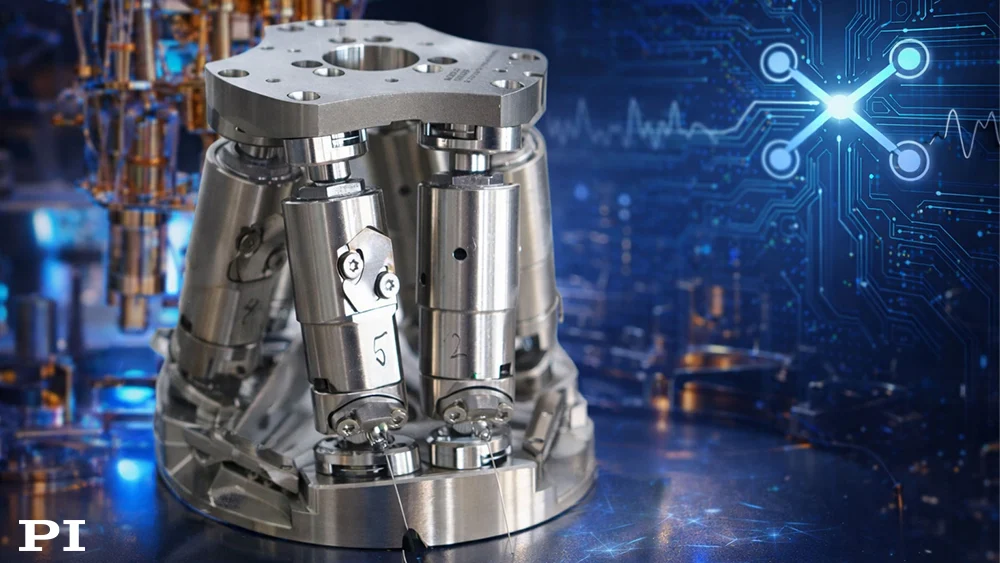
PI (Physik Instrumente), a global leader in high-precision motion control and nanopositioning solutions, has officially launched a dedicated low-temperature development program. This strategic initiative is meticulously focused on advancing multi-axis nanopositioning systems specifically tailored for the demanding requirements of emerging quantum applications. The program represents a significant step forward in enabling the next generation of quantum research and industrial deployment, addressing critical challenges associated with operating ultra-precise mechanical systems in extreme cryogenic environments.
Evolving Demands in Cryogenic Motion Control
The landscape of scientific research and technological development, particularly within quantum computing, quantum communication, and quantum sensing, has rapidly evolved. Early cryogenic motion solutions, while functional for their time, often relied on simpler, stacked XYZ stages. These configurations, while capable of providing basic linear motion, presented inherent limitations for modern, complex experiments. The nature of quantum phenomena often necessitates intricate optical setups, precise sample manipulation, and the alignment of multiple components with unprecedented accuracy, often in confined spaces.
Contemporary quantum applications frequently demand 5- and 6-degree-of-freedom (DOF) alignment systems. These advanced systems are crucial for supporting increasingly larger payloads, which might include intricate optical components, superconducting circuits, or entire quantum device assemblies. Furthermore, they must accommodate more complex optical configurations, requiring simultaneous and coordinated movements across multiple axes to achieve optimal performance. The limitations of stacked stages—including accumulated error, increased footprint, and reduced stiffness—become significant bottlenecks when striving for the femtometer-level precision and stability required in cutting-edge quantum experiments. The cumulative error in serial kinematic stacks, where the error of each stage adds to the subsequent one, can severely compromise overall system accuracy and repeatability, a critical factor at the quantum scale where environmental perturbations can decohere quantum states.
PI’s Innovative Approach: Compact Parallel Kinematics for Cryogenic Environments
In response to these escalating demands, PI’s development program is founded on a sophisticated approach utilizing compact 6DOF parallel kinematics. This design philosophy is particularly advantageous for operation within the highly constrained spaces characteristic of cryostats and dilution refrigerators. These specialized cooling systems, essential for achieving the ultra-low temperatures necessary for quantum phenomena (often below 4 Kelvin, and sometimes even millikelvin ranges), offer limited volume for internal instrumentation. The compact nature of PI’s parallel kinematic systems, often referred to as hexapods or Stewart platforms, allows for efficient integration without compromising the thermal stability or vacuum integrity of the cryogenic environment.
The systems under development are specifically engineered for a wide array of optical tasks critical to quantum research. These include precise beam steering, essential for guiding photons to specific locations within a quantum circuit; lens aberration correction, ensuring the highest fidelity in imaging and light manipulation; polarization control, vital for encoding and decoding quantum information carried by photons; and highly accurate fiber alignment, crucial for coupling light into and out of quantum devices. Additionally, they facilitate the precise positioning of dispersive elements such as gratings and prisms, enabling spectral analysis and manipulation of quantum states. The ability to perform these tasks with nanoscale precision at extremely low temperatures is paramount for advancing quantum technologies.
A core design objective for these new systems is robust operation at temperatures below 4 Kelvin (K). This temperature range is crucial for a variety of quantum phenomena, including superconductivity, enabling coherent manipulation of qubits, and significantly reducing thermal noise that can disrupt delicate quantum states. Despite these extreme conditions, the systems are designed to support motion of several hundred grams over millimeter-scale travel ranges, all while maintaining exceptional stability and repeatability. This combination of payload capacity, travel range, and precision in a cryogenic environment represents a significant engineering challenge and a breakthrough capability for researchers.
Technical Advantages of Hexapod-Type Parallel Kinematics

Hexapod-type parallel kinematics offer distinct advantages over traditional serial kinematic stages, especially in demanding applications like quantum research. Unlike stacked systems where each stage moves independently and errors can accumulate, hexapods provide simultaneous control of all six degrees of freedom (three translational: X, Y, Z; and three rotational: pitch, roll, yaw). This inherent design characteristic significantly helps reduce the error accumulation often observed in stacked systems, leading to higher overall precision and accuracy.
Other critical characteristics of PI’s parallel kinematic design include low inertia, which allows for faster response times and more dynamic adjustments—a key factor in real-time quantum experiment control. Their lower energy requirements are particularly beneficial in thermally sensitive low-temperature environments, as minimizing heat generation is crucial to maintaining the cryogenic temperature. The programmable pivot point for rotational alignment offers unparalleled flexibility, allowing researchers to define the exact point around which an object rotates, simplifying complex alignment procedures. Furthermore, the open aperture design provides unobstructed optical access, which is indispensable for applications involving laser beams, microscopy, or other optical pathways within the system.
The underlying piezo-based architecture is a cornerstone of PI’s cryogenic nanopositioning strategy. Piezoelectric actuators operate on the principle of the inverse piezoelectric effect, where an applied voltage induces a precise, nanoscale deformation in a ceramic material. This technology is uniquely suited for cryogenic applications due to several factors. Firstly, piezo elements generate very little heat compared to conventional electromagnetic motors, a critical advantage in low-temperature environments where any heat input can significantly impact temperature stability and increase cooling loads. Secondly, the piezo-based design allows for self-locking operation when power is switched off. This means the position is maintained without continuous power consumption, further reducing heat load and power requirements, which is incredibly useful in thermally sensitive cryostats and dilution refrigerators.
Beyond thermal considerations, the use of non-magnetic materials in the construction of these systems is paramount. Many quantum experiments involve highly sensitive magnetic fields, and even trace amounts of magnetic materials can introduce interference, corrupting delicate quantum states. PI’s commitment to non-magnetic construction ensures compatibility with these sensitive quantum devices. Additionally, the systems are designed for ultra-high vacuum (UHV) compatibility, which is often a prerequisite for cryogenic systems to prevent contamination and ensure optimal performance of quantum devices. This combination of low heat generation, self-locking capability, non-magnetic properties, and UHV compatibility makes PI’s piezo-based parallel kinematics an ideal solution for the most demanding quantum research environments.
The Quantum Technology Landscape and the Role of Nanopositioning
The global quantum technology sector is experiencing unprecedented growth, driven by significant investments from governments, research institutions, and private companies worldwide. Quantum computing, quantum communication, and quantum sensing hold the promise of revolutionizing industries from healthcare and finance to materials science and national security. For instance, the global quantum computing market alone is projected to grow from an estimated USD 10 billion in 2023 to over USD 100 billion by 2030, according to various market analyses, indicating a compound annual growth rate exceeding 30%. This exponential growth underscores the urgent need for enabling technologies that can accelerate research and development in this nascent field.
The demand for high-precision cryogenic solutions is intrinsically linked to the fundamental principles of quantum mechanics. Many quantum phenomena, such as superposition and entanglement, are incredibly fragile and susceptible to decoherence from thermal noise and environmental vibrations. Operating at extremely low temperatures (often below 4 Kelvin, and in some cases, millikelvin temperatures) is essential for several reasons: it minimizes thermal vibrations, allows for superconductivity in certain qubit architectures, and extends the coherence times of qubits, which are critical for performing complex quantum computations.
Within this rapidly expanding ecosystem, nanopositioning systems play a foundational role. They are the unsung heroes that provide the necessary infrastructure for manipulating and interrogating quantum devices. Whether it’s precisely aligning optical fibers to single-photon emitters, positioning scanning probes over superconducting circuits, or correcting for minute thermal drifts in complex optical setups, the ability to control motion at the nanoscale in cryogenic conditions is indispensable. PI’s development program directly addresses this critical need, offering tools that enable researchers to push the boundaries of quantum science and engineering.
Strategic Implications and Market Impact
This development program significantly expands PI’s established work in motion technology for quantum research and cryogenic photonic systems. By focusing on advanced 6DOF parallel kinematics with piezo-based actuation, PI is cementing its position at the forefront of precision motion control for the most demanding scientific and industrial applications. This strategic move is not merely about introducing new products; it’s about providing foundational technology that will accelerate breakthroughs across multiple high-tech sectors.

The technology is primarily intended for use in the burgeoning quantum technology industry, where its precision and cryogenic capabilities are directly applicable to the development of quantum computers, sensors, and communication networks. Beyond quantum, the solutions will also find critical applications in the photonics industry, particularly in areas requiring ultra-precise alignment of optical components at low temperatures, such as advanced spectroscopic systems, astronomical instrumentation, and next-generation optical communication devices. Furthermore, the semiconductor industry, which consistently pushes the boundaries of miniaturization and precision, stands to benefit. Applications in advanced lithography, metrology, and defect inspection at cryogenic temperatures could leverage these new capabilities.
The implications for PI are multifaceted. It underscores the company’s commitment to continuous innovation and its foresight in anticipating the technological needs of future industries. By investing heavily in R&D for such specialized areas, PI reinforces its brand as a provider of cutting-edge, high-performance solutions. For the broader market, the availability of such sophisticated tools can significantly lower the barrier to entry for certain quantum experiments, enabling more researchers to explore complex phenomena and accelerate the pace of discovery. This also positions PI as a key enabler in the global race for quantum supremacy, supplying the precision instrumentation that underpins experimental success.
Looking Ahead: The Future of Quantum-Enabled Precision
The launch of PI’s cryogenic nanopositioning development program marks a crucial juncture in the advancement of quantum technologies. From the early, relatively simple stacked XYZ stages used in nascent cryogenic experiments, the field has progressed to a point where integrated, multi-axis, highly stable, and precise positioning systems are non-negotiable. PI’s hexapod-based solutions, with their inherent advantages in reducing accumulated error, offering simultaneous 6DOF control, and optimizing for low-temperature operation with piezo technology, represent a significant leap forward.
The timeline of development in this niche but critical area can be seen as an evolution:
- Past (Pre-2020s): Reliance on customized, often less optimized, serial kinematic stages for cryogenic applications, suitable for simpler experiments but limiting in complex optical and device integration.
- Present (2020s): Recognition of the need for purpose-built, highly integrated 5-6DOF solutions. PI’s program launch represents a direct response to this, moving towards commercially available, robust parallel kinematic systems.
- Future (Post-2025): Anticipated broader adoption of these advanced systems as quantum technologies mature, leading to faster research cycles, more robust quantum devices, and ultimately, the commercialization of quantum applications across various industries.
While no specific official statements from PI executives were provided in the original brief, it can be logically inferred that a senior spokesperson would articulate the strategic importance of this initiative. For instance, a statement from a PI representative, perhaps the Head of the Quantum Technologies Division, might emphasize: "This development program is a testament to PI’s unwavering commitment to pushing the boundaries of precision engineering. We recognize that the future of quantum technology hinges on the ability to control and manipulate matter at the most fundamental levels, even under extreme conditions. Our new generation of cryogenic nanopositioning systems, built upon our expertise in parallel kinematics and piezo technology, is designed to be a cornerstone for researchers worldwide, enabling breakthroughs that were previously unimaginable. We are not just building components; we are building the infrastructure for the quantum revolution."
Similarly, an independent industry analyst specializing in quantum technologies might comment: "The availability of highly precise, robust, and cryo-compatible motion systems is a critical enabler for the quantum industry. Companies like PI, investing in dedicated development programs for these niche but vital components, are accelerating the entire field. Their focus on parallel kinematics and low-heat piezo actuation directly addresses some of the most persistent engineering challenges in building stable and scalable quantum systems. This move by PI signals a maturing ecosystem where specialized, high-performance tools are becoming readily available, which is essential for translating quantum research into tangible technologies."
The broader impact of such advancements extends beyond immediate scientific discovery. It contributes to the global technological competitiveness of nations investing in quantum research. By providing reliable and advanced tools, PI helps accelerate the development cycles of quantum prototypes, potentially leading to faster commercialization of quantum computing, secure quantum communication networks, and highly sensitive quantum sensors that could transform fields like medicine, materials science, and environmental monitoring. This technological push also creates new opportunities for skilled labor in engineering, manufacturing, and research, further stimulating economic growth within the high-tech sector.
However, challenges remain. The continuous miniaturization of quantum devices, the increasing complexity of optical circuits, and the drive towards even lower operating temperatures will require ongoing innovation in materials science, control algorithms, and system integration. PI’s development program, with its focus on adaptability and modularity, is well-positioned to evolve alongside these future demands, ensuring that the necessary precision mechanics are available to meet the ever-increasing requirements of the quantum age.
In conclusion, PI’s launch of its cryogenic nanopositioning development program is a pivotal moment for the quantum technology, photonics, and semiconductor industries. By addressing the critical need for ultra-precise, multi-axis motion control in extreme low-temperature environments, PI is not only expanding its technological portfolio but also providing essential tools that will empower scientists and engineers to unlock the full potential of quantum phenomena, paving the way for a new era of technological advancement.