In the immediate aftermath of a nuclear detonation or a catastrophic reactor failure, the physics of the environment undergoes a transformation unlike any other on Earth. Within less than a millionth of a second, an immense burst of energy is liberated, generating temperatures that reach millions of degrees. This extreme thermal energy instantly vaporizes all surrounding materials—be they the components of the device itself, the air, or the nearby infrastructure—creating a brilliant, rapidly expanding fireball of gas and ionized plasma. As this fireball ascends and expands, it begins to entrain the surrounding atmosphere, cooling at a rate that dictates the eventual chemical and physical composition of the solid particles known as nuclear fallout.
Understanding the precise mechanics of this condensation process is not merely an academic exercise; it is a fundamental requirement for national security, environmental safety, and nuclear forensics. In a landmark study recently published in the journal Analytical Chemistry, a team of researchers at Lawrence Livermore National Laboratory (LLNL) has provided new clarity on how specific radioactive elements—uranium, cerium, and cesium—behave as they transition from high-temperature vapors back into solid matter. Their findings suggest that the current computational models used to predict fallout behavior may be oversimplifying the complex chemical interactions that occur during the cooling phase, potentially leading to inaccuracies in how we interpret nuclear events.
The Mechanics of the Nuclear Fireball and Particle Condensation
The lifecycle of nuclear fallout begins in the plasma state, where atoms are stripped of electrons and matter exists as a chaotic, high-energy soup. As the fireball expands and its pressure drops, the temperature falls from millions of degrees to several thousand. It is during this cooling window—specifically between 5,000 and 1,000 degrees Celsius—that the chemistry of fallout is determined.
Elements with high boiling points, known as refractory elements, are the first to condense into liquid droplets and then solid seeds. Elements with lower boiling points, or volatile elements, condense much later, often coating the surfaces of the already-formed refractory particles. However, the LLNL study reveals that this process is not a simple, sequential layering. Instead, the "thermal history"—the specific path and duration of the cooling process—plays a decisive role in the final chemical signature of the debris.
"Changing how long materials remain at high temperature can alter chemical reactions and how volatile elements like cesium are incorporated into particles," explained Rakia Dhaoui, an LLNL scientist and the lead author of the study. According to Dhaoui, these microscopic particles act as a "black box" recorder of the event. By deciphering how they formed, scientists can work backward to determine the nature of the source material and the conditions of the explosion.
Replicating the Extreme Conditions of a Nuclear Event
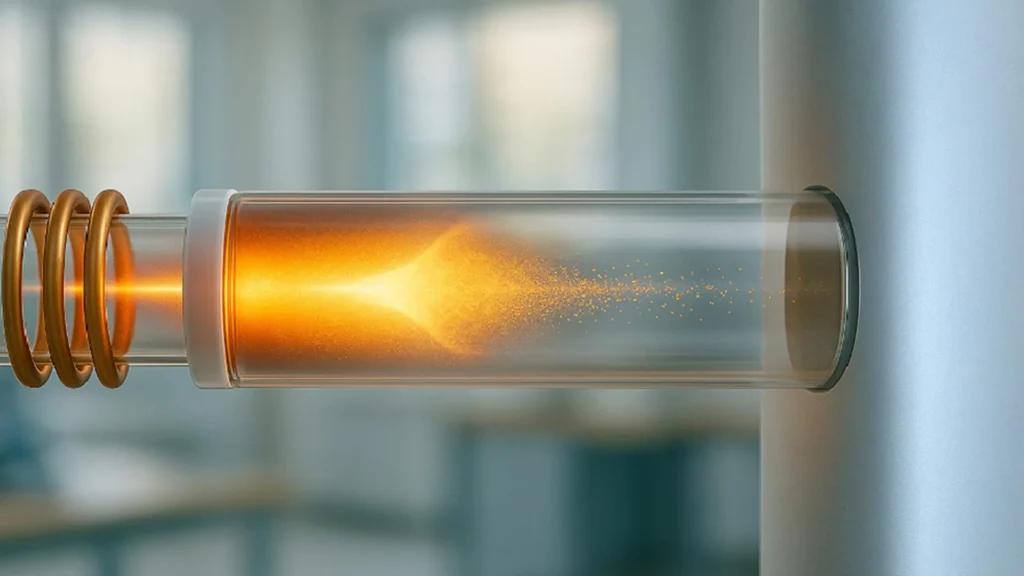
To study these processes without the need for actual nuclear testing, which has been prohibited by international moratoriums for decades, the LLNL team utilized a sophisticated plasma flow reactor. This device is designed to simulate the specific cooling environment of a nuclear fireball in a controlled, laboratory setting.
The experiment involved introducing specific combinations of uranium, cerium, and cesium into a high-temperature inductively coupled plasma. Uranium was chosen as the primary benchmark because it is the fundamental fuel for nuclear weapons and reactors. Cerium was included as a chemical surrogate for plutonium, as it shares similar oxidation states and condensation behaviors but is safer to handle in a laboratory environment. Cesium represented the volatile fission products, which are of significant concern in the event of a reactor accident like Chernobyl or Fukushima due to their high radioactivity and mobility in the environment.
The researchers subjected these materials to two distinct "thermal histories." The first scenario involved a steady, gradual decline in temperature as the vapor moved through the reactor tube. The second scenario held the materials at a sustained high temperature for a longer duration before subjecting them to a rapid "quench" or cooling phase. Because the plasma flow reactor operates in a steady state, the scientists could collect samples at various physical points along the tube, effectively capturing "snapshots" of the particle formation process at different stages of cooling.
The Role of Chemical Speciation and Thermal History
The results of the LLNL experiments challenged several long-standing assumptions in the field of nuclear chemistry. Traditionally, many fallout models have operated on the "independent condensation" theory, which posits that each element condenses according to its own individual thermodynamic properties, largely unaffected by the presence of other elements.
However, the LLNL data showed that uranium and cerium—the refractory components—showed significant changes in their chemical speciation depending on their thermal history. When held at high temperatures for longer periods, these elements underwent different chemical reactions with the surrounding oxygen and with each other than they did during rapid cooling.
The most striking discovery involved cesium. As a volatile element, cesium was expected to condense late and remain mostly on the surface of the particles. Instead, the researchers found that when the mixture remained hot for an extended period, the cesium mixed far more extensively with the uranium and cerium. This suggests a high degree of chemical "mixing" or solubility within the molten droplets before they solidified. If the cooling is slow, the elements have more time to react and bond, creating complex mineral phases rather than simple layers.
Historical Context and the Evolution of Fallout Science
The study of fallout has its roots in the early days of the Cold War. Following the "Trinity" test in 1945 and subsequent atmospheric tests in Nevada and the Pacific, scientists realized that the radioactive "ash" falling from the sky carried vital information. During the 1950s, "Project Sunshine" was launched by the U.S. Atomic Energy Commission to track the global distribution of Strontium-90, a byproduct of nuclear tests that was accumulating in human bones and teeth.
During this era, fallout science was largely empirical, based on collecting dust from the roofs of buildings or soil samples from downwind communities. While these studies provided data on the distribution of fallout, they could not fully explain the formation of the particles because the interior of a nuclear fireball remained a mystery.
The shift toward laboratory-based plasma physics, as demonstrated by the LLNL team, represents a new frontier in this field. By replacing the "black box" of an actual explosion with the precision of a plasma reactor, scientists can move away from simplified assumptions and toward a measurement-based understanding of nuclear chemistry. This transition is essential for modern nuclear forensics, where the goal is to identify the origin of intercepted nuclear materials or the source of an undeclared detonation.
Implications for Public Safety and National Security
The findings of the LLNL study have immediate implications for several areas of national interest:
- Improved Atmospheric Modeling: Current models used by agencies like the EPA or the Department of Energy to predict the spread of radiation after an accident may need to be updated. If cesium and other volatile isotopes are being chemically "locked" into larger, heavier uranium particles more than previously thought, they might fall out of the atmosphere closer to the source rather than traveling long distances as fine aerosols.
- Nuclear Forensics: In a post-detonation scenario, the ability to accurately "fingerprint" debris is vital. If investigators know how thermal history affects the mixing of uranium and cesium, they can better estimate the yield of the device and the materials used in its construction.
- Reactor Safety: The research provides valuable data for the nuclear power industry. In a severe reactor core melt scenario, understanding how fuel (uranium) and fission products (cesium) interact at high temperatures can help in designing better containment systems and emergency response strategies.
Future Research and Complex Mixtures
While the study of uranium, cerium, and cesium provides a critical foundation, the LLNL team acknowledges that real-world nuclear events are far more complex. A nuclear detonation involving a weapon, for instance, would also vaporize kilograms of iron, aluminum, silicon (from soil), and other structural materials.
"The team plans to expand the work by studying more realistic mixtures of materials," the researchers noted. Future experiments will likely include the introduction of environmental materials like silica or calcium to see how the presence of "dirt" in the fireball affects the chemistry of the radioactive isotopes. The ultimate goal is to create a comprehensive database of chemical behaviors that can be plugged into global safety models.
As the geopolitical landscape remains uncertain and the threat of nuclear proliferation persists, the work being done at Lawrence Livermore National Laboratory ensures that the scientific community is prepared to interpret the silent record left behind by nuclear debris. By illuminating the hidden chemistry of the fireball, these researchers are providing the tools necessary for better decision-making in the face of the world’s most significant technological risks. This study in Analytical Chemistry serves as a reminder that even in the most chaotic millionth of a second, the laws of chemistry remain constant, waiting to be decoded by those with the right tools.