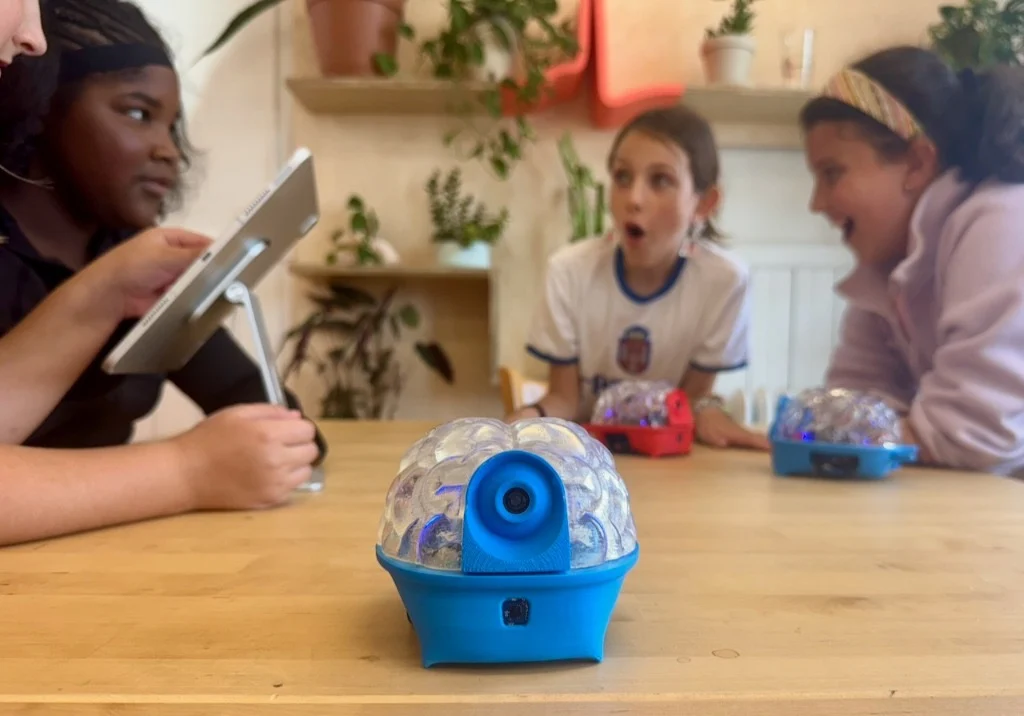
In a significant stride towards democratizing complex scientific principles, Backyard Brains has unveiled SpikerBot, an innovative educational robot designed to introduce users to the intricacies of neuroscience and robotics through an entirely new programming paradigm. Eschewing traditional lines of code and complex logical statements, SpikerBot allows individuals to program sophisticated, lifelike behaviors by manipulating virtual neurons, synapses, and circuits within an intuitive app interface. This novel approach aims to make the often-daunting fields of engineering and brain science accessible, engaging, and deeply informative for learners of all ages.
Bridging the Neuroscience Education Gap
At its core, SpikerBot addresses a long-standing challenge in science education: the significant gap in how neuroscience is taught. As Co-Founder & CEO Greg Gage of Backyard Brains highlights, while elementary school curricula often introduce the basic function of a single neuron, the continuity of learning about how millions of these neurons collectively give rise to complex thought and behavior typically halts until college-level studies, if at all. This creates a vast chasm, akin to understanding a single transistor without any intermediate knowledge before jumping to high-level programming languages like Python. SpikerBot is meticulously engineered to bridge this critical gap, fostering what Backyard Brains terms "neuroscience literacy" from an earlier age.
The initiative comes at a time when STEM (Science, Technology, Engineering, and Mathematics) education is paramount, with a growing demand for innovative tools that can engage students beyond conventional textbooks and theoretical lectures. Educational robotics, a sector experiencing robust growth, is valued for its hands-on approach to problem-solving, critical thinking, and computational skills. SpikerBot distinguishes itself within this landscape by offering a biologically inspired programming method that directly correlates with the functioning of natural brains, thereby providing a tangible, experiential understanding of neural networks.

A New Programming Language: Neurons, Synapses, and Emergent Behavior
The most radical departure SpikerBot introduces is its programming interface. Instead of grappling with "if-then" statements, loops, or object-oriented structures, users interact with a visual environment where they drag and connect virtual neurons and axons on a screen. This method is likened by its creators to moving cables on a patch synthesizer, offering a holistic, visual overview of the entire "brain" circuit. Designer Alex Hatch elaborates on this philosophy, stating, "there’s no code, no LLMs, just neurons, synapses, and behavior emerging from a circuit a kid designed." This emphasis on emergent behavior is heavily influenced by Valentino Braitenberg’s seminal 1984 book, Vehicles, which demonstrated how surprisingly complex and seemingly intelligent behaviors could arise from simple, direct connections between sensors and motors.
This paradigm shift yields fascinating results. Behaviors traditionally considered challenging for beginner robotics enthusiasts, such as a robot tracking and following a person, become remarkably straightforward to implement with just a few neuronal connections. For instance, creating a creature that chases objects can be achieved with only two neurons. Conversely, tasks that are trivial in traditional computer logic, like making a robot count in binary, transform into intricate webs of neuronal connections, demanding a different kind of problem-solving. This inversion not only offers a fresh perspective on programming but also intuitively demonstrates the fundamental differences between artificial intelligence based on computational logic and the biological intelligence of living organisms.
A key design feature enhancing the learning experience is the instantaneous feedback loop. Any alteration made to the virtual neural circuit – whether changing a neuron from excitatory to inhibitory or re-routing a connection – is reflected immediately in the robot’s physical behavior. There is no compilation time, no waiting for code uploads, allowing for rapid experimentation and iterative learning that mirrors the pace of thought and scientific inquiry. This immediacy is crucial for maintaining engagement and fostering a deeper understanding of cause and effect within the neural system.
Grounded in Scientific Principles and Pedagogical Design

The development of SpikerBot has been a collaborative effort, incorporating feedback from both child educators and professional neuroscientists. This ensures that while the interface is intuitive and fun, the underlying principles and patterns users discover are genuinely rooted in contemporary neuroscience. The app provides a library of sample brain models, allowing users to deconstruct, modify, and learn from pre-built circuits. Through this hands-on exploration, users can grasp core neurological patterns such as recurrent pairs (neurons that excite each other, leading to persistent activity), lateral inhibition (a mechanism for enhancing contrast in sensory perception), and the foundational concepts behind working memory.
Beyond its educational value in robotics and neuroscience, SpikerBot aims to foster a broader societal understanding of brain function. With approximately one in five individuals worldwide experiencing a neurological condition, there is an urgent need for greater public literacy regarding the brain. By providing a shared language and an accessible framework for understanding building-block brain patterns, SpikerBot can contribute to increased empathy, reduced stigma, and a more informed discourse around various neurological conditions, from learning disabilities to neurodegenerative diseases.
Hardware, Customization, and Ecosystem Integration
The physical manifestation of SpikerBot is as thoughtfully designed as its software. The robot itself features a distinctive brain-shaped chassis, drawing inspiration from Backyard Brains’ own logo. It is equipped with an array of sensors to perceive its environment in the real world, including a camera for visual input, a microphone for auditory cues, and a distance sensor for spatial awareness. Its lights and sounds are not merely functional but are crafted to react with a natural, organic quality – lights pop on and gracefully fade out akin to bioluminescent cells, and sound effects are charmingly quirky, enhancing the robot’s personality.
Customization is a significant aspect of the SpikerBot experience. Connection points on the chassis facilitate the attachment of 3D-printed accessories, allowing owners to personalize their bot and give it a unique "personality" or specific functional enhancements. This encourages creativity and further engineering exploration beyond the core neural programming. Moreover, SpikerBot supports integration with Backyard Brains’ existing peripherals, notably their Spiker:bit board. This compatibility opens up exciting possibilities, such as controlling the SpikerBot with muscle signals from a user’s own arm, offering a direct, biofeedback-driven interaction that blurs the lines between human and machine.

Commitment to Longevity and Accessibility
Backyard Brains has demonstrated a clear commitment to the long-term viability and accessibility of SpikerBot. The programming app is offered free of charge and crucially, does not require cloud-based authentication, ensuring that users retain full control and functionality regardless of internet connectivity or future service changes. This stands in contrast to a growing trend of subscription-based or cloud-dependent educational tools.
Furthermore, the robot is designed to run on easily swappable AA batteries, rather than non-replaceable, constantly decaying lithium-ion cells. Recognizing the environmental and practical benefits of rechargeable options, Backyard Brains also offers its own custom, high-performance NiMh AA batteries, promoting a sustainable and user-friendly power solution. These design decisions underscore a philosophy focused on empowering users and ensuring the product’s utility for years to come, aligning with the "maker" ethos of repairability and longevity.
The Launch and Backyard Brains’ Track Record
SpikerBot was launched via a Kickstarter campaign, a popular crowdfunding platform often utilized by innovative hardware projects. The campaign, set to conclude on June 14, offered early backers the opportunity to acquire a SpikerBot for $219, a significant discount from its anticipated retail price of $299. While crowdfunding inherently carries risks, Backyard Brains has a well-established and successful track record in delivering on its promises. The company has previously launched acclaimed products like the SpikerBox, which brought DIY electrophysiology to schools and homes, and the Spiker:bit, an interface board for microcontrollers to record neural signals. This history of successful product development and delivery inspires confidence among potential backers and the broader educational community.

Backyard Brains was founded with the mission to bring neuroscientific tools and concepts out of specialized labs and into the hands of everyday learners, fostering a new generation of scientists and thinkers. Their dedication to making complex science accessible has resonated globally, with their products being used in classrooms and by hobbyists worldwide. The SpikerBot represents a natural evolution of this mission, tackling the challenge of brain-inspired robotics in a uniquely intuitive way.
Future Horizons and Community Engagement
While SpikerBot already boasts a rich set of features and capabilities, Backyard Brains envisions an evolving platform. Part of the development strategy involves learning how the general public will interact with and utilize the robot, allowing user feedback to shape future enhancements and new functionalities. As Alex Hatch aptly puts it, "a lot we haven’t seen because you guys haven’t built anything yet." This open-ended approach fosters a strong sense of community and collaborative innovation, where users are not just consumers but active contributors to the expansion of SpikerBot’s potential.
The implications of SpikerBot extend beyond individual learning. By nurturing an understanding of neural processes from an early age, it has the potential to inspire future neuroscientists, roboticists, and AI developers who approach problems with a biologically informed perspective. As artificial intelligence continues to advance, tools like SpikerBot offer a critical foundation for understanding the principles that underpin both natural and artificial intelligence, preparing learners for a world increasingly shaped by these technologies. SpikerBot is not merely a robot; it is a meticulously crafted educational ecosystem designed to illuminate the mysteries of the brain, empower creative exploration, and redefine the landscape of STEM learning.