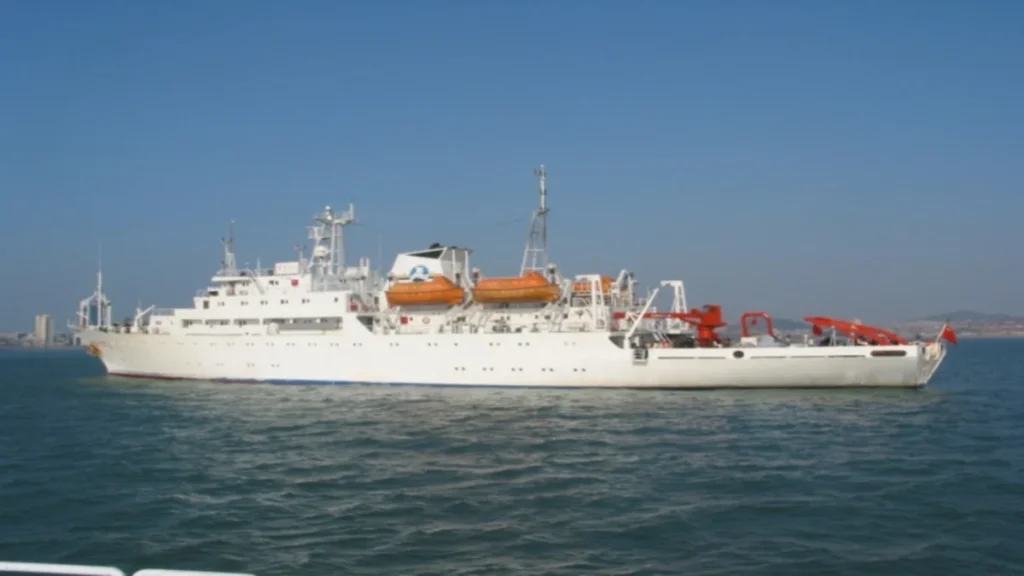
The distinguished Chinese marine research vessel, the Dong Fang Hong 2, a colossal over 300 feet in length, has recently undergone a comprehensive and significant upgrade, heralding a new and advanced era for cooperative oceanographic research. This extensive modernization positions the vessel at the forefront of global marine science, enhancing its capabilities for deep-sea exploration, environmental monitoring, and international scientific collaboration. The announcement marks a pivotal moment for China’s commitment to advancing ocean science and its role in addressing pressing global maritime challenges.
A Legacy of Exploration: The Dong Fang Hong 2’s Enduring Contribution
Commissioned in 1996 by the prestigious Ocean University of China (OUC), the Dong Fang Hong 2 has long been recognized as one of China’s most vital comprehensive oceanographic research vessels. For 27 years, this workhorse of the seas has tirelessly plied the world’s oceans, accumulating an impressive record of service. Measuring 314.96 feet (approximately 96 meters) in length and 49.21 feet (approximately 15 meters) in width, with a displacement of 3,000 tons, the vessel has traversed over 600,000 nautical miles—a distance equivalent to circling the Earth nearly 28 times. Its expeditions have spanned across multiple critical disciplines, including hydrology, meteorology, physical oceanography, chemical oceanography, marine geology, geophysics, and crucial student fieldwork, contributing immensely to the understanding of marine ecosystems and Earth’s climate systems.
The vessel’s operational history is a testament to its robust design and the dedication of its crews. It has been instrumental in numerous groundbreaking studies, from mapping intricate seafloor topography to monitoring changes in ocean currents and temperatures, and analyzing the distribution of marine life. Its voyages have provided invaluable data for understanding phenomena such as El Niño, climate variability, and the impacts of human activities on marine environments. The upgrade, therefore, is not merely a technical refurbishment but a strategic investment in the continuity and expansion of a legacy that has profoundly shaped China’s marine scientific endeavors and its engagement with the international scientific community.
The Genesis of Modernization: Adapting to New Scientific Frontiers
The decision to undertake such a significant upgrade reflects the evolving demands of modern marine science. As oceanographic research delves deeper into complex phenomena, requiring more sophisticated instrumentation and greater operational flexibility, older vessels, even well-maintained ones, need technological refreshes. The Dong Fang Hong 2, despite its distinguished service, faced the challenge of integrating cutting-edge technologies that did not exist at the time of its initial construction. The planning for this ambitious modernization likely began years ago, driven by the Ocean University of China’s strategic vision to maintain its leadership in marine research and to equip its scientists with the best possible tools.
The comprehensive refit, culminating around 2025, addressed key areas of the vessel’s operational and scientific infrastructure. This proactive approach ensures that the Dong Fang Hong 2 remains a relevant and highly capable platform for the next decades, capable of tackling emerging scientific questions and supporting international research initiatives. The scale of the investment underscores China’s national strategic emphasis on marine science, recognizing the oceans as vital for economic development, environmental sustainability, and national security.
Transformative Upgrades: Enhancing Precision, Reach, and Efficiency
The recent renovations have profoundly enhanced the Dong Fang Hong 2’s capabilities across several critical domains. According to CGTN, the improvements span the vessel’s control and power systems, scientific research functions, workspace layout, and overall navigation performance. However, the most notable adjustments and technological advancements have been concentrated in three key areas: the bridge, the laboratories, and the deep-sea operational equipment.
The Command Center: A Revolution on the Bridge
The vessel’s bridge, the operational nerve center, has undergone a radical transformation. Tong Yao, project manager of the Dong Fang Hong 2, highlighted the significance of these changes to CGTN. "The bridge now is very open, providing the crew a better view for navigation and scientific experiments," Yao stated. This improved visibility enhances safety and situational awareness, critical for complex operations in challenging marine environments.
Crucially, a state-of-the-art dynamic positioning (DP) system has been integrated. This advanced technology allows the Dong Fang Hong 2 to maintain a precise, stationary position at sea for extended periods, even in adverse weather conditions. "The key point is that we added a dynamic positioning system to this ship, allowing it to remain stationary at sea for extended periods, facilitating our scientific research experiments," Yao explained. This capability is indispensable for deploying and recovering sensitive instruments, conducting deep-sea coring, or performing time-series observations at specific locations, where even slight drift can compromise data quality. Furthermore, the vessel now features trajectory planning capabilities, enabling fully automated operation from point A to point B. This "reduces the operational burden on the crew at sea," improving efficiency and allowing the crew to focus more on scientific tasks rather than manual navigation. The integration of automated navigation systems not only enhances precision but also contributes to fuel efficiency and optimizes mission profiles.
Laboratories Reimagined: Space for Cutting-Edge Science
The ship’s laboratory facilities have also experienced profound changes, addressing both their physical placement and internal configuration. A significant relocation has moved the main laboratory space closer to the vessel’s stern deck. This strategic positioning "reduce[s] the distance water samples travel once extracted from the sea," as Tong Yao explained. Minimizing travel time for samples is critical for maintaining their integrity, especially for delicate biological specimens or rapidly changing chemical parameters, ensuring the accuracy and reliability of experimental results.
Beyond relocation, the internal layout of the labs has been dramatically expanded and reconfigured. Previously, the ship’s laboratory comprised a series of smaller, separate rooms. The new design consolidates and enlarges these spaces, creating a more adaptable and spacious environment for the latest generation of scientific equipment. "After the optimization, the laboratory can accommodate a wider variety of experimental equipment, and the types of experiments that can be conducted on a single voyage are more diverse. The layout has undergone a significant adjustment," Yao confirmed. This flexibility allows for multidisciplinary research to be conducted simultaneously, maximizing the scientific output of each expedition and fostering greater collaboration among scientists from different fields. The expanded space also facilitates the integration of advanced analytical instruments, such as mass spectrometers, DNA sequencers, and sophisticated imaging systems, essential for modern oceanographic research.
Extending the Reach: Deep-Sea Capabilities Enhanced
Perhaps one of the most impactful upgrades is the installation of a new, large folding crane, specifically designed to meet the rigorous demands of contemporary deep-sea research. This powerful new equipment significantly bolsters the vessel’s capacity for deploying and recovering heavy scientific payloads. "We equipped the vessel with a large crane. Its load-bearing capacity has been improved to accommodate the needs of larger scientific research equipment during expeditions," Yao elaborated. Modern deep-sea submersibles, remotely operated vehicles (ROVs), and autonomous underwater vehicles (AUVs) are often substantial, requiring robust lifting capabilities for safe and efficient deployment.
Furthermore, the crane’s innovative folding design offers significant operational advantages. "Secondly, its boom has been replaced with a folding type, which can effectively lower the ship’s center of gravity and improve stability during navigation," Yao added. Enhanced stability is crucial for both crew safety and the precise operation of sensitive equipment, particularly in rough seas. Most dramatically, this upgrade has extended the Dong Fang Hong 2’s operating water depth from 6,000 meters to an astonishing 10,000 meters. This profound increase in depth capability means the vessel can now access and explore virtually all of the world’s ocean basins, including the vast abyssal plains and deep-ocean trenches, which comprise some of the planet’s least-explored environments. "Our operating water depth has increased from 6,000 meters to 10,000 meters, and the equipment can support our operations in all sea areas more effectively," Yao concluded. This capability opens up new frontiers for geological studies of plate tectonics, biological discoveries in chemosynthetic ecosystems, and understanding the role of the deep ocean in global carbon cycles.
Implications for Global Oceanographic Research
The modernization of the Dong Fang Hong 2 carries profound implications for both China’s scientific standing and global oceanographic research.
Advancing China’s Marine Science Ambitions:
This upgrade reinforces China’s strategic commitment to becoming a global leader in marine science and technology. By equipping its flagship research vessel with cutting-edge capabilities, China is better positioned to address its national interests related to maritime resource management, coastal protection, and understanding its vast exclusive economic zone. The enhanced research capacity will facilitate more accurate predictions of marine weather and climate, improve fisheries management, and aid in the discovery of new marine natural resources. It also supports the training of a new generation of marine scientists and engineers, ensuring a sustained pipeline of talent for future endeavors.
Deep-Sea Exploration and Discovery:
The ability to operate at depths of 10,000 meters places the Dong Fang Hong 2 among a select few research vessels globally capable of exploring the Hadal Zone – the deepest parts of the ocean. This opens up unprecedented opportunities for discovering new species, understanding unique deep-sea ecosystems such as hydrothermal vents and cold seeps, and studying the geological processes that shape the Earth’s crust. Research in these extreme environments can yield insights into the origins of life, the resilience of ecosystems, and potentially new biotechnological resources.
Addressing Global Challenges:
The oceans play a critical role in regulating Earth’s climate, and they are profoundly impacted by climate change, pollution, and overexploitation. The enhanced Dong Fang Hong 2 will be a powerful tool for monitoring ocean health, tracking the impacts of climate change (e.g., ocean acidification, sea-level rise), and assessing marine biodiversity. Its multidisciplinary capabilities mean it can contribute holistically to understanding complex environmental issues, from plastic pollution in the deep sea to the dynamics of ocean carbon sinks. The data collected will be invaluable for informing international policy and conservation efforts.
A Symbol of International Scientific Cooperation
Beyond its technical advancements, the Dong Fang Hong 2 continues to embody the spirit of international scientific collaboration. The Ocean University of China (OUC) has a long-standing history of joint research ventures with institutions from around the world, underscoring the universal nature of ocean science. The OUC’s website proudly details these partnerships, which have seen the Dong Fang Hong 2 and its scientific teams working alongside colleagues from the U.S., Canada, France, Japan, and South Korea in vital regions such as the Yellow Sea, Bohai Sea, and East China Sea.
Examples of these cooperative programs highlight the diverse range of shared scientific interests:
- "Joint Investigation for Sino-Japan Subtropical Circulation": This program focuses on understanding the complex ocean currents that influence regional climate and marine ecosystems.
- "Sino-German Research for Sustainable Development of Ecological System Dynamics and Biological Resources at Bohai Sea": A crucial effort to study and protect the delicate ecosystems and valuable marine resources of the Bohai Sea.
- "Sino-British Joint Testing of Apparatus": Demonstrates collaboration in developing and validating new scientific instrumentation, a cornerstone of technological advancement in research.
- "Sino-American Cooperative Survey for Change of Some Routes at the Offshore in Shanghai": Addressing practical concerns related to maritime navigation and environmental changes in busy coastal areas.
- "Investigation of Environmental Geology in Northwest Pacific Ocean": A broader initiative to understand the geological processes and environmental conditions of a vast and strategically important ocean region.
The enhanced capabilities of the Dong Fang Hong 2 are expected to invigorate and expand these existing partnerships, as well as foster new ones. The advanced laboratories, dynamic positioning, and deep-sea access make the vessel an even more attractive platform for international scientists seeking to conduct cutting-edge research. In an era where global challenges like climate change and marine pollution transcend national borders, collaborative scientific efforts are more critical than ever. The Dong Fang Hong 2, with its renewed vigor, stands ready to serve as a vital instrument for shared discovery and collective action, reinforcing the principle that the pursuit of knowledge about our oceans is a common endeavor for all humanity. This investment by China not only strengthens its own scientific infrastructure but also contributes significantly to the global capacity for understanding and safeguarding the marine environment.






