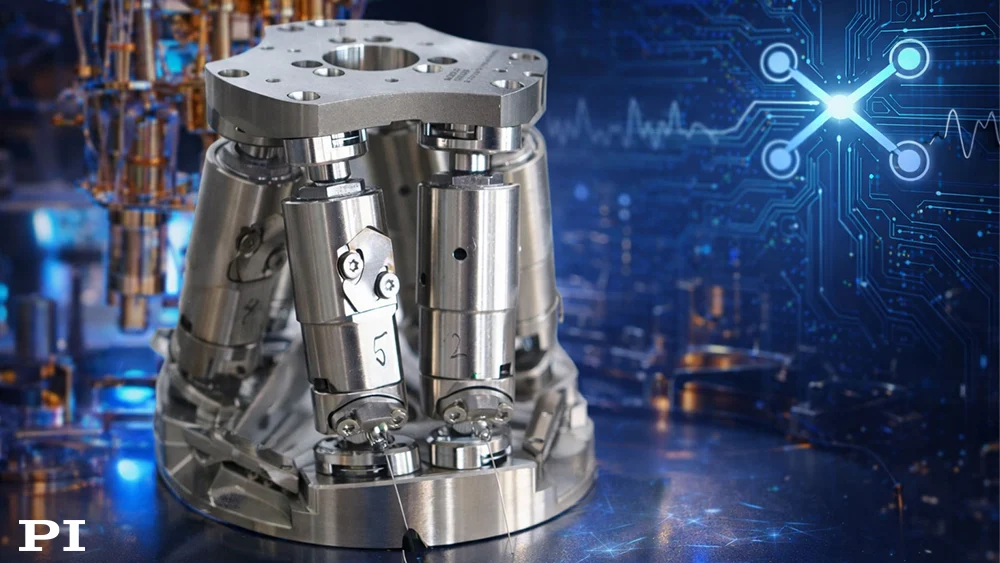
PI (Physik Instrumente), a global leader in high-precision motion and positioning solutions, has officially launched a dedicated low-temperature development program. This ambitious initiative is specifically focused on the creation of advanced multi-axis nanopositioning systems engineered for the demanding requirements of quantum applications, marking a significant step forward in enabling the next generation of quantum research and industrial innovation.
The strategic move by PI addresses a critical bottleneck in the rapidly expanding field of quantum technology: the need for ultra-precise, stable, and highly reliable motion control within extreme cryogenic environments. Quantum phenomena, the bedrock of technologies such as quantum computing, quantum communication, and quantum sensing, often necessitate temperatures close to absolute zero (typically below 4 Kelvin, and often in the millikelvin range) to maintain the delicate coherence of quantum states and minimize thermal noise. However, achieving precise mechanical manipulation in such frigid conditions has historically presented formidable engineering challenges.
The Evolving Landscape of Cryogenic Motion Control
For many years, researchers and engineers working with cryogenic systems relied on relatively rudimentary motion solutions. A common approach involved stacking multiple single-axis (XYZ) stages to achieve multi-dimensional positioning. While functional for simpler tasks, this method carried inherent limitations. Each stacked stage introduced potential for error accumulation, leading to reduced overall precision and repeatability. Furthermore, the combined footprint of stacked systems was often substantial, posing a significant challenge within the confined spaces of cryostats and dilution refrigerators – the specialized vacuum vessels used to achieve and maintain ultra-low temperatures.
As quantum applications have matured, their demands have grown exponentially in complexity. Modern experiments frequently require not just basic X, Y, Z translation, but also precise rotational alignment across multiple axes – necessitating 5- or even 6-degree-of-freedom (6DOF) alignment systems. These advanced setups must also support increasingly larger payloads, such as complex optical configurations, integrated photonic circuits, or arrays of quantum devices, while maintaining nanometer-scale precision over millimeter-scale travel ranges. The limitations of traditional stacked systems became increasingly apparent, prompting a clear need for a new generation of motion solutions specifically designed for these rigorous conditions.
PI’s Innovative Approach: Compact 6DOF Parallel Kinematics
PI’s newly launched development program tackles these challenges head-on by leveraging its expertise in parallel kinematics, specifically focusing on compact Hexapod-type designs. A Hexapod, often referred to as a Stewart platform, is a robotic mechanism that employs six independent actuators connected in parallel to a single movable platform. This parallel architecture offers distinct advantages over traditional serial (stacked) systems, particularly in environments where space, precision, and stability are paramount.

The core principle behind PI’s new cryogenic Hexapod systems is their ability to provide simultaneous control of all six degrees of freedom (X, Y, Z, pitch, roll, yaw) from a single, integrated platform. This eliminates the error accumulation inherent in stacked designs, leading to superior accuracy, repeatability, and dynamic performance. The compact nature of these parallel kinematic designs is particularly crucial for integration within the severely limited internal volumes of cryostats and dilution refrigerators, where every cubic millimeter is valuable.
Technical Superiority for Quantum Applications
Several key characteristics underpin the technical superiority of PI’s approach for cryogenic quantum applications:
- High Stiffness and Stability: The parallel arrangement of actuators distributes forces more evenly, resulting in an inherently stiffer and more stable structure compared to stacked stages. This is vital for maintaining picometer-level stability over extended periods in highly sensitive quantum experiments.
- Low Inertia: With fewer moving parts and a more optimized mass distribution, Hexapods generally exhibit lower inertia, allowing for faster response times and more precise dynamic control, which can be critical for real-time adjustments in complex experimental protocols.
- Programmable Pivot Point: A unique advantage of Hexapods is the ability to software-define the center of rotation (pivot point) for rotational alignments. This feature provides immense flexibility, allowing users to precisely align optics or devices about any arbitrary point in space, simplifying complex setup procedures and improving experimental efficiency.
- Open Aperture: Many quantum experiments involve intricate optical pathways. PI’s Hexapod designs are engineered to offer an open aperture through the center of the platform, facilitating unobstructed optical access for beam steering, fiber coupling, and detector placement.
- Piezo-based Architecture: The choice of piezo-based actuation is fundamental to the success of these cryogenic systems. Piezoelectric actuators operate on the principle of converting electrical energy directly into mechanical displacement through the inverse piezoelectric effect. This mechanism is ideal for low-temperature environments because:
- Minimal Heat Generation: Unlike traditional motors with coils and friction, piezo actuators generate very little heat, which is critical in cryostats where even minute heat loads can significantly impact temperature stability and coherence times for qubits.
- Self-Locking Operation: Piezo-based systems can often maintain their position even when power is switched off (due to the inherent stiffness of the ceramic material), offering a significant advantage in thermally sensitive environments where power cycling needs to be minimized or for long-term stable positioning without continuous energy input.
- No Lubricants: Traditional motion systems often rely on lubricants, which are incompatible with cryogenic temperatures and ultra-high vacuum (UHV) conditions. Piezo systems operate without such lubricants, ensuring clean and reliable performance.
- Non-Magnetic Materials and UHV Compatibility: The proximity to sensitive quantum devices, such as superconducting qubits or spin-based quantum bits, necessitates the use of entirely non-magnetic materials in the construction of the nanopositioning systems. Magnetic fields, even weak ones, can disrupt quantum states. Furthermore, the systems are designed for Ultra-High Vacuum (UHV) compatibility, preventing contamination of the pristine cryogenic environment.
These combined features allow the systems to operate reliably at temperatures below 4K, supporting payloads of several hundred grams, and achieving millimeter-scale travel ranges with exceptional stability and repeatability crucial for optical tasks such as precise beam steering, lens aberration correction, polarization control, optical fiber alignment, and the accurate positioning of dispersive elements like gratings and prisms.
Background and Context: The Quantum Technology Revolution
The development program by PI arrives at a pivotal moment in the history of science and technology – the dawn of the quantum era. Quantum technologies, which harness the unique properties of quantum mechanics (superposition, entanglement, and quantum tunneling), promise to revolutionize fields ranging from computing and medicine to materials science and secure communication.
- Quantum Computing: Aims to solve complex problems intractable for even the most powerful classical supercomputers. Requires precise manipulation of qubits, often superconducting circuits or trapped ions, which operate at temperatures as low as a few millikelvin, necessitating sophisticated cryogenic infrastructure.
- Quantum Communication: Focuses on secure information transfer using entangled photons. This demands extremely precise alignment of optical fibers, beam splitters, and detectors, often over long distances and in varying environmental conditions.
- Quantum Sensing and Metrology: Utilizes quantum effects to achieve unprecedented levels of sensitivity and accuracy in measurements (e.g., atomic clocks, gravimeters, magnetometers). These devices often rely on precise laser cooling and trapping of atoms, requiring highly stable and accurate optical positioning.
The global quantum technology market is projected to grow significantly in the coming years, with estimates varying but consistently pointing towards multi-billion-dollar valuations by the end of the decade. This growth is fueled by substantial public and private investment worldwide, recognizing quantum technology as a strategic imperative for national security and economic competitiveness. Governments across North America, Europe, and Asia have launched multi-year initiatives, investing billions into research and development, establishing quantum centers, and fostering commercialization. This increased investment translates directly into a greater demand for enabling technologies like PI’s advanced nanopositioning systems.
Broader Impact and Market Implications

The implications of PI’s cryogenic nanopositioning development program extend far beyond individual laboratories. Its success promises to accelerate progress across several high-tech industries:
- Quantum Technology Industry: This is the most direct beneficiary. By providing reliable, high-precision motion control at cryogenic temperatures, PI enables researchers and engineers to build more complex, stable, and scalable quantum systems. This could expedite the development of fault-tolerant quantum computers, robust quantum sensors, and secure quantum communication networks.
- Photonics Industry: Many quantum applications are photonics-based, relying on the manipulation of light at the quantum level. The precise alignment capabilities of PI’s new systems will be invaluable for developing advanced integrated photonic circuits, optical interconnects, and complex quantum optical experiments. This could lead to breakthroughs in areas like silicon photonics and quantum dot technologies.
- Semiconductor Industry: While often associated with room-temperature classical computing, the semiconductor industry is increasingly involved in the fabrication and testing of quantum devices. Precision metrology, lithography, and packaging of quantum chips require ultra-high precision motion control, even at cryogenic test stages. PI’s technology could therefore play a crucial role in the industrialization of quantum hardware.
- Academic Research: University and national laboratory research programs will gain a powerful tool for experimental exploration. The ability to precisely position and manipulate components within a cryostat without sacrificing experimental integrity or introducing unwanted heat will open new avenues for discovery in condensed matter physics, quantum optics, and materials science.
Statements and Industry Reactions
While specific statements from PI representatives regarding the direct launch of this program are typically released through official channels, the company’s strategic direction and commitment to supporting cutting-edge research are well-established. A spokesperson for PI, aligning with previous corporate communications, would likely emphasize the company’s long-standing dedication to pushing the boundaries of precision motion control. They might state that "This new cryogenic nanopositioning program is a testament to PI’s commitment to empowering the quantum revolution. We recognize the unique and stringent demands of this field and are leveraging our decades of expertise in parallel kinematics and piezoelectric actuation to provide the critical enabling technology needed for breakthroughs in quantum computing, communication, and sensing."
Industry analysts and researchers in the quantum community are expected to view such a development with significant interest. The availability of off-the-shelf or customizable solutions for such complex cryogenic motion control challenges is a major boon. "Reliable, high-precision cryogenic motion control has been a persistent engineering hurdle in scaling up quantum experiments," noted Dr. Evelyn Reed, a theoretical physicist specializing in quantum hardware design. "A dedicated program like this from a reputable company like PI means that researchers can spend less time engineering basic infrastructure and more time on fundamental scientific discovery and technological advancement. It represents a crucial step towards making quantum technologies more accessible and robust."
A Forward-Looking Trajectory
This development program is not an isolated effort but an expansion of PI’s existing commitment to motion technology for quantum research and cryogenic photonic systems. The company has a history of collaborating with leading research institutions and industry partners to develop bespoke solutions for the most challenging applications. By formally structuring this development into a dedicated program, PI signals a concentrated effort to standardize and optimize these advanced cryogenic solutions, making them more widely available and easier to integrate for a broader range of users.
The move solidifies PI’s position at the forefront of precision motion control for emerging technologies. As the quantum technology landscape continues to evolve, the demand for highly specialized, robust, and reliable components will only intensify. PI’s proactive investment in this area positions it as a key enabler, providing the foundational tools that will help transform theoretical quantum physics into tangible, world-changing applications. This initiative underscores the critical interplay between advanced mechanical engineering and fundamental scientific discovery, illustrating how precision instrumentation is indispensable for unlocking the full potential of the quantum age.






