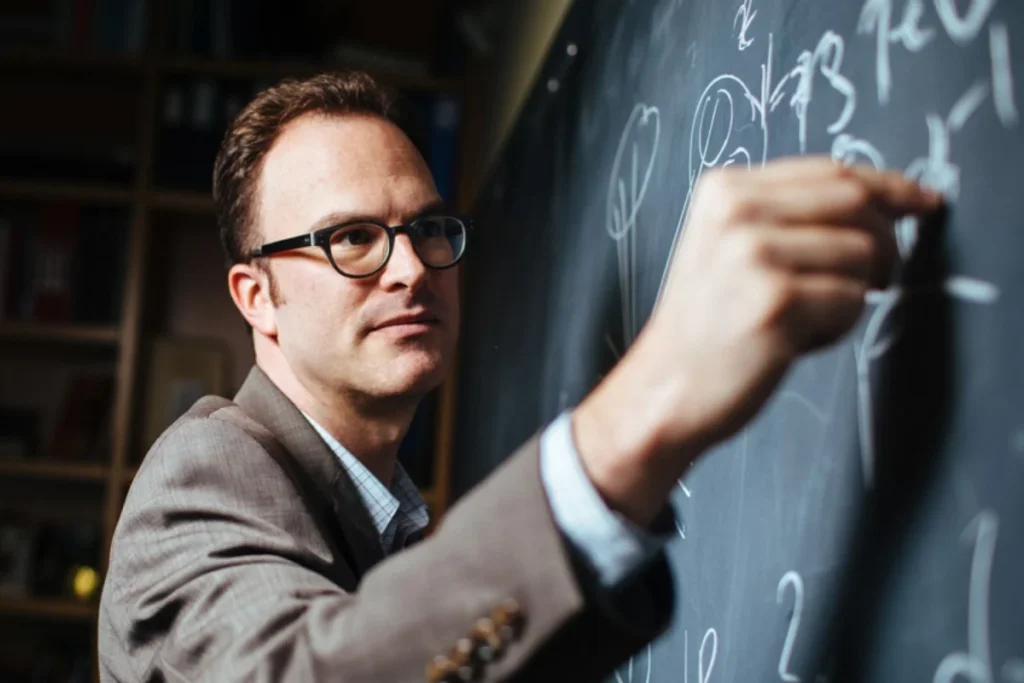
In a move that signals a strategic shift toward the integration of computational intelligence and fundamental physical research, Professor Jesse Thaler has been named the new director of the Massachusetts Institute of Technology (MIT) Laboratory for Nuclear Science (LNS). Effective August 1, Thaler succeeds Professor Bolek Wyslouch, who led the laboratory through a decade of significant growth and experimental milestones. Thaler, a prominent theoretical particle physicist, brings a specialized focus on the intersection of quantum field theory and machine learning, a combination increasingly viewed as the future of high-energy physics.
The Laboratory for Nuclear Science, established in 1946, has long served as a cornerstone of MIT’s research infrastructure, originally founded to support the burgeoning fields of nuclear and particle physics in the post-World War II era. Under Thaler’s leadership, the laboratory is expected to further expand its reach into cosmology, gravity, field theory, and quantum information science, leveraging the latest advancements in artificial intelligence (AI) to interpret the massive datasets generated by modern particle accelerators.
A Vision for AI-Integrated Fundamental Physics
Jesse Thaler’s appointment comes at a critical juncture for the physical sciences. As experimental facilities like the Large Hadron Collider (LHC) at CERN produce increasingly complex data, the traditional methods of manual analysis and classical statistical modeling are being supplemented—and in some cases replaced—by sophisticated machine learning algorithms.
Dean of the MIT School of Science, Nergis Mavalvala, highlighted Thaler’s role as a pioneer in this transition. "In his research, Jesse has done pioneering work on particle jets at the Large Hadron Collider and is a leader in combining AI and machine learning with fundamental particle physics," stated Mavalvala, who also holds the Curtis and Kathleen Marble Professor of Astrophysics chair. She emphasized that Thaler’s collaborative approach is uniquely suited for an era where scientific discovery is increasingly driven by interdisciplinary AI applications.
Thaler currently serves as the William and Emma Rogers Professor of Physics within the MIT Center for Theoretical Physics (CTP), which is part of the Leinweber Institute (CTP-LI). His work focuses on "unlocking" the secrets of the universe by developing algorithms that can identify patterns in subatomic debris—specifically particle jets—that would be nearly impossible for human researchers to discern alone.
Chronology of Academic and Professional Excellence
Professor Thaler’s trajectory to the directorship of LNS is marked by a series of academic achievements and leadership roles at the highest levels of the scientific community.
- 2002: Graduated from Brown University with a Bachelor of Science in Mathematics and Physics.
- 2006: Earned his PhD in Physics from Harvard University, focusing on theoretical frameworks that go beyond the Standard Model of particle physics.
- 2006–2009: Served as a fellow at the Miller Institute for Basic Research in Science at the University of California, Berkeley, where he refined his expertise in particle phenomenology.
- 2010: Joined the MIT faculty, quickly becoming a central figure in the Center for Theoretical Physics.
- 2020: Appointed as the inaugural director of the National Science Foundation (NSF) AI Institute for Artificial Intelligence and Fundamental Interactions (IAIFI).
- 2024: Named Director of the MIT Laboratory for Nuclear Science, following the successful five-year renewal of the IAIFI program.
During his time at MIT, Thaler has not only contributed to theoretical physics but has also been instrumental in building the institutional framework for modern data-driven science. His leadership at IAIFI has been particularly noteworthy, as the institute serves as a bridge between the physics community and AI researchers, fostering a "virtuous cycle" where physics informs AI design and AI accelerates physical discovery.
The Evolution of the Laboratory for Nuclear Science
The Laboratory for Nuclear Science has evolved significantly since its inception nearly 80 years ago. While its name reflects its origins in nuclear research, the LNS now acts as an umbrella organization for a vast array of sub-disciplines. These include the study of the fundamental constituents of matter, the forces that govern them, and the history of the early universe.
Under the outgoing director, Bolek Wyslouch, the LNS maintained a strong presence in international collaborations, most notably at the LHC’s Compact Muon Solenoid (CMS) experiment. Wyslouch’s tenure was characterized by a steady hand during the discovery of the Higgs boson and the subsequent exploration of its properties.
As Thaler takes the helm, the laboratory’s scope is broader than ever. Current research areas under the LNS purview include:
- High-Energy Particle Physics: Investigating the smallest building blocks of matter.
- Hadronic Physics: Studying the structure of protons and neutrons.
- Theoretical Physics: Developing new models to explain gravity, dark matter, and quantum field theory.
- Cosmology and Astrophysics: Exploring the origins and evolution of the universe.
- Quantum Information Science: Utilizing quantum mechanical properties to process information in ways classical systems cannot.
Strategic Initiatives: IAIFI and the Genesis Mission
One of the primary catalysts for Thaler’s appointment is his proven ability to manage large-scale, multi-institutional research initiatives. His work with the NSF-funded IAIFI has been a template for how physics departments can integrate data science. The institute was recently renewed for another five years, ensuring that the momentum in AI-driven physics continues. Mike Williams, a professor of physics at MIT, will succeed Thaler as the director of IAIFI, allowing Thaler to focus on the broader administrative and strategic goals of the LNS.
In addition to IAIFI, the LNS is set to play a pivotal role in the Department of Energy’s (DOE) Genesis Mission. This mission is specifically designed to harness AI for scientific discovery, focusing on automating experimental workflows and enhancing the precision of theoretical calculations. Thaler’s expertise is expected to be a major asset as the LNS seeks to secure and execute projects under this new DOE framework.
"In my own field of particle physics, researchers are developing cutting-edge AI algorithms to handle the data deluge from collider experiments and to perform heroic theoretical calculations," Thaler remarked. He noted that these algorithms often have utility far beyond physics, impacting fields such as medical imaging, finance, and climate modeling.
Philanthropy and Institutional Growth
Thaler’s role as Director will also involve overseeing the Center for Theoretical Physics – Leinweber Institute (CTP-LI). The center recently received a landmark donation from the Leinweber Foundation, aimed at establishing a global network of theoretical physics research institutes.
According to the Science Philanthropy Alliance, this gift represents the largest philanthropic commitment ever made to the field of theoretical physics. Such funding is crucial for supporting "blue-sky" research—work that may not have immediate commercial applications but is fundamental to our understanding of the universe. This financial backing provides Thaler with the resources to recruit top-tier talent and support high-risk, high-reward research projects that might struggle to find funding through traditional government grants.
Cultivating the Next Generation of Scientists
Beyond research and administration, Thaler has demonstrated a deep commitment to education and mentorship. At IAIFI, he was a key architect of a new doctoral program in physics, statistics, and data science, created in collaboration with the MIT Institute for Data, Systems, and Society (IDSS). This program addresses a growing demand for scientists who are equally proficient in high-level physics and advanced computational techniques.
Thaler also championed the creation of dedicated postdoctoral fellowships that allow early-career researchers to pursue interdisciplinary work without being confined to a single traditional silo. "Giving young scientists space to build connections across domains, universities, and career stages has been transformative within IAIFI," Thaler said. He intends to implement similar frameworks within the LNS to ensure that the laboratory remains a destination for the world’s most innovative young minds.
Broader Impact and Scientific Implications
The appointment of a director with Thaler’s profile suggests a recognition that the future of physics is inextricably linked to the future of computation. The "data deluge" mentioned by Thaler is not hyperbole; the next generation of experiments, such as the High-Luminosity LHC, will produce data at rates that exceed current processing capabilities.
AI-driven discovery offers a path forward. By training neural networks to recognize the signatures of rare physical processes, researchers can filter through billions of "noise" events to find the one-in-a-billion signal that could indicate new physics, such as evidence of dark matter or extra dimensions.
Furthermore, the theoretical calculations required to predict these signals are becoming increasingly "heroic" in their complexity. Thaler’s work in using machine learning to assist in these calculations—essentially using AI to help solve the equations of quantum field theory—could dramatically accelerate the pace of theoretical breakthroughs.
Conclusion
As Professor Jesse Thaler prepares to lead the MIT Laboratory for Nuclear Science, the institution stands on the threshold of a new era. The transition from Professor Bolek Wyslouch to Thaler represents a passing of the torch from a generation of experimental excellence to a new generation of AI-enabled discovery.
With the support of major federal grants from the NSF and DOE, and historic philanthropic backing from the Leinweber Foundation, the LNS is positioned to remain at the forefront of global physics research. Thaler’s dual expertise in the nuances of subatomic particles and the intricacies of neural networks provides the LNS with the leadership necessary to navigate the complexities of 21st-century science, ensuring that MIT continues to define the boundaries of human knowledge.