In 2022, the global construction sector’s material production was responsible for over 7 percent of total carbon emissions, a stark figure highlighting the urgent need for more sustainable building practices. A promising avenue for reducing this environmental impact lies in a computational design technique known as topology optimization. This method has the potential to drastically reduce the amount of material required for structures, with some applications demonstrating material savings of up to 90 percent. Such reductions could translate into a multi-gigaton decrease in building-related emissions, a significant step toward mitigating climate change.
However, the widespread adoption of topology optimization in large-scale civil engineering projects, such as the design of buildings and bridges, has been hampered by a critical barrier: the constructability of the resulting complex, often organic-looking designs. While researchers have successfully utilized topology optimization for applications like 3D printing, where intricate geometries are more feasible, engineers responsible for constructing tangible structures are primarily concerned with designs that can be realized efficiently and within budget. The intricate nature of traditionally optimized structures often presents significant challenges in terms of on-site fabrication, assembly, and adherence to conventional construction timelines and costs.
Addressing this disconnect between theoretical material efficiency and practical construction feasibility, a team of researchers at the Massachusetts Institute of Technology (MIT) has developed a novel framework designed to bridge this gap. Their innovative approach, detailed in a new paper published in the journal Automation in Construction, empowers users to integrate specific constraints into algorithmically generated designs. This allows for the creation of topology-optimized structures that are not only material-efficient but also readily buildable using conventional methods.
Bridging the Gap: Enhancing Constructability
The core of the MIT researchers’ breakthrough lies in their ability to impose limitations on the complexity of the designs generated by topology optimization algorithms. This is achieved by allowing users to define parameters such as the maximum number of components that can converge at any given point within a structure, and the minimum allowable size for individual parts. These constraints directly address the practical challenges faced by construction professionals. For instance, limiting the number of connections at a joint simplifies assembly and reduces potential points of failure, while setting a minimum part size ensures that components are robust enough for handling and installation.
"There’s an interplay between the materials you’re using, the constructability of designs, and the optimization of the structure," explained Josephine Carstensen, the Gilbert W. Winslow (1937) Career Development Professor in Civil Engineering at MIT and senior author of the study. "You need to be able to address all three at the same time. That’s what we tried to do here."
The framework builds upon prior research by incorporating the ability to design structures utilizing multiple materials. Crucially, it accounts for the distinct properties of each material, enabling the algorithm to intelligently distribute loads and specify appropriate connections between different components. This multi-material approach is vital for maximizing both structural integrity and sustainability, as different materials can be employed where their specific strengths are most beneficial.
The researchers demonstrated the efficacy of their framework by designing various truss structures, common in buildings and bridges, using steel, wood, and combinations of both. Their analysis revealed that the carbon emissions associated with material selection and design significantly varied depending on the applied constructability constraints. This underscores the tangible impact of their approach on reducing the environmental footprint of construction.
"In the literature, there’s sometimes been a disconnect between the carbon savings you can achieve on a computer and the realistic carbon savings you can achieve for built structures—especially when it comes to design technologies like topology optimization," Carstensen noted. "The problem lies in the lack of constructability of designs. These designs have been perceived as too difficult to make with conventional methods, so they are never even attempted. That’s what is exciting about our approach: we can add constraints so that you will never be in a situation where the design that comes out is too hard to make."
The paper’s first author, Zane Schemmer, a PhD student in civil and environmental engineering at MIT, highlighted the driving question behind their research: "A big question Josephine and I were asking is why isn’t industry using it? What are the obstacles that prevent industry from designing things more efficiently, and how can we fill the gaps between research and real life?"
A Decade of Progress in Design Optimization
Computer-based topology optimization has been a subject of academic research for several decades. Its fundamental principle involves using algorithms to determine the optimal distribution of material within a defined space to achieve specific performance goals, such as maximizing strength while minimizing weight. The resulting designs often exhibit an organic, lattice-like structure that, while highly efficient in theory, poses considerable fabrication challenges for conventional construction methods.
In recent years, a growing body of research has focused on making topology optimization more accessible and practical for industry application. Schemmer and Carstensen sought to synthesize these advancements and introduce new capabilities, particularly in the realm of multi-material design, which has historically been a significant hurdle.
"A big aspect of sustainability going forward will be not only using less material, but also implementing materials efficiently based on considerations like where you are in the world, your access to materials, and each of their associated carbon costs," Schemmer explained.
To achieve this, their framework employs a class of mathematical tools known as mixed-integer algorithms. These algorithms are adept at making binary decisions, which are essential for determining material choices and connection types. For example, a component cannot be partially timber and partially steel; instead, the algorithm designates it as one or the other, and then ensures that all connections meet stringent strength standards based on that material selection.
The system’s intelligence extends to understanding material properties. It recognizes that while steel is excellent for compressive loads (struts), it is less suitable for tensile loads (cables), where materials like steel cables or even certain composites might be more appropriate. Furthermore, the model incorporates more realistic representations of how parts connect in construction, a significant improvement over methods that might assume seamless integration, as is common in additive manufacturing.
"In 3D printing, the way things come together is easy," Carstensen stated. "In construction, that’s not the case. If you’re building with timber there’s a certain rule set, versus steel has a different rule set."
The user’s ability to control design complexity is further enhanced by specifying parameters like the maximum number of connections at each joint and the minimum angle between connected components. The inclusion of minimum part size limits further bolsters the practical constructability of the designs.
"It’s tough to give a contractor these complex, intricate designs because it’s going to be super difficult to build," Schemmer elaborated. "A lot of times contractors won’t pick up a project like that to begin with."
Real-World Implications and Case Studies
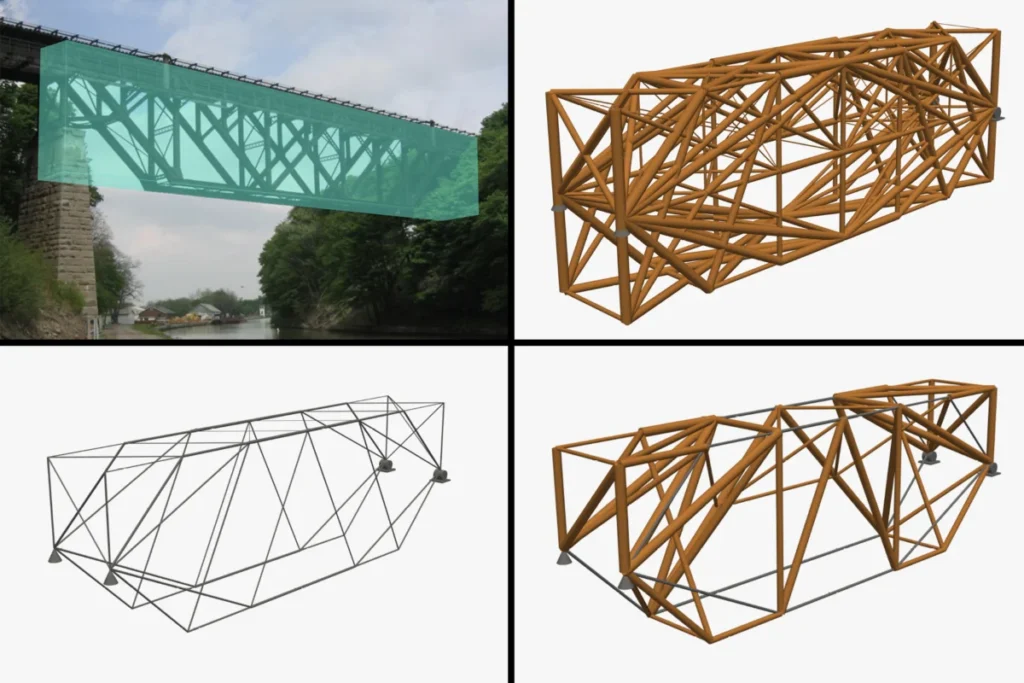
To validate their approach, the researchers compared structures designed using their constrained topology optimization method with those generated by conventional, unconstrained topology optimization. The differences in the resulting designs were dramatic, fundamentally altering how the structures would be built.
As a practical illustration, they applied individual constraints to the truss design of the Lockport "Upside-Down Bridge" near Buffalo, New York. By systematically applying constraints such as a minimum angle on part connections or minimum part sizes, they were able to meticulously analyze the impact of each constraint on the final design. This analysis provided valuable insights into how specific design parameters influence both efficiency and constructability.
Subsequently, they generated truss designs using only wood, only steel, and a combination of wood and steel. This allowed them to explore the trade-offs between environmental impact and constructability for different material choices on a hypothetical bridge project.
"We saw how the system knew that you could design a bridge of pure steel, but that might not be best from a carbon standpoint," Schemmer observed. "Or you could design a bridge out of purely timber, but that might not be the strongest. But these materials can work together, so you use timber for the carbon savings and steel where you need extra strength, and there’s a balance you can find in these structures."
Computational Feasibility and Future Directions
While the researchers acknowledge that their approach is more computationally intensive than some other optimization methods, they emphasize its practical feasibility for most civil engineering firms. They successfully ran their programs on a standard MacBook Pro, suggesting that the computational demands are well within reach for the industry.
"It’s computationally a little tougher to solve, but there’s a lot of tools coming out nowadays that make these problems a lot more feasible," Schemmer stated. "This approach has been avoided by industry in the past, but now we think it’s a practical way to solve problems dealing with variable constraints."
The researchers are confident that with increased computational resources, their framework could be applied to a wider range of materials and significantly larger structures, extending beyond homes, small buildings, and bridges to encompass more complex infrastructure projects.
Looking ahead, Carstensen indicated that the team plans to construct scaled-down physical prototypes of structures designed by their model. This experimental validation will further confirm the accuracy of their predictions and the real-world performance of the optimized designs. Additionally, they aim to incorporate more sophisticated constraints into their model to streamline its integration into the workflows of civil engineers designing the world’s infrastructure.
"As a structural engineer by training, I was never taught how to design for low-carbon," Schemmer reflected. "To tackle a problem as big as climate change, addressing the built environment is a great place to start. One of the most tangible things we can do is work at the layer of construction, at the design stage, because that’s a fundamental step that we can control. There’s a lot of decisions we make early on that lead us to use extra material we don’t need."
This research was supported by the MIT Morningside Academy for Design, underscoring the institution’s commitment to fostering innovative solutions for pressing global challenges. The development of this practical framework for topology optimization represents a significant stride towards making the construction industry a more sustainable and environmentally responsible sector.
Broader Implications for Sustainable Infrastructure
The implications of MIT’s research extend far beyond simply reducing material waste. By enabling the design of more efficient and less carbon-intensive structures, this framework has the potential to reshape how infrastructure is conceived and constructed globally.
As nations grapple with aging infrastructure and the need for new developments, the ability to build more sustainably becomes paramount. The current reliance on traditional construction methods, often characterized by over-engineering to ensure safety margins, can lead to significant material overconsumption. Topology optimization, when made practical, offers a data-driven approach to precisely engineer structures for their intended purpose, eliminating unnecessary material.
Furthermore, the integration of multi-material design capabilities addresses a critical aspect of the circular economy in construction. By intelligently combining materials like timber, known for its carbon sequestration properties, with high-strength materials like steel, engineers can create structures that are both strong and environmentally beneficial. This approach can lead to a reduced demand for virgin materials, a decrease in embodied carbon, and potentially structures that are easier to deconstruct and recycle at the end of their lifecycle.
The researchers’ emphasis on computational feasibility is also a crucial factor for widespread adoption. If the tools are accessible and can be integrated into existing engineering workflows, the transition to more sustainable design practices can accelerate. This democratization of advanced design techniques could empower a wider range of engineers to contribute to a greener built environment.
The challenges of climate change require a multi-faceted approach, and the built environment, with its substantial contribution to global emissions, is a critical area for intervention. MIT’s work on making topology optimization more constructible offers a tangible pathway to reduce the environmental impact of buildings and infrastructure, paving the way for a more sustainable future.