The relentless pursuit of automotive safety hinges on meticulous crash testing, a process where every captured millisecond of data is invaluable. However, the very instruments designed to record this critical information—cameras, optics, and electrical devices mounted within the test vehicle—face extreme conditions. Subjected to immense G forces and violent impacts, these components must not only survive but also continue functioning to transmit the data that informs the next generation of vehicle safety. For Photron, a leading crash test agency based in Japan, ensuring the integrity of this data has been a persistent challenge, often exacerbated by the physical positioning and vulnerability of onboard equipment. Recognizing the potential for data loss due to equipment failure under duress, Photron has partnered with a specialist in advanced manufacturing to develop robust solutions.
This collaboration has led to the creation of innovative 3D-printed components that significantly enhance the reliability of data capture during high-impact crash simulations. The partnership leverages the expertise of Andy Schaefer, the owner and sole engineer of Germany-based Additive Printing Solutions (APS). Schaefer, who founded APS five years ago, brings a unique blend of design acumen, 3D printing proficiency, and a deep understanding of additive manufacturing principles. His company offers comprehensive services ranging from custom design and 3D printing to specialized workshops aimed at educating manufacturers on the strategic integration of additive manufacturing into their operations. APS’s specialized knowledge in polymer-composite 3D printing, particularly using Markforged equipment and its durable Onyx material, has proven instrumental in addressing Photron’s complex crash testing requirements.
Addressing the Challenges of Data Integrity in Crash Testing
Crash testing, a cornerstone of automotive safety development, involves simulating real-world collision scenarios to evaluate vehicle performance and occupant protection. These tests are meticulously orchestrated, often involving instrumenting vehicles with a battery of sensors and high-speed cameras. The data generated from these tests informs engineers about structural deformation, restraint system effectiveness, and the forces experienced by occupants. However, the extreme kinetic energy released during a crash poses a significant threat to the delicate electronic equipment and wiring systems tasked with capturing this vital information.
Historically, the mounting and protection of cameras and sensors within a test vehicle have been ad-hoc, often relying on conventional methods that proved insufficient under severe impact conditions. This led to disruptions in camera focus, disconnections in data transmission lines, and ultimately, gaps in the crucial data stream. For agencies like Photron, whose reputation and client trust are built on the accuracy and completeness of their test results, such data loss is unacceptable. The challenge is not merely about surviving the impact, but about ensuring the continuous and accurate transmission of data throughout the event.
Innovative 3D-Printed Solutions for Enhanced Data Capture
APS’s engagement with Photron has yielded a series of practical and effective solutions, each designed to overcome specific failure points identified in traditional crash test setups. The core of these solutions lies in the strategic application of 3D printing, specifically utilizing Markforged’s advanced polymer-composite printing technology. This approach allows for the creation of highly customized, durable, and precisely engineered parts that can withstand the harsh environment of a crash test.
Robust Camera Casings for Uninterrupted Visuals
One of the primary challenges Photron faced was ensuring that internal cameras, strategically placed in locations such as under seats or behind the steering wheel to capture occupant movement and interior dynamics, maintained their focus and image clarity. The intense vibrations and shockwaves generated during a collision can easily dislodge or misalign these cameras, leading to blurred or lost footage at the most critical moments.
To combat this, APS has developed custom-designed camera casings. These enclosures are engineered to securely house the cameras, providing a stable platform that resists movement and vibration. The casings are designed for easy installation, often utilizing readily available fastening methods like zip ties, which are ubiquitous in crash test assemblies due to their simplicity and effectiveness. By rigidly holding the camera in place, these 3D-printed casings ensure that the camera’s field of view remains consistent and sharp, thereby preserving the integrity of the visual data captured. This seemingly simple solution has a profound impact on the quality of footage obtained, providing clearer insights into vehicle behavior and occupant interaction during a crash.
Adaptable Cabling Adapters for Seamless Data Flow
Another significant hurdle addressed by APS and Schaefer involved the complex network of cables connecting the internal cameras and sensors to the data collection console, typically located in the rear of the vehicle. While the camera housings themselves might be standardized, the length of the connecting cables can vary significantly depending on the specific test setup and the placement of the camera. This variation historically necessitated different adapter configurations or even custom housings to ensure a secure and reliable connection.
Schaefer’s ingenious solution involves the design and production of universal, puck-shaped adapters. These adapters act as intermediaries, ensuring a stable and robust connection between the camera housing and cables of varying lengths. "If they have a 3-meter cable or an 8-meter cable, they need different adapters," Schaefer explains. "They don’t want to have to make another housing for the cameras, so I make them adapters so they can always use the same housing." This modular approach significantly simplifies the setup process and reduces the need for specialized, single-use components. APS produces these adapters in three distinct sizes, catering to the most common cable lengths used by Photron, thereby maximizing compatibility and minimizing potential points of failure. The precise fit and robust construction of these adapters ensure that data transmission remains uninterrupted, even under extreme stress.

Advanced Cable Management Tooling for Data Console Stability
The most complex challenge tackled by APS involved enhancing the stability of cable connections directly at the data collection console. With multiple instruments feeding data into this central unit, maintaining continuous and secure connections is paramount. Photron had observed instances where cables would momentarily disconnect during impact, leading to critical data gaps.
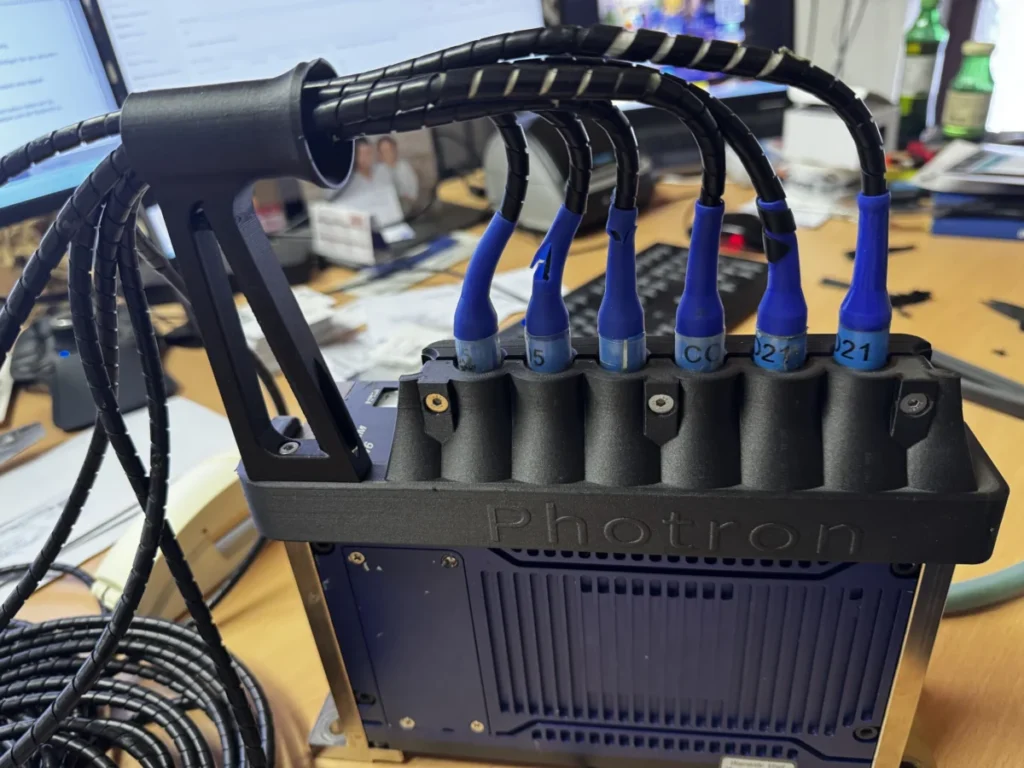
Schaefer’s approach to this problem was multi-faceted, focusing on creating custom tooling that could be integrated with the existing console without requiring any modifications to the original equipment. The initial iteration involved a simple support structure for the plug connections, secured to the console using zip ties. This demonstrated the feasibility of using 3D-printed components for cable management in this sensitive area.
The subsequent and current iteration of this solution represents a significant advancement. It features a sophisticated three-part assembly designed for maximum stability and cable protection. The outer support, designed to face the camera, snaps onto the console and is secured with screws using existing mounting points. This outer component is further enhanced by incorporating Markforged’s fiber-reinforcement capability, utilizing fiberglass layers within the Onyx material to significantly increase its stiffness and resistance to deformation. This is achieved through careful design within Markforged’s Eiger software, allowing for targeted reinforcement in critical areas.
A crucial element of this design is the inner support, which attaches to the outer support via screws, utilizing embedded nuts that are integrated directly into the 3D-printed part during the manufacturing process. This two-part construction fully encapsulates each cable, providing comprehensive support at the point of connection. Furthermore, a third component in the assembly elevates the cables approximately 100 mm away from the console. This strategic elevation reduces stress on the wires at the connection point, a common cause of intermittent failures. This taller support also incorporates three fiberglass-reinforced regions facing the direction of impact, ensuring its structural integrity throughout the entire crash event.
This advanced cable management system not only prevents accidental disconnections but also enhances the overall reliability of the data acquisition process. The use of embedded nuts and fiber reinforcement demonstrates a sophisticated understanding of additive manufacturing’s potential for creating functional, high-performance components.
The Impact of 3D Printing on Crash Test Efficiency and Cost-Effectiveness
The adoption of 3D-printed solutions by Photron, facilitated by APS, has yielded significant benefits beyond just improved data capture. The durability of these components has proven to be a key advantage. Schaefer humorously notes the double-edged sword of his success: "This is the problem," he quips. "On the one hand, I’m very happy about this fact that they don’t break down on the crash test. But on the other side I don’t sell them much, because they are reused so often." This reusability directly translates into substantial cost savings for Photron, as they no longer need to frequently replace damaged or worn-out fixtures.
The ability to rapidly iterate designs and produce custom solutions on demand is another critical advantage of additive manufacturing. This agility allows Photron to adapt to evolving testing requirements and address unforeseen challenges without lengthy lead times or prohibitive tooling costs. For a sector that constantly pushes the boundaries of innovation, this speed and flexibility are invaluable.
The Future of Automotive Safety Testing
The successful implementation of 3D-printed solutions by APS for Photron signals a broader trend in the automotive safety testing industry. As vehicles become more complex, incorporating advanced driver-assistance systems (ADAS) and intricate electronic architectures, the demands on data acquisition systems will only increase. The ability to create custom, high-performance components that can withstand extreme conditions is no longer a luxury but a necessity.
The collaboration between Photron and APS exemplifies how specialized engineering expertise, combined with cutting-edge additive manufacturing technologies, can solve critical industry challenges. This partnership not only enhances the accuracy and reliability of crash test data but also contributes to the overall efficiency and cost-effectiveness of automotive safety development. As the industry continues to prioritize safety, the role of advanced manufacturing techniques like 3D printing in enabling more robust and insightful testing methodologies will undoubtedly grow, paving the way for safer vehicles on our roads. The ongoing evolution of materials and printing processes promises even more sophisticated solutions, further solidifying the indispensable role of additive manufacturing in the future of automotive safety.