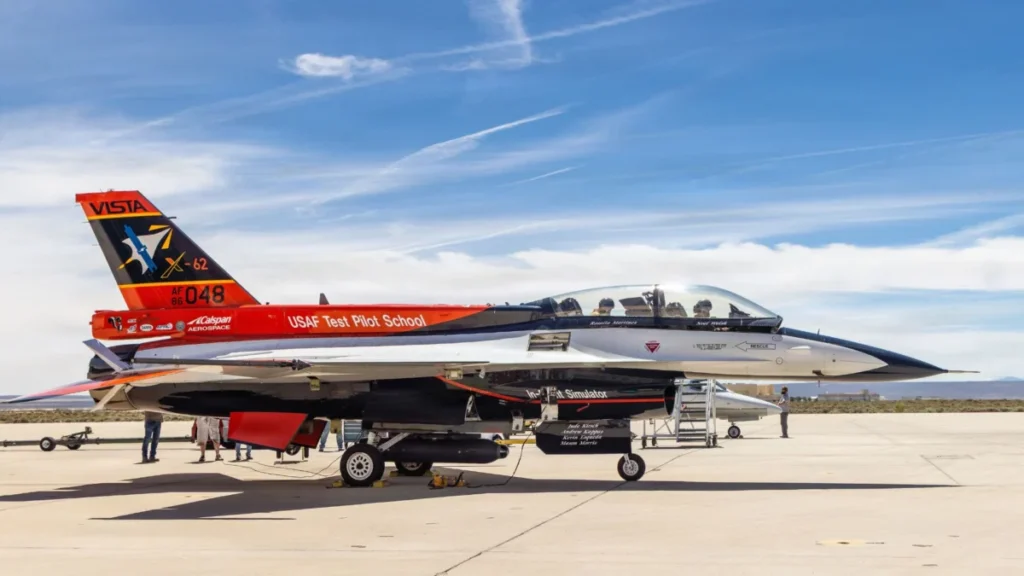
The groundbreaking campaign represents one of the most definitive demonstrations to date of a closed-loop airborne autonomy system operating in a real-world scenario. Diverging from previous experiments that often relied on simulated inputs or pre-generated datasets, this advanced AI processed authentic data streamed directly from an operational sensor aboard the aircraft. This real-time information enabled the AI to make tactical decisions and execute maneuvers during flight, culminating in 27 successful autonomous intercepts across eight sorties. These pivotal tests were conducted using the X-62A Variable In-flight Simulation Test Aircraft, more commonly known as VISTA, a highly modified F-16D Block 30 aircraft serving as a dedicated platform for experimental flight control and autonomy research.
Infrared Guides Advanced Autonomy in Live Flight
At the heart of these recent tests was a sophisticated sensor package known as the Legion Pod. This pod played a critical role by tracking a live T-38 adversary aircraft during the flight maneuvers. Its Infrared Search and Track (IRST) data, a passive, long-range detection system that senses heat signatures, was fed directly into the onboard AI agent. This agent, in turn, assumed control of the X-62A, autonomously guiding it into optimal tactical intercept positions. The T-38, a twin-engine, supersonic jet trainer, served as a realistic target, providing dynamic and unpredictable movement essential for challenging the AI’s capabilities.
This methodology marks a significant departure from many prior AI demonstrations in aviation, which frequently utilized simulated targets or relied on carefully curated, pre-recorded datasets for training and validation. The use of live sensor feeds is crucial because it exposes the autonomous software to the same type of raw, unfiltered, and potentially ambiguous information that human military pilots encounter during actual combat missions. This real-world data includes environmental variables, potential sensor noise, and the complexities of tracking a maneuvering adversary, all of which are vital for robust AI development.
Lockheed Martin further highlighted the remarkable speed of the project’s execution, stating that its engineers completed the comprehensive AI integration, software validation, and ground testing phases in approximately three months. The company attributed this accelerated development cycle to its proprietary "Supermassive" AI development framework. This framework is designed to streamline the entire process, enabling teams to transition new autonomous agents from the initial development stages to rigorous flight testing much faster than traditional, more linear engineering methodologies. This rapid prototyping capability is becoming increasingly important in the fast-paced world of defense technology, where quick iteration and deployment can provide a significant strategic advantage.
Ron Fehlen, vice president and general manager of Lockheed Martin Skunk Works – the company’s renowned advanced development program division – underscored the profound implications of these flights. He stated that the tests unequivocally proved the company’s AI could effectively process classified infrared search and track information and subsequently execute combat-relevant maneuvers in real time. Fehlen characterized this achievement as a critical step toward the realization of AI-assisted air combat capabilities for the U.S. military, suggesting a future where AI acts as a force multiplier rather than a mere assistant.
Expanding Airborne Autonomy: The X-62A VISTA’s Pivotal Role
The recent flight campaign significantly expands the U.S. Air Force Test Pilot School’s already growing body of work in autonomous aviation. The school, located at Edwards Air Force Base in California, has increasingly leveraged the X-62A VISTA as a dynamic flying laboratory. This unique aircraft provides an unparalleled platform for evaluating cutting-edge AI technologies and advanced flight control systems in a controlled yet realistic environment before they are considered for integration into operational aircraft.
The X-62A VISTA itself has a rich history as an experimental testbed. Originally designated as the NF-16D VISTA (Variable In-flight Stability Aircraft), it was first modified in the early 1990s. Its core capability lies in its ability to emulate the flight characteristics of other aircraft, making it invaluable for testing advanced control laws and concepts. Over the decades, it has undergone numerous upgrades, including the installation of sophisticated computing systems and advanced sensor suites, transforming it into the ideal platform for AI experimentation. The "Variable In-flight Simulation Test Aircraft" moniker reflects its primary mission: to serve as a versatile simulator in the air, allowing engineers to test novel flight control algorithms and, more recently, autonomous AI agents in a live flight environment with a safety pilot always present.
Stacy Kubicek, vice president and general manager of Lockheed Martin Sensors and Global Sustainment, emphasized the foundational importance of accurate sensing in modern warfare. However, she further highlighted that the true strategic value emerges when these highly accurate sensors are directly connected to sophisticated autonomous systems capable of immediate and intelligent responses. This synergistic integration allows for faster decision-making and execution, potentially reducing reaction times in high-stakes combat scenarios.
The overarching argument put forth by both Lockheed Martin and the Air Force is that strategically delegating selected tasks to AI could substantially reduce pilot workload during complex missions. In the highly demanding environment of air combat, where pilots must process vast amounts of information and make split-second decisions, AI could take on time-sensitive actions, routine tasks, or even complex tactical calculations. This division of labor would free up human aircrews to devote more of their cognitive capacity and attention to higher-level tactical decision-making, strategic planning, and overall mission management, thereby enhancing effectiveness and potentially improving survivability.
Preparing for Future Combat Systems and the NGAD Program
These latest experiments are not merely isolated tests; they lay crucial groundwork for future upgrades planned for the X-62A. Lockheed Martin has announced that the aircraft’s upcoming Mission Systems Upgrade will facilitate even tighter integration between its onboard sensors, combat systems, and multiple AI agents operating across next-generation military networks. This vision aligns with the broader U.S. Air Force strategy for future air combat, particularly concepts like the Next Generation Air Dominance (NGAD) program and the development of Collaborative Combat Aircraft (CCA).
NGAD envisions a "system of systems" approach, combining advanced manned fighters with a network of semi-autonomous or fully autonomous unmanned aircraft acting as loyal wingmen, sensor platforms, or weapon carriers. The X-62A’s development of AI agents capable of autonomous interception using live sensor data directly contributes to validating the core technologies required for such a future. The ability of AI to process real-time intelligence and execute tactical maneuvers independently is fundamental to the operational success of CCA, where autonomous platforms are expected to operate in close coordination with manned aircraft, extending their reach, survivability, and lethality.
Lockheed Martin’s Skunk Works division has been a steadfast supporter of the X-62A program for decades, playing a pivotal role in developing its open software and hardware architecture. This architectural philosophy is a critical enabler, allowing engineers to quickly and efficiently integrate new technologies and iterate on designs without necessitating a complete redesign of the aircraft from scratch. This modularity and adaptability are vital for rapid prototyping and ensuring that experimental platforms can keep pace with the accelerating advancements in AI and other aerospace technologies.
While these demonstrations remain firmly within the realm of a test program, they offer a compelling indication of how the U.S. military intends to incorporate artificial intelligence into future air combat doctrine and systems. The prevailing philosophy is not to replace human pilots entirely but rather to position AI as a sophisticated mission partner. In this envisioned future, AI will serve as an invaluable adjunct, capable of processing information at speeds far exceeding human cognitive abilities and executing complex maneuvers with precision, especially in situations where every second can be decisive.
Broader Implications and the Path Forward
The successful integration of AI into live flight operations with genuine sensor data has profound implications across several domains:
- Accelerated Development and Deployment: The "Supermassive" framework’s ability to compress development cycles from months or years to mere weeks suggests a paradigm shift in how defense technologies are conceived, tested, and fielded. This agility is crucial for maintaining a technological edge in an increasingly competitive global landscape.
- Enhanced Pilot Capabilities and Safety: By offloading cognitive burdens and routine tasks, AI can enable human pilots to focus on higher-order tactical and strategic decision-making. This could lead to more effective mission outcomes and potentially improve pilot safety by reducing stress and workload in high-risk environments.
- Future Aircraft Design and Doctrine: These tests inform the design requirements for future manned and unmanned aircraft. The ability of AI to manage complex flight dynamics and tactical intercepts autonomously will shape how future platforms are conceived, with greater emphasis on interoperability, advanced sensor fusion, and robust autonomous capabilities.
- Ethical Considerations and Trust: While not explicitly detailed in the original article, any discussion of autonomous combat systems inevitably raises ethical questions regarding human oversight, accountability, and the "human in the loop" principle. Future development will undoubtedly need to address these concerns to build trust in AI systems within the military and among the public. The presence of a safety pilot in the X-62A is a testament to the cautious, iterative approach being taken.
- Strategic Competition: Nations globally are investing heavily in AI for defense applications. The U.S. military’s progress in this area sends a clear signal regarding its commitment to maintaining technological superiority, particularly against peer competitors who are also rapidly advancing their autonomous warfare capabilities.
- Training Evolution: Pilot training programs will need to adapt. Future aviators will not only need to master flying complex aircraft but also learn how to effectively command and collaborate with highly intelligent AI systems, understanding their capabilities, limitations, and how to integrate them seamlessly into mission execution.
The trajectory of AI in military aviation is clearly pointing towards a future where autonomous systems are integral to air combat operations. The X-62A VISTA’s recent achievements underscore a pivotal shift from theoretical concepts and simulated environments to practical, real-world application. As technology continues to evolve, the partnership between human intelligence and artificial intelligence is poised to redefine the capabilities and dynamics of airpower, ensuring that the U.S. military remains at the forefront of aerospace innovation for decades to come. This ongoing research and development will not only refine autonomous flight but also establish the foundational trust and operational protocols necessary for AI to reach its full potential as a transformative element in national defense.






