In the intricate domain of high-precision motion control, the pursuit of absolute accuracy and repeatability extends far beyond the mechanical attributes of a system. While actuators, linear stages, and robotic arms are often evaluated primarily by their inherent specifications—such as repeatability, accuracy, and load capacity—true precision is a holistic achievement, demanding a profound understanding and meticulous integration of every system component. This includes the foundational mechanics, the sophisticated motors, and, critically, the intelligent drives and controls that orchestrate their every movement. This installment, the third in an ongoing series, delves into the pivotal role of drive and control designs and features, highlighting their indispensable contribution to unlocking the full potential of high-performance motion applications.
The initial articles in this series laid the groundwork for a comprehensive understanding of motion system performance. The first article dissected the mechanical layer, scrutinizing often-overlooked factors such as bearing deflection, body stiffness, and structural smoothness, which can significantly influence overall system integrity and precision. Following this, the second article explored the motor layer, examining various designs, construction methodologies, quality considerations, and their inherent impact on motion fidelity. This third part pivots to the electronic brain of the operation: the drives and controls, revealing how their sophistication and proper configuration are paramount in transitioning from theoretical specifications to tangible, real-world performance. As motion systems increasingly push beyond micron-level accuracy into the nanometer realm, traditional datasheet specifications often lose their practical relevance, underscoring the necessity for nuanced engineering decisions at every stage of system integration. This series aims to equip engineers, designers, and system integrators with the insights needed to recognize the profound importance of each component decision in constructing a truly high-precision motion system.
The Evolution of Motion Control Intelligence
The journey of motion control technology mirrors the broader advancements in industrial automation and computing. Historically, the most basic electric motor applications operated without inherent intelligence. Power was applied directly, resulting in simple, uncontrolled rotation. Early drives emerged as electronic intermediaries, smoothing power delivery and improving efficiency. Controllers then introduced a layer of intelligence, enabling rudimentary control over acceleration, velocity, and basic positioning. For many simple applications, this level of electronics remains sufficient, with default settings often sufficing if tuning features are present. The primary requirement is mere compatibility, allowing the motor to run predictably.
However, the modern industrial landscape, characterized by the rise of Industry 4.0 and the demand for increasingly complex manufacturing processes, has necessitated a radical evolution in motion control intelligence. The global industrial automation market, valued at approximately $196 billion in 2022, is projected to reach over $395 billion by 2030, driven significantly by advancements in precision motion control systems. This growth underscores the escalating need for sophisticated drives and controllers capable of executing intricate tasks with unparalleled accuracy and speed.
Drives and Controls: The Command Center for Precision
In applications demanding tighter control, the capabilities of drives and controllers transition from a convenience to a necessity. Here, tuning features become critical, requiring careful adjustment of parameters to achieve desired performance characteristics. Controllers must be programmed with precise motion profiles and action sequences. Many common issues, such as suboptimal motion or instability, often stem from simple setup errors, missing settings, or improper tuning. Such problems frequently arise when systems are adjusted by personnel lacking adequate training, leading to motion that is either sluggish and unresponsive or excessively aggressive and unstable. While pairing a high-performance motor with lower-performance electronics might not always cause catastrophic failure in less demanding scenarios, its limitations become glaringly apparent in applications pushing the boundaries of precision. The motor may fail to meet its advertised potential, and the system becomes notoriously difficult to tune, resulting in compromised performance or, in extreme cases, rendering the application unfeasible.
High-performance applications, particularly those in semiconductor manufacturing, medical device fabrication, and advanced robotics, necessitate an advanced tier of drives and controls. These systems demand features far beyond basic velocity or position loops. Key requirements include:
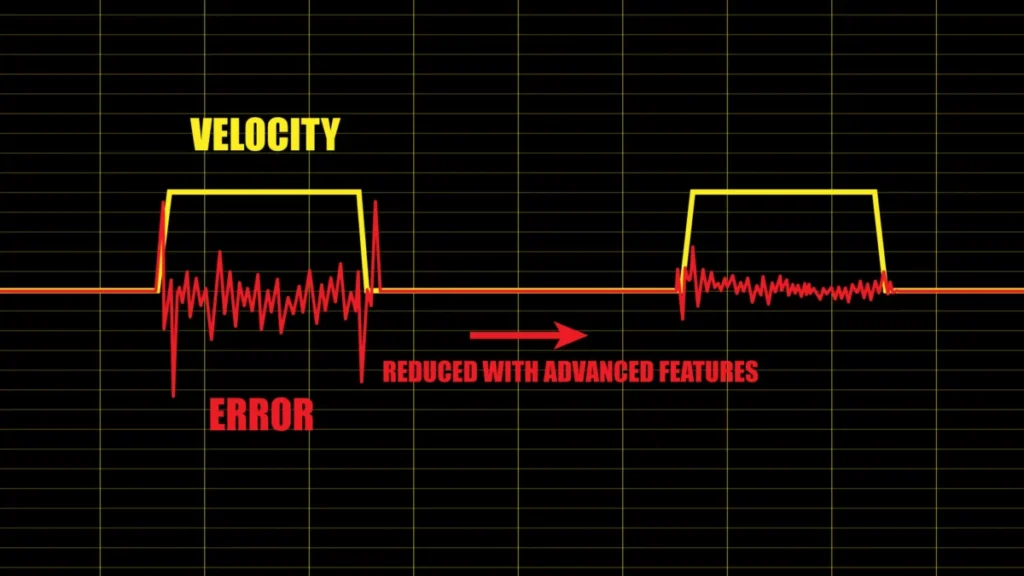
- Advanced Tuning Features with Dynamic and Adaptable Gains: Static PID (Proportional-Integral-Derivative) control often falls short in systems with varying loads, changing dynamics, or environmental disturbances. High-performance controllers incorporate advanced algorithms like adaptive control, feedforward control, and gain scheduling, which dynamically adjust control parameters to maintain optimal performance across diverse operating conditions. This adaptability is crucial for maintaining stability and accuracy in the face of external forces or internal changes.
- Multi-axis Synchronization: For complex mechanical configurations such as gantries, Cartesian robots, or coordinated multi-link manipulators, simultaneous and perfectly synchronized movement across multiple axes is paramount. Advanced controllers offer sophisticated multi-axis interpolation capabilities, ensuring that each axis moves in harmony, preventing mechanical stresses, and achieving precise contouring or path following. Industrial Ethernet protocols like EtherCAT, PROFINET, and SERCOS III are critical enablers here, providing deterministic, high-speed communication between the controller and multiple drives.
- Fast Update Rates: The speed at which a controller samples feedback, calculates control outputs, and updates motor commands directly impacts system responsiveness and accuracy. High-performance systems demand extremely fast servo loop update rates, often in the microsecond range, to maintain tight current and voltage control. This rapid processing minimizes lag, reduces following error, and enables the system to react almost instantaneously to changes in desired motion or unexpected disturbances.
- Powerful Processors: To handle complex algorithms, real-time data processing, and rapid command execution, high-performance drives and controllers are equipped with fast, dedicated processors (DSPs, FPGAs, multi-core CPUs). These processors prevent computational bottlenecks, ensuring that the control logic can keep pace with the demanding requirements of precision motion.
- Environmental Adaptability and Robustness: Real-world industrial environments are rarely pristine. Electrical noise from arc welders, mechanical vibrations from heavy machinery, and temperature fluctuations can all degrade motion performance. High-performance controls incorporate tools like highly configurable notch filters to suppress specific resonant frequencies within the mechanical system, advanced digital filters to mitigate electrical interference, and robust power electronics designed to withstand industrial conditions. One notable example involved an OEM whose precision tool performed flawlessly in an isolated lab environment but failed to meet expectations on the production floor due to external electrical and mechanical noise. The solution necessitated an upgrade to controls offering dynamic tuning parameters and advanced filtering capabilities to adapt to the real-world operational environment.
Beyond the Datasheet: Critical Nuances in Control

Several other factors, often not prominently featured on standard data sheets, play a decisive role in achieving high-end performance:
- "Auto-tuning" as a Starting Point, Not a Panacea: While auto-tuning features offer a convenient initial setup, they are rarely a "silver bullet" for optimal performance in high-precision applications. These algorithms typically provide a stable baseline, but fine-tuning, often requiring expert knowledge of system dynamics and application-specific requirements, is almost always necessary to extract maximum performance. Engineers often utilize frequency response analysis (FRA) and advanced system identification techniques to precisely characterize the mechanical system and then manually adjust control parameters for optimal damping, responsiveness, and disturbance rejection.
- Encoder Resolution and Electronics Compatibility: The resolution of the feedback encoder must be appropriately matched not only to the application’s positional accuracy goal but also to the capabilities of the drive and controller. A high-resolution encoder is useless if the drive’s analog-to-digital converter (ADC) or its processing capabilities cannot effectively utilize the fine-grained feedback. Conversely, a low-resolution encoder will inherently limit the system’s precision, regardless of how sophisticated the drive. Modern absolute encoders with high bit counts and sophisticated interpolation capabilities, combined with drives designed to handle high-frequency digital feedback, are crucial for sub-micron accuracy.
- Fieldbus Communication Protocols: In multi-axis systems, the choice of fieldbus communication protocol is critical for ensuring deterministic, high-speed data exchange and coordinated motion. Standard protocols like CANopen or Modbus may suffice for simpler applications, but high-performance systems demand industrial Ethernet variants like EtherCAT, which offers microsecond-level synchronization, distributed clock capabilities, and high data throughput, essential for coordinating complex, multi-axis movements in real-time. The latency and jitter characteristics of the chosen protocol directly impact the ability to achieve tight synchronization and prevent cumulative errors across multiple axes.
The Broader Impact and Future Trajectory
The implications of robust, intelligent drives and controls extend far beyond individual machine performance. In sectors like semiconductor manufacturing, where feature sizes are measured in nanometers, the precision afforded by advanced motion control directly translates to higher yields and the ability to produce next-generation microchips. In medical robotics, the safety and efficacy of surgical procedures rely heavily on the precise, repeatable movements orchestrated by sophisticated controllers. The aerospace industry leverages these technologies for precise assembly of complex components and for testing critical systems. The global market for servo drives and motors alone is projected to exceed $18 billion by 2027, underscoring the vital economic role of these components.
Looking ahead, the integration of artificial intelligence (AI) and machine learning (ML) is poised to usher in a new era of motion control. AI algorithms can analyze vast datasets from motion systems to predict failures, optimize tuning parameters autonomously, and even adapt control strategies in real-time to changing environmental conditions or material properties. Edge computing will enable faster, localized decision-making, reducing reliance on centralized cloud resources and further enhancing responsiveness. Predictive maintenance, powered by AI-driven analysis of drive and motor performance data, will minimize downtime and extend the lifespan of critical machinery.
In conclusion, precision motion is not merely about guiding a motor effectively; it is the sophisticated art of harmonizing information from the target, accounting for environmental variables, and meticulously coordinating the inherent characteristics of both mechanics and motors to fulfill the application’s specified goal. The most exquisite mechanical components and powerful motors can only perform to the extent allowed by their controlling intelligence. A poorly designed or inadequately tuned control loop acts as a fundamental bottleneck, negating the potential of superior hardware. Achieving true, high-performance motion control demands an integrated approach where the drives and controls are recognized as the intelligent orchestrators, translating complex commands into flawless physical action, thus unlocking unprecedented levels of precision and efficiency across diverse industrial applications.
Read the other installments in this series:
Part 1: Layers of performance and specifications in motion control
Part 2: Layers of performance and specifications in motion control
Part 4: Layers of performance and specifications in motion control






