A groundbreaking development in materials science and robotics is poised to revolutionize microscopic manipulation and medical interventions. Engineers at the Massachusetts Institute of Technology (MIT), in collaboration with researchers from the École Polytechnique Fédérale de Lausanne (EPFL) in Switzerland and the University of Cincinnati, have unveiled a novel soft magnetic hydrogel. This innovative material can be precisely 3D printed into complex, three-dimensional microstructures that respond instantaneously and with intricate movements to external magnetic fields. The potential applications range from targeted drug delivery and minimally invasive biopsies to the creation of highly sophisticated micro-robots.
The genesis of this research lies in the persistent challenge of creating functional, deformable structures at the microscopic scale. Traditional methods of embedding magnetic particles directly into printable resins often compromise structural integrity or hinder the printing process itself due to light scattering and particle aggregation. This new hydrogel circumvents these limitations by employing a unique post-fabrication magnetization process, offering unprecedented design freedom and a significant leap forward in the field of soft robotics.
The Magnetic Transformation: From Passive Structures to Active Grippers
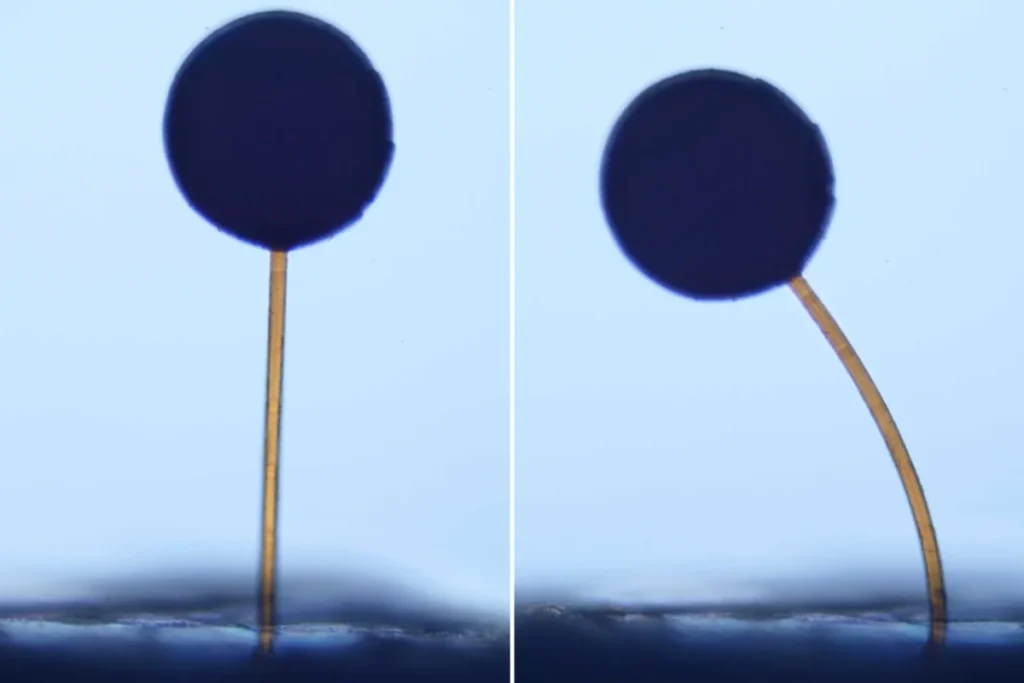
The remarkable capabilities of this new material were vividly demonstrated in laboratory experiments. Under the magnification of a microscope, a delicate assembly of lollipop-shaped structures, each measuring less than a grain of sand, was observed suspended in a petri dish. These seemingly inert components underwent a dramatic transformation when a small magnet was brought near the dish. In a swift, coordinated action, the lollipop heads snapped together, mirroring the rapid closure of a Venus flytrap. This instantaneous transition from passive elements to an active, functional robotic gripper highlights the material’s responsiveness and potential for complex manipulation.
This transformation is not merely a visual spectacle; it represents a fundamental shift in how microscopic objects can be controlled. Unlike previous magnetic micro-swimmers, which often rely on embedding magnetic particles that dictate overall movement, this new hydrogel allows for the creation of intricate internal architectures with spatially tuned magnetic properties. This means individual components within a single microscopic structure can move and deform independently, enabling more sophisticated maneuvers and functionalities.
A New Era of Programmable Materials
The development of this soft magnetic hydrogel is a testament to the ongoing advancements in the field of metamaterials, materials engineered with specific microscopic architectures to achieve extraordinary properties. Professor Carlos Portela, the Robert N. Noyce Career Development Associate Professor of Mechanical Engineering at MIT and a lead researcher on the project, has a well-established track record in fabricating such advanced materials. His previous work includes creating metamaterials with exceptional toughness, stretchability, and the ability to manipulate sound and withstand extreme impacts.
This latest research expands upon Portela’s work with "programmable" materials – substances designed to alter their properties in response to external stimuli such as chemicals, light, or electromagnetic fields. The team’s focus on magnetic fields stems from their inherent advantages: "With a magnetically responsive material, we have control at a distance and the response is instantaneous," explained co-lead author Andrew Chen. "We don’t have to wait for a slow chemical reaction or physical process, and we can manipulate the material without touching it." This instantaneous and remote controllability is crucial for applications where precise and immediate action is required, particularly in delicate biological environments.
Overcoming Fabrication Challenges: The Double-Dip Process
The creation of microscopic, magnetically responsive structures has long been hampered by significant fabrication hurdles. High-resolution 3D printing techniques, such as two-photon lithography, are adept at producing intricate micro-architectures. However, integrating magnetic particles into the printable resin without compromising the process has proven exceptionally difficult. Magnetic nanoparticles, being metallic, tend to scatter laser light, leading to weakened structures or outright printing failures. They can also aggregate or settle out of the resin prematurely.
"Directly 3D printing deformable micron-scale structures with a high fraction of magnetic particles is extremely difficult, often involving a tradeoff between magnetic functionality and structural integrity," stated co-lead author Rachel Sun. This inherent difficulty means researchers have historically had to choose between robust structures and strong magnetic responsiveness.
The MIT-led team’s breakthrough lies in their innovative "double-dip" fabrication process. This method ingeniously separates the structural printing from the magnetic particle integration. First, conventional 3D resin printing is employed to create the desired microscopic structure using a standard polymer gel, entirely free of magnetic particles. This ensures the structural integrity and precision of the initial design.
Following the printing of the basic structure, the gel is immersed in a solution containing iron ions. The porous hydrogel readily absorbs these ions. Subsequently, the iron-infused structure undergoes a second dip in a solution containing hydroxide ions. This crucial step triggers a chemical reaction within the gel, causing the iron ions to bond with the hydroxide ions and form iron-oxide nanoparticles. These nanoparticles are inherently magnetic and become permanently embedded within the hydrogel structure.
Precision and Control: Tuning Magnetic Properties
This post-fabrication magnetization technique offers a significant advantage: it allows researchers to precisely control the magnetic properties of individual features within a single microscopic structure. By manipulating the laser power during the initial 3D printing stage, the team can alter the cross-linking density, or how "tight" the gel is, in specific regions. A tighter gel can accommodate fewer magnetic particles, thus exhibiting weaker magnetism, while a more relaxed gel can absorb more iron ions and develop stronger magnetic properties.
"This provides unprecedented design freedom to print multifunctional structures and materials at the microscale," Sun elaborated. This ability to create gradients of magnetism within a single object opens up a vast array of possibilities for creating sophisticated micro-robots and smart materials.
Demonstrations of Functionality: Grippers and Bistable Switches
The research team showcased the potential of their new hydrogel through several compelling demonstrations. The aforementioned "lollipop grippers" served as a prime example of the material’s ability to create active robotic components. These structures, less than a millimeter in height with magnetic heads smaller than a grain of sand, were printed from polymer gel and then infused with varying degrees of magnetic particles. When a macroscopic magnet was applied, the lollipop heads were observed to orient and move towards it, mimicking the coordinated action of gripping fingers.
Professor Portela envisions immediate medical applications for such micro-grippers: "You could imagine a magnetic architecture like this could act as a small robot that you could guide through the body with an external magnet, and it could latch onto something, for instance to take a biopsy," he stated. "That is a vision that others can take from this work." The ability to remotely control and precisely maneuver such microscopic tools within the human body could dramatically enhance diagnostic procedures and therapeutic interventions, potentially reducing invasiveness and improving patient outcomes.
Beyond grippers, the team also developed a magnetically responsive "bistable" switch. This device, approximately a millimeter long, featured four tiny, oar-like magnetic structures, each about 8 microns thick – comparable to the diameter of a red blood cell – attached to its sides. When a magnet was applied to one end of the rectangular structure, the oars flipped, pulling the rectangle in that direction and locking it into place. Applying the magnet to the opposite side reversed the process, causing the oars to flip again and the rectangle to move in the other direction, effectively functioning as a magnetic micro-switch.
"We think this is a new kind of bistable mechanism that could be used, for instance, in a microfluidic device, as a magnetic valve to open or shut some flow," Portela explained. This application could be vital in controlling the movement of fluids in lab-on-a-chip devices, enabling complex biological assays and analyses at the micro-scale.
Broader Implications and Future Directions
The implications of this research extend far beyond immediate demonstrations. The development of soft magnetic hydrogels with tunable magnetic properties at the microscale represents a significant stride towards the realization of complex, bio-integrated microscopic robots. These "magno-bots" could be instrumental in fields such as minimally invasive surgery, targeted drug delivery systems that release medication precisely where needed, and advanced diagnostic tools capable of performing intricate biopsies or cellular manipulations.
The ability to fabricate these structures with micron-scale precision and integrate them into complex 3D architectures also opens doors for novel materials with stimuli-responsive behaviors. Such materials could find applications in advanced manufacturing, adaptive sensors, and even in the development of micro-scale actuators for a wide range of devices.
The collaboration between MIT, EPFL, and the University of Cincinnati underscores the global nature of cutting-edge scientific research. This interdisciplinary effort, supported in part by the National Science Foundation and the MathWorks seed grant program, has successfully navigated complex fabrication challenges to deliver a material with transformative potential. The work was also facilitated by the advanced facilities at MIT.nano, highlighting the importance of dedicated infrastructure for groundbreaking research.
Looking ahead, the researchers plan to further explore the material’s capabilities, focusing on increasing the complexity of the printed architectures and investigating the material’s long-term stability and biocompatibility for potential medical applications. The ability to spatially tune magnetic properties within a single microscopic construct is a powerful new tool, and the team is eager to see how other researchers will leverage this innovation to engineer the next generation of microscopic robots and smart materials. The successful demonstration of the lollipop grippers and bistable switches suggests that this technology is not merely theoretical but holds tangible promise for practical, impactful applications in the near future.