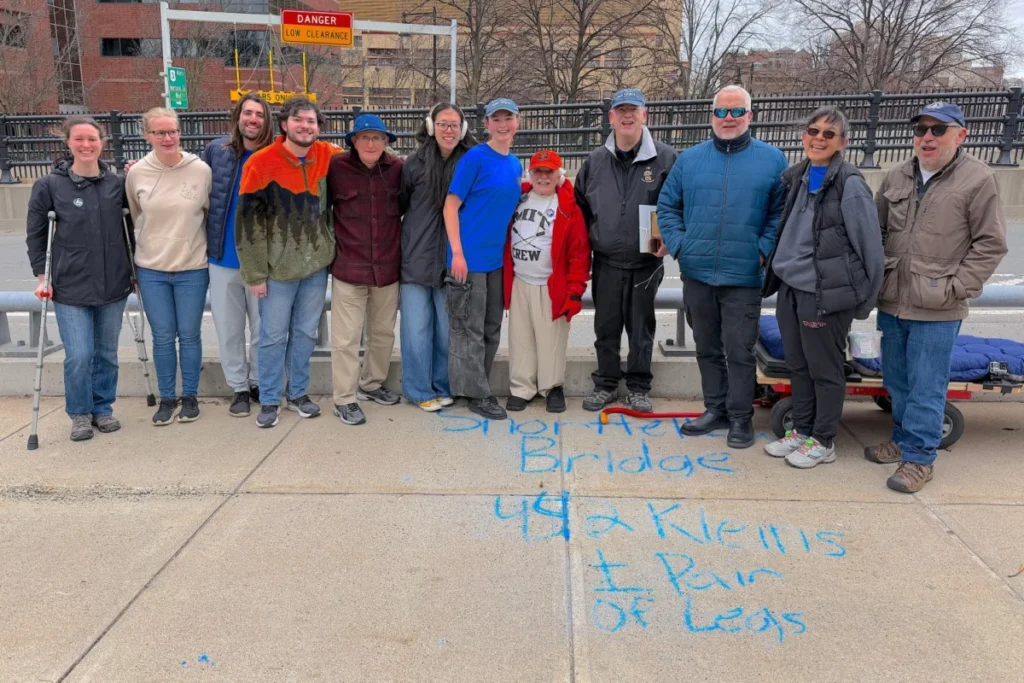
Cambridge, MA – In a whimsical yet deeply symbolic continuation of its storied tradition of "hacks" – elaborate, non-destructive pranks that blend intellectual prowess with humor – the Massachusetts Institute of Technology (MIT) recently undertook a unique expedition to measure the historic Longfellow Bridge in a new unit: the "klein." This innovative measurement, named in honor of MIT alumnus Martin Klein ’62, a pioneering figure in marine technology, mirrors the institute’s most famous stunt, the 1958 measurement of the Massachusetts Avenue Bridge in "smoots." The event, which unfolded on April 4th, served as a tribute to Klein on the occasion of his 85th birthday, celebrating his profound contributions to oceanography and the spirit of curiosity he embodies.
A New Chapter in MIT’s Hacking History
The "klein" expedition stands as a direct homage to the legendary "smoot" measurement, a hallmark of MIT lore. Nearly 70 years ago, Oliver R. Smoot Jr. ’62, then a first-year pledge at the Lambda Chi Alpha fraternity, famously lent his 5-foot, 7-inch stature as the standard unit to measure the length of the Massachusetts Avenue Bridge. On that fateful night, Smoot repeatedly lay down across the span while his fraternity brothers marked the bridge with paint, ultimately determining its length to be 364.4 smoots (plus 1 ear). These markings, remarkably, have persisted to this day, periodically repainted by subsequent generations of MIT students, serving as an enduring testament to the institute’s unique blend of scientific rigor and playful ingenuity.
The April 4th event, spearheaded by a diverse team of MIT affiliates, sought to establish a new, equally memorable unit of measurement. One "klein" was defined as 4 feet, 9.5 inches (57.5 inches or 146.05 centimeters), a length intentionally chosen to be equal to 0.85820896 smoots, thus intertwining the two legacies. The target for this new measurement was the Longfellow Bridge, a significant landmark connecting Boston and Cambridge across the Charles River, much like its Massachusetts Avenue counterpart. The expedition’s organizers envisioned this act not merely as a prank, but as a living tribute to Klein’s innovative spirit and his long-standing connection to the institute.
The Honoree: Martin Klein, Father of Commercial Side-Scan Sonar
The choice of Martin Klein as the namesake for this new unit is particularly fitting, given his monumental impact on the field of marine exploration. Born in 1939, Klein graduated from MIT in 1962, the same year Oliver Smoot’s name became immortalized on the Massachusetts Avenue Bridge. Klein is widely recognized as the "father of commercial side-scan sonar," a technology that revolutionized underwater imaging and discovery. His groundbreaking work, beginning in the late 1960s, transformed the ability to map the seafloor, detect submerged objects, and locate shipwrecks with unprecedented detail.
Klein’s side-scan sonar technology works by emitting sound waves in a fan shape to the sides of a towfish, which is typically pulled behind a vessel. The sound waves reflect off the seabed and any objects on it, creating acoustic images that reveal topography and hidden features. This innovation moved beyond the single-point measurements of traditional sonar, providing a much broader and more detailed "view" of the underwater environment. Its applications are vast, ranging from geological surveying and pipeline inspection to search and rescue operations and archaeological discoveries.
Indeed, Klein’s sonar has been instrumental in locating countless historically significant shipwrecks across the globe. Among the most famous discoveries aided by his technology are the RMS Titanic, the British luxury liner that sank in 1912; the World War I ocean liner RMS Lusitania, torpedoed in 1915; and the Nuestra Señora de Atocha, a Spanish galleon laden with treasure that sank off the Florida Keys in 1622. His contributions have not only advanced scientific understanding of the oceans but have also enriched humanity’s historical record, making accessible treasures and insights previously beyond reach.
Beyond his technological innovations, Martin Klein maintains deep ties to MIT and the broader scientific community. He serves on the MIT Sea Grant Advisory Board and the MIT Museum Collections Committee, contributing his expertise to the preservation and dissemination of marine knowledge. He is also a life fellow of both the Marine Technology Society and the Explorers Club, an international organization dedicated to fostering field exploration and scientific inquiry. His career exemplifies the MIT ethos of applying rigorous scientific and engineering principles to solve real-world challenges and expand the boundaries of human knowledge.
The "Klein" Expedition: A Modern-Day Measurement
The April 4th expedition across the Longfellow Bridge was a meticulously planned undertaking, blending the playful spirit of a hack with the precision of an engineering project. Appropriately, the MIT team employed a "side-scan" method, mirroring Klein’s pioneering sonar technology. In a truly unique twist, Martin Klein himself served as the official observation device. Reclined comfortably on a custom-engineered wooden cart, complete with a mission-specific chaise lounge pillow, Klein was pulled along the bridge by the team. His role was to "side-scan" the bridge visually, looking to the sides to observe and record anomalies and discoveries along the path.
The expedition commenced with an air of anticipation, drawing together a diverse group of over a dozen surveyors. This collaborative effort included a significant representation from the MIT community, spanning generations and departments. Alumni, faculty, and staff from the Department of Mechanical Engineering (MechE), MIT Sea Grant, MIT Edgerton Center, and the MIT Museum Hart Nautical Collections joined forces. External partners also participated, highlighting the broad appeal and collaborative nature of such initiatives, including representatives from Harvard Extension School and the Woods Hole Oceanographic Institution. MIT students, the lifeblood of the institute’s future, were also integral to the team, with senior Teagan Sullivan, junior Adrienne Lai, and graduate students Ansel Garcia-Langley, Erin Menezes, Manuel Valencia, and Gerardo Berlanga Molina all contributing their energy and enthusiasm.
The journey across the Longfellow Bridge was not without its own unique discoveries and amusing observations, which Klein diligently noted during his "side-scan." These included the momentary spectacle of a Boston Duck Boat passing underneath the bridge, a testament to the bustling activity of the Charles River. Other curious sightings included a mermaid tail, a lost kayak paddle, and even a serenely sleeping goose. The team itself, characterized by its "tenacious" spirit, became part of the observed phenomena, embodying the dedication required for such an endeavor.
Upon completion of the measurement, the Longfellow Bridge was officially declared to be 442 kleins (plus 2 legs). The "plus 2 legs" is a charming nod to the original "plus 1 ear" of the smoot measurement, maintaining the quirky precision that defines MIT hacks. Given that one klein is 57.5 inches, 442 kleins equates to approximately 25,415 inches, or roughly 2,117.9 feet (about 645.5 meters). This makes the Longfellow Bridge slightly longer than the Massachusetts Avenue Bridge, which at 364.4 smoots (67 inches per smoot) measures approximately 24,414.8 inches or 2,034.6 feet (about 620.1 meters).
The successful conclusion of the expedition was marked by a celebratory ceremony, where the Longfellow Bridge was affectionately dubbed the "Shortfellow Bridge," a playful renaming that captured the spirit of the event. The atmosphere was one of camaraderie and shared accomplishment, reflecting the unique bond forged through such collaborative and unconventional projects.
The Enduring Spirit of MIT Hacking
The "klein" measurement is more than just a prank; it is a vibrant manifestation of MIT’s distinctive culture, known globally for its "hacks." Unlike mere vandalism, MIT hacks are characterized by their ingenuity, technical sophistication, humor, and often, a deeper meaning. They are typically harmless, meticulously planned, and executed with a level of engineering precision that often astonishes observers. Past hacks include the placement of a police car atop the Great Dome, the transformation of the dome into R2-D2 or a giant cap-and-gown, and the aforementioned annual Baker House Piano Drop, where old pianos are dropped from the dorm’s roof.
One of the most famous examples, beyond the Smoot measurement, is the 1982 MIT weather balloon stunt at the Harvard-Yale football game. During halftime, a large weather balloon, emblazoned with "MIT" and a caricature of a beaver (the institute’s mascot), slowly inflated and emerged from under the field, much to the chagrin of the Harvard and Yale faithful. This audacious act showcased the blend of technical skill, strategic planning, and irreverent humor that defines MIT hacking.
These traditions serve several critical functions within the MIT community. They foster a sense of identity and belonging, uniting students and alumni through shared experiences of clever mischief. They provide an outlet for creative problem-solving and engineering challenges outside the traditional curriculum. Moreover, they act as a potent reminder that even within the intense academic environment of MIT, there is ample room for joy, creativity, and a healthy disregard for conventional boundaries.
Intergenerational Collaboration and Institutional Pride
The success of the "klein" expedition highlights the powerful synergy between different generations of the MIT community. The involvement of a second-year undergraduate, Makenna Reilly, as a spearhead, working alongside seasoned faculty like Andrew Bennett ’85, PhD ’97 (MIT Sea Grant education administrator and senior lecturer in MechE), demonstrates the seamless transfer of the hacking tradition from one generation to the next. Reilly, a mechanical engineering student, embodied the spirit of hands-on problem-solving, while Bennett brought institutional knowledge and logistical support.
"This project was a fantastic blend of historical reverence and modern ingenuity," stated Reilly, reflecting on the collaborative effort. "It was inspiring to work with so many different people from across MIT and beyond, all united by a common goal to honor Martin Klein and contribute to our institute’s unique legacy. It really shows how our community can come together to celebrate our history in such a fun and meaningful way."
Andrew Bennett added, "The ‘smoot’ measurement is iconic, and to create a new unit, the ‘klein,’ to honor Martin, a true pioneer and a friend, was a privilege. It wasn’t just about measuring a bridge; it was about connecting generations, celebrating innovation, and reinforcing the playful, yet deeply intelligent, spirit of MIT. Martin’s willingness to be the ‘measurement device’ himself speaks volumes about his own sense of humor and his dedication to the MIT spirit."
The expedition also underscored the broad network of support within MIT, with various departments and centers lending their expertise and resources. This interdisciplinary cooperation, a hallmark of MIT’s research and educational philosophy, was evident in the participation of the Edgerton Center, known for its hands-on learning, and the MIT Museum, which preserves the institute’s rich history, including its hacking exploits.
Measurements, Legacy, and Future Implications
The detailed conversion table for the "klein" unit provided by the MIT team further solidifies its place in the annals of measurement. One klein, at 57.5 inches, is meticulously broken down into various units: 146.05 centimeters, 1.4605 meters, 0.0009075126 miles, 1.597222 yards, 4.791667 feet, 0.0007886069 nautical miles, 0.007260087 furlongs, 0.7986111 fathoms, 172.5 barleycorns, 292,100,000 beard seconds (a humorous unit based on beard growth), 647.4421 Ligne, 14.375 horse hands, 4.819655 shaku, and of course, 0.85820896 smoots. This level of precise, yet playful, detail is quintessential MIT.
The establishment of the "klein" unit and the measurement of the Longfellow Bridge serve as more than just a fleeting moment of amusement. They represent the living history of MIT, demonstrating how traditions are not merely preserved but actively reimagined and re-enacted by successive generations. Such events reinforce the idea that innovation extends beyond the laboratory or classroom, finding expression in creative, community-building endeavors.
The "klein" hack ensures that the legacy of Martin Klein, a man whose work has allowed humanity to peer into the ocean’s depths, will be remembered in a uniquely MIT way – with a blend of respect, cleverness, and a touch of the absurd. It also subtly connects the visible world above the Charles River, traversed by students and commuters daily, with the hidden underwater world that Klein’s technology illuminates.
As the "klein" markings potentially join the "smoot" markings as enduring symbols on Cambridge’s bridges, they will continue to tell a story. A story of intellectual curiosity, collaborative spirit, and the distinctive institutional identity that makes MIT a truly unique place, where the pursuit of knowledge is often accompanied by a hearty laugh and an inventive prank. The "Shortfellow Bridge" now stands as a monument not just to engineering marvel, but to the playful genius that thrives within the hallowed halls and across the iconic bridges of MIT.






