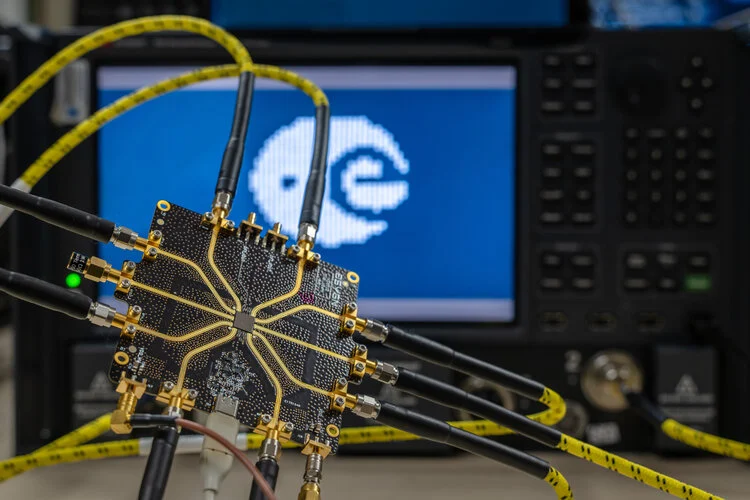
The unassuming black chip nestled at the heart of an electronic circuit board represents a significant leap forward in communication technology, a miniature marvel capable of precisely steering radio beams. This capability is not merely an incremental improvement; it is foundational to the development and widespread adoption of phased array antennas, a technology poised to revolutionize satellite communications, navigation, Earth observation, and deep space exploration. Traditional antennas, reliant on mechanical tilting to maintain a connection with their targets, face limitations in speed, reliability, and environmental resilience. Phased array antennas, in stark contrast, achieve this crucial task without a single moving part, ushering in an era of dynamic, agile, and robust communication systems.
The Evolution of Beamforming: From Mechanical Gears to Digital Precision
For decades, the concept of steering radio beams electronically has been a driving force in research and development. The principle behind phased array antennas lies in the sophisticated manipulation of radio wave signals. Instead of physically rotating a large dish, a multitude of smaller antenna elements work in concert. Each element emits a radio signal, and by precisely controlling the timing, or phase, and the strength, or amplitude, of the signal from each element, the overall radio beam can be directed. This intricate dance of signal manipulation is known as beamforming.
The advent of modern silicon semiconductor technologies has been instrumental in miniaturizing these complex control systems. What were once bulky and expensive components have been consolidated into highly integrated circuits, often referred to as beamforming integrated circuits (ICs). This miniaturization has directly translated into phased array antennas that are not only more compact and lighter but also significantly more reliable and cost-effective. This has unlocked their potential for widespread application across a diverse range of sectors.
ESA’s Longstanding Commitment to Beamforming Advancement
The European Space Agency (ESA) has a well-established history of pioneering advancements in beamforming technology. For many years, ESA has actively explored innovative methods for electronically steering radio beams, recognizing their critical importance for both space-based and terrestrial applications. Vaclav Valenta, an engineer and expert in phased array technology at ESA, highlights this ongoing commitment. "For decades, ESA has been at the forefront of beamforming technology, exploring innovative ways to electronically steer radio beams for space and terrestrial applications," Valenta stated. He further emphasized the current trajectory of the field: "Today, the focus is increasingly shifting towards highly integrated analogue and digital beamforming chips both designed and manufactured in Europe. These developments combine cutting-edge performance with the strategic advantage of a secure European supply chain." This strategic emphasis on European design and manufacturing underscores a broader geopolitical and economic imperative to secure technological sovereignty in critical sectors.
Asygn’s Next-Generation Beamforming ICs: A Tangible Demonstration of Progress
The recent technology demonstration at ESA’s RF Active Technology Laboratory at ESTEC, Noordwijk, Netherlands, provided a compelling showcase of these advancements. The French company Asygn, a key player in the European microelectronics landscape, presented its new generation of beamforming integrated circuits. These ICs represent the culmination of years of research and development, integrating sophisticated analogue and digital functionalities onto a single chip.
To vividly illustrate the precise control that Asygn’s microchip offers, the company’s engineers devised a visually striking demonstration. They used the beamforming capabilities of their new IC to meticulously arrange hundreds of individual dots of radio frequency energy to form the recognizable blue-and-white ESA logo. Each dot within this logo represents a specific amplitude and phase setting, meticulously controlled by the beamformer. This artistic rendition serves as a powerful, real-world metaphor for the intricate and precise control required to steer radio beams in complex communication scenarios.
Clement Jany, Radio Frequency business unit co-director at Asygn, elaborated on the technical merits of their innovation. "By designing single-chip solutions dedicated to specific frequency bands – notably X and Ka – we achieve the very high levels of performance required for mission-critical satellite communication applications," Jany explained. The X-band (typically 8-12 GHz) and Ka-band (typically 26.5-40 GHz) are crucial for high-throughput satellite communications, offering a balance of bandwidth and atmospheric penetration. Jany further articulated Asygn’s strategic objective: "Our objective is to simplify system integration for phased array antenna manufacturers by delivering high-precision phase and amplitude control and an ultra-low noise figure on a single chip." This simplification of system integration is vital for accelerating the deployment of advanced antenna systems, reducing development time and costs for manufacturers.
Supporting Data and the Broader Context
The miniaturization and integration of beamforming ICs are not just about smaller components; they are about enabling entirely new classes of applications and enhancing existing ones.
- Increased Data Throughput: Phased array antennas, powered by advanced beamforming, can dynamically allocate bandwidth to multiple users or services simultaneously. This is critical for the burgeoning demand for high-speed internet access in remote areas, advanced telecommunications, and the proliferation of connected devices in the Internet of Things (IoT). For example, current geostationary satellites equipped with phased array technology can achieve data rates exceeding hundreds of gigabits per second, a significant improvement over traditional single-beam antennas.
- Enhanced Reliability and Resilience: The absence of moving parts eliminates a common point of failure in traditional antennas. This makes phased array systems inherently more robust and reliable, particularly in harsh environments such as space, where mechanical components are susceptible to wear and tear, extreme temperatures, and radiation. This enhanced reliability is paramount for critical infrastructure like navigation systems and disaster communication networks.
- Reduced Power Consumption and Size: Integrated beamforming ICs are designed for energy efficiency, contributing to the overall power budget of satellite payloads and ground terminals. Their compact size also allows for the development of smaller, lighter antennas, which can be integrated into a wider range of platforms, including smaller satellites (CubeSats), drones, and even portable communication devices.
- Cost-Effectiveness for Widespread Deployment: While initial development costs for advanced semiconductor technologies can be high, the mass production of integrated circuits leads to significant cost reductions per unit. This makes phased array antennas, and the services they enable, more accessible and affordable for a broader range of applications, democratizing access to advanced communication capabilities.
- Strategic Importance of European Supply Chain: Valenta’s emphasis on a "secure European supply chain" points to the global strategic importance of semiconductor manufacturing. Recent geopolitical events have highlighted the vulnerabilities associated with relying on distant and potentially unstable supply chains for critical technologies. By fostering domestic design and manufacturing capabilities, Europe aims to enhance its technological independence and economic security. This aligns with broader European initiatives like the European Chips Act, which aims to bolster the continent’s semiconductor industry.
Timeline and Future Implications
The journey from concept to a demonstrably functional next-generation beamforming chip has been a multi-year endeavor. Research into phased array antennas began in earnest in the mid-20th century, with early applications in military radar systems. The evolution of semiconductor technology in the late 20th and early 21st centuries, particularly the advancements in silicon CMOS (Complementary Metal-Oxide-Semiconductor) technology, paved the way for the miniaturization and integration of beamforming functions onto single chips.
The demonstration by Asygn at ESA’s ESTEC laboratory in the latter half of 2023 or early 2024 signifies a critical milestone in this ongoing evolution. This showcases that the technology has moved beyond theoretical concepts and laboratory prototypes to a stage where it is ready for integration into commercial and scientific missions.
The implications of these advancements are far-reaching:
- Next-Generation Satellite Constellations: Future satellite constellations, designed for global internet coverage, Earth observation with unprecedented detail, and sophisticated navigation, will heavily rely on phased array antennas powered by these advanced ICs. Companies like Starlink and OneWeb are already leveraging this technology.
- Enhanced Space Exploration: Missions to the Moon, Mars, and beyond will benefit from more robust and efficient communication systems. Phased arrays can enable higher data rates for transmitting scientific data and allow for more flexible communication links with spacecraft.
- Autonomous Systems and 5G/6G Integration: The precision and agility of phased array antennas will be crucial for integrating space-based communication with terrestrial networks, supporting the development of autonomous vehicles, smart cities, and the next generations of wireless communication (5G and 6G).
- Scientific Research and Earth Observation: The ability to precisely steer radio beams will allow for more targeted and efficient data collection for scientific research, from monitoring climate change and natural disasters to understanding the Earth’s geology and atmosphere.
Official Responses and Industry Perspectives
While the primary statements came from ESA and Asygn, the broader industry context suggests significant enthusiasm for such advancements. Competitors and partners in the satellite communication and semiconductor sectors would view Asygn’s progress as both an indicator of market trends and a potential catalyst for further innovation.
Industry analysts have consistently predicted strong growth in the phased array antenna market, driven by the increasing demand for high-bandwidth satellite services and the miniaturization of electronic components. The development of integrated beamforming ICs is seen as a key enabler for this market expansion. The focus on European manufacturing also resonates with the global trend towards regionalizing supply chains for critical technologies, a move aimed at enhancing resilience and reducing geopolitical risks.
The successful demonstration by Asygn, supported by ESA’s expertise and facilities, not only highlights a technological achievement but also underscores the collaborative ecosystem that is vital for driving innovation in complex fields like space technology and advanced electronics. This partnership between space agencies and private industry is crucial for translating cutting-edge research into tangible applications that benefit society.
Conclusion: A New Era of Connectedness
The miniature black chip, unassuming in its physical presence, is a testament to human ingenuity and the relentless pursuit of technological advancement. The development of highly integrated beamforming integrated circuits represents a significant milestone in the evolution of communication. As Europe solidifies its position in designing and manufacturing these critical components, the world moves closer to an era of ubiquitous, reliable, and high-performance connectivity, shaping the future of how we interact with each other and explore the universe. The precise steering of radio beams, once a complex engineering challenge, is now becoming an accessible and powerful tool, poised to redefine the landscape of global communication and scientific discovery.