An international research consortium comprising scientists from École Polytechnique, Collège de France, and Helmholtz-Zentrum Dresden-Rossendorf (HZDR) has successfully engineered and experimentally demonstrated the world’s first all-optical photonic time crystal (PTC). This groundbreaking material is uniquely designed to rapidly and repeatedly alter its optical behavior over time, a feat previously unattainable and poised to revolutionize a spectrum of advanced technologies. The achievement, detailed in the prestigious journal Nature, represents a significant leap in our ability to manipulate light, opening doors to ultrafast optical computing, next-generation telecommunications, and entirely novel terahertz laser systems.
A New Frontier in Light-Matter Interaction
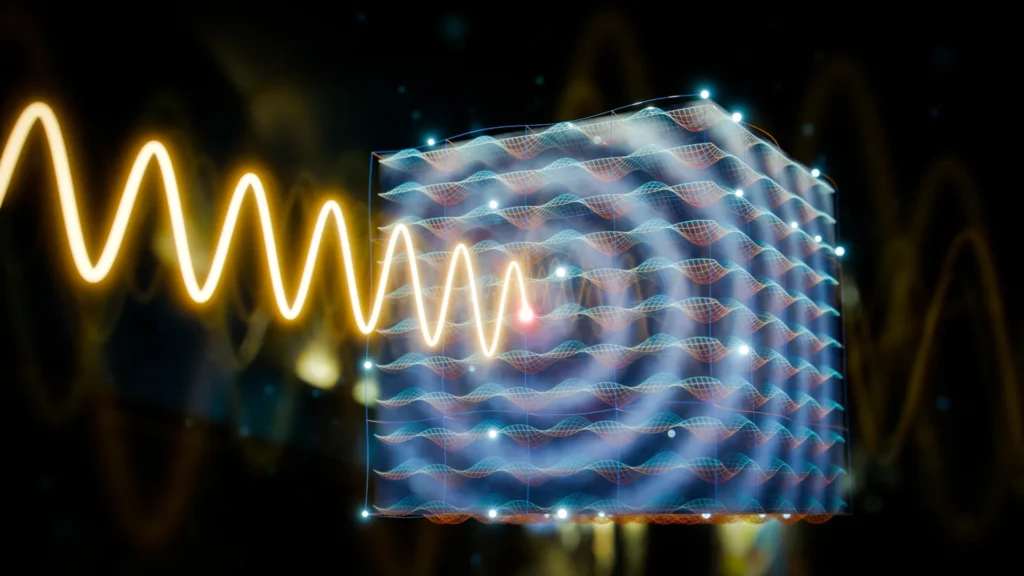
The successful creation of the photonic time crystal was critically enabled by HZDR’s formidable TELBE superradiant terahertz source. This state-of-the-art facility provided the precise, high-intensity terahertz radiation necessary for the scientists to delve into a previously inaccessible realm of light-matter interaction. Unlike conventional photonic crystals, which rely on spatial patterns to control light, a photonic time crystal introduces a repeating pattern in the temporal domain, allowing for dynamic and instantaneous modification of its optical properties.
The control of light’s behavior within materials has historically driven monumental technological advancements. From the ubiquitous optical fibers that form the backbone of global communication networks to the precision of lasers used in medicine and manufacturing, and the myriad optical sensors crucial for scientific research and industrial applications, the mastery of light has consistently reshaped modern life. This latest breakthrough represents a fundamental shift in that control paradigm, moving beyond static manipulation to dynamic, ultrafast modulation.
Bridging the Terahertz Gap
At the heart of this innovation lies the exploration of the terahertz (THz) frequency range, a largely underutilized segment of the electromagnetic spectrum situated between conventional electronics and photonics. Often referred to as the "terahertz gap," this region, spanning from roughly 0.1 THz to 10 THz, has long presented significant technological challenges in both generation and detection. However, its immense potential, offering frequencies up to 1,000 times faster than those used in electronic components, has spurred intense research efforts globally. Terahertz waves possess unique properties, including the ability to penetrate many common materials non-destructively, making them ideal for applications ranging from advanced medical imaging (e.g., skin cancer detection, dental diagnostics) and security screening (e.g., contraband detection at airports) to non-destructive material testing, high-bandwidth communications, and molecular spectroscopy.
Yannis Laplace, an assistant professor at École Polytechnique’s Laboratory of Irradiated Solids (LSI), and his team have been at the forefront of developing photonic devices capable of controlling light within this promising THz range. "The THz range represents the frontier between electronic and photonic technologies," explains Laplace. "It is a range full of opportunities both for science and for society, yet is still underdeveloped technologically compared to its electrical and photonic counterparts. Creating photonic crystals could lead the way to the closing of this gap." This sentiment underscores the strategic importance of the current research, aiming to unlock the full potential of the terahertz spectrum for practical applications.
Evolution of Photonic Crystals: From Space to Time
To appreciate the significance of a photonic time crystal, it’s essential to understand its predecessor: the conventional photonic crystal. These nanostructured materials feature a repeating optical pattern—much like a lattice—that dictates how photons propagate through them. By meticulously arranging materials with varying shapes and refractive indices, scientists can precisely block, guide, or amplify specific wavelengths of light. In essence, photonic crystals control photons in a manner analogous to how semiconductors control electrons, forming the basis for many modern optical components.
However, a fundamental limitation of traditional photonic crystals has been their static nature. While earlier experiments conducted by Laplace’s team demonstrated that factors like temperature and magnetic fields could influence a photonic crystal’s ability to capture light, these conditions, once established, resulted in optical behaviors that remained fixed over time. The breakthrough with the all-optical photonic time crystal shatters this limitation. Its optical properties, such as reflectivity and resonance frequency, can be dynamically altered on picosecond timescales—a timescale remarkably close to the oscillations of light itself. A picosecond is one trillionth of a second (10⁻¹² seconds), a duration in which light travels only about 0.3 millimeters. This unprecedented speed of modulation introduces a new dimension for light control, moving beyond spatial arrangement to incorporate a repeating pattern in time.
Tingwen Guo, a PhD student at École Polytechnique and the lead author of the publication, elaborates on this paradigm shift: "By extending photonic crystals from space to time, we open a new dimension for light control – and a novel path toward amplification and lasing. That could be a game-changer for optical technologies at terahertz frequencies and beyond." This statement highlights the profound implications for not only manipulating light but also for enhancing its intensity and coherence, critical for laser development.
Engineering the Photonic Time Crystal: A Plasmonic Metamaterial
The creation of such a rapidly controllable device demanded a highly specialized and intricate design. The research team, supported by Thales’ Laboratoire Albert Fert and Polytechnique’s Physics of Interfaces (PICM) laboratory, engineered a specific type of photonic crystal known as a "plasmonic metamaterial." Metamaterials are artificially structured materials designed to possess properties not found in nature, often by manipulating their sub-wavelength architecture.
The core structure of this metamaterial consists of micrometer-scale gold crenelated structures precisely positioned atop an insulating layer, which in turn rests on a semiconductor composed of a mixture of indium and antimony. The intricate gold structures are designed to form tiny cavities, effectively confining light within the interface between the gold and the semiconductor layers.
The crucial dynamic control mechanism arises when the semiconductor surface is excited. This excitation generates "surface plasmons," which are collective oscillations of electrons at the metal-dielectric interface. These surface plasmons possess the remarkable ability to capture light and sustain its oscillations, providing the researchers with a powerful and exceptionally fast method to manipulate the trapped photons. This sophisticated interplay between light, electrons, and the engineered material structure is what enables the dynamic modulation of the photonic time crystal’s properties.
The Indispensable Role of TELBE
Achieving the required speed and strength of optical property alteration posed a formidable technical challenge. The team overcame this by exposing the metamaterial device to intense terahertz laser pulses generated by the TELBE facility at HZDR’s ELBE accelerator. TELBE stands out as a unique facility, capable of producing high-field, phase-stable terahertz radiation that can be precisely tuned to various frequencies. This distinct capability allowed the researchers to induce strong and rapid changes in the material’s optical properties, particularly its reflectivity.
The ability to achieve both significant strength of change and picosecond-scale transformation simultaneously was a major hurdle in the field. To put the "strength of change" into perspective, it was akin to compelling an object to emit a completely different color, while the transformation itself occurred in a timescale of one trillionth of a second. This combination of intensity and speed is what differentiates this breakthrough from previous attempts at dynamic light control.
Jan-Christoph Deinert, the coordinator of the TELBE facility, underscored its critical contribution: "TELBE’s unique ability to generate high-field, phase-stable terahertz pulses was critical. Without this infrastructure, achieving the coherent, ultrafast modulation needed for the PTC regime would have been impossible." This highlights the essential role of cutting-edge research infrastructure in pushing the boundaries of scientific discovery.
Theoretical Validation and Reduced Dissipation
The experimental findings were robustly supported by a comprehensive theoretical model developed by Marco Schirò, a Research Scientist at Collège de France, and his team. This model not only reproduced the experimental observations with high fidelity but also provided invaluable insights into the intricate behavior of photons within the device. The theoretical framework offered a deeper understanding of the underlying physics, helping to explain the complex light-matter interactions at play.
One particularly significant finding from the theoretical calculations was that the dynamic alteration of the material over time effectively cut photon dissipation in half. In this context, dissipation refers to the fraction of photons that are not reflected by the metamaterial’s surface and instead pass through or are absorbed. Reducing dissipation is crucial for enhancing the efficiency of optical devices, ensuring that more light is utilized rather than lost. "The theory not only reproduces the experiment but also provides the basis for guiding future discoveries in this system," rejoiced Schirò, emphasizing the model’s role as a predictive tool for future research directions.
Implications and Future Outlook
The successful demonstration of the all-optical photonic time crystal marks a pivotal moment in photonics research, with profound implications across numerous scientific and technological domains. The immediate next steps for the research team involve further reducing photon dissipation and increasing the number of photons that can be effectively confined within the crystal. If they can achieve sufficiently strong amplification, this innovative device could form the foundation for a new generation of highly adaptable lasers.
The potential applications of photonic time crystals extend far beyond current capabilities. Their ability to dynamically alter light on extremely short timescales could underpin a new class of ultrafast lasers, which would find critical applications in high-resolution medical imaging, such as precise surgical tools or advanced diagnostic techniques. In the realm of communications, these crystals could enable ultra-high-bandwidth data transmission, revolutionizing optical fiber networks and wireless communication at terahertz frequencies.
Moreover, this technology could facilitate the instantaneous and on-demand tuning of fundamental light properties like its "color" (wavelength or frequency) or intensity. Such a degree of control would pave the way for faster, smarter, and more adaptable optical systems across various sectors. Consider the impact on quantum computing, where precise and ultrafast control of light could be vital for manipulating quantum states. In fundamental physics, photonic time crystals offer a novel platform for exploring non-Hermitian physics and topology in time-varying systems.
The development of the first all-optical photonic time crystal represents not just a scientific curiosity but a foundational breakthrough with the potential to redefine how light interacts with matter and, consequently, how it is harnessed for technological advancement. By bridging the terahertz gap and adding a temporal dimension to light control, this international collaboration has opened up a vast landscape of opportunities for innovation, promising a future where light can be manipulated with unprecedented agility and precision.