A groundbreaking new 3D printing system developed by researchers at the Massachusetts Institute of Technology (MIT) promises to revolutionize how objects interact with their users. Dubbed ShiftLens, this innovative technology allows for the creation of 3D printed objects that can dynamically change their visual appearance in response to physical manipulation, entirely without the need for intricate electronics. This advancement offers a robust and intuitive method for imbuing everyday objects with interactive capabilities, addressing a significant limitation in current additive manufacturing techniques.
Traditional interactive objects often rely on embedded electronics, such as light-emitting diodes (LEDs) and screens, to alter their appearance. While effective, these electronic components are inherently fragile and susceptible to damage from physical stress, chemical exposure, or moisture. In contrast, surface optics, which utilize static labels or curved lenses, can modify an object’s visual presentation based solely on the viewer’s perspective. However, their interactivity is typically passive and limited, lacking the dynamic responsiveness that ShiftLens aims to provide.
The ShiftLens system overcomes these limitations by integrating mechanical ingenuity with advanced optical design. At its core, the system employs small, precisely controlled mechanical shifts to alter how light interacts with the object’s surface. This is achieved by combining built-in mechanical components with specially arranged optical layers. The result is an object whose surface appearance changes in direct correlation with user interaction, such as turning a dial, pressing a button, or screwing on a lid. This breakthrough opens up a vast array of possibilities for creating objects that can communicate information, provide feedback, or simply enhance user experience through tangible, mechanical interactions.
A New Paradigm in Interactive Object Design
"With our system, an object can tell you whether you are using it properly, without the need for sensors or any complicated electronics," explained Yunyi Zhu, a graduate student in the MIT Department of Electrical Engineering and Computer Science (EECS) and the lead author of the paper detailing the ShiftLens system. "The interactive display is mechanical, so you can create a self-contained, multistate, interactive device that a user can control very intuitively." This emphasizes the system’s potential for creating interfaces that are both sophisticated in their functionality and simple in their operation, bridging the gap between complex technological capabilities and user-friendly design.
The research team, comprising a multidisciplinary group of academics, has made significant strides in this field. Zhu’s co-authors include Dingning Cao, an MIT undergraduate; Jeremy Mrzyglocki, a graduate student at the Technical University of Munich; Stefanie Mueller, an associate professor in EECS and the Department of Mechanical Engineering at MIT and a member of the Computer Science and Artificial Intelligence Laboratory (CSAIL); and Narjes Pourjafarian, a postdoc at Northeastern University. Their collective expertise spans computer science, electrical engineering, and mechanical engineering, underscoring the interdisciplinary nature of this innovation.
The Mechanics of Visual Transformation
The ShiftLens system works by generating a 3D printable model of an object that possesses a "mechanically switchable surface appearance." This is accomplished through a sophisticated combination of two primary optical layers integrated into the object’s surface. The top layer consists of an array of tiny lenticular lenses. These lenses are specifically shaped to refract light in different directions depending on the angle of observation. Beneath this lenticular layer lies a patterned backplane, which contains strips of different images. These image strips correspond to the various visual states or appearances the object can display.
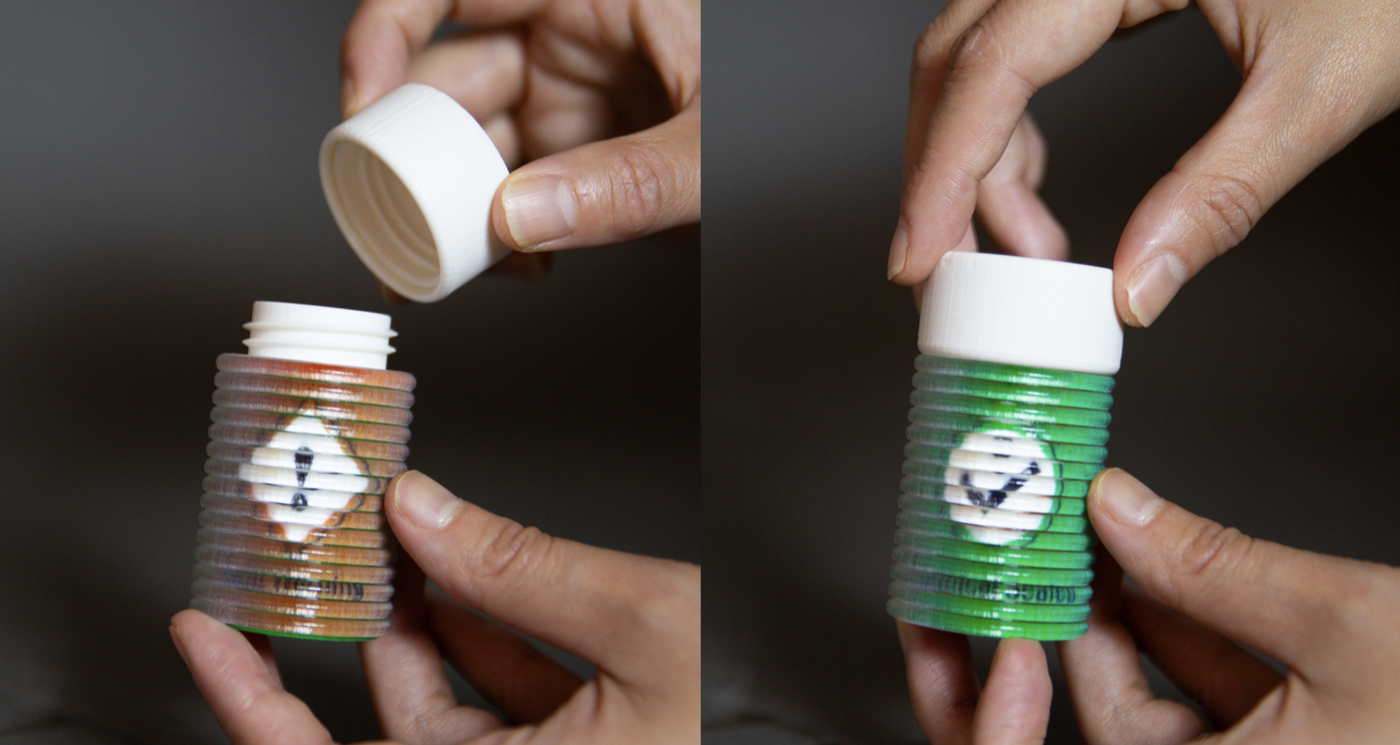
When the top lenticular lens layer is subjected to a mechanical shift—induced by user interaction—it effectively aligns different sections of the underlying patterned backplane to be visible. The lenticular lenses then magnify these displayed sections, thereby altering the perceived surface appearance of the object. This process allows for seamless transitions between multiple visual states, controlled entirely by physical movement.
Demonstrating the Potential: From Packaging to Personal Care
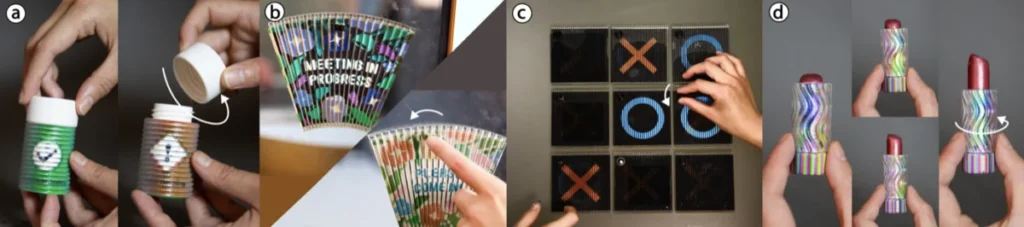
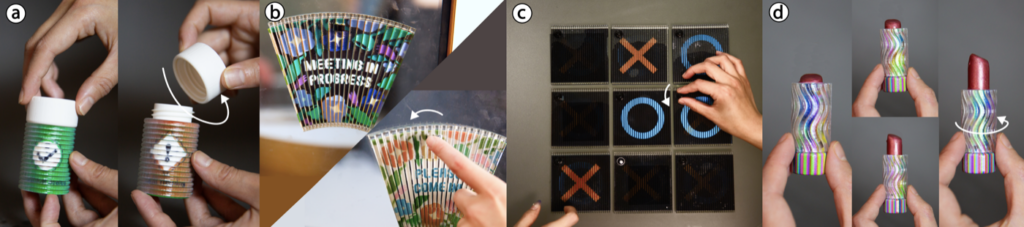
The practical applications of ShiftLens are diverse and compelling. One notable example demonstrated by the researchers is packaging that can alert users if any fasteners, such as caps or lids, have come loose. For instance, a chemical bottle could be designed to display a clear safety warning if its cap is not properly secured. This feature is particularly valuable in laboratory or industrial settings where the incorrect handling of hazardous materials can have severe consequences.
"I cannot begin to articulate how helpful something like this latter example could be at the end of a long day in the lab, when you’re so tired you’re practically sleepwalking, and completing your final tasks on autopilot," commented one observer familiar with laboratory safety protocols. "That is exactly when mistakes happen. So having a bottle that physically changes color when the dangerous materials inside aren’t properly secured could be a game-changer."
Another compelling application is a door sign that can toggle between two distinct messages simply by being flipped. Imagine a conference room door that displays "In Use" on one side and "Available" on the other, with the switch being a physical rotation or flip of the sign itself. Furthermore, the system can create interactive game boards, such as a tic-tac-toe board where individual cells can be activated or changed by rotating knobs. In the realm of personal care, a lipstick tube could be designed to display a gradient of colors as the barrel is rotated, offering a unique and engaging user experience. These examples highlight the versatility of ShiftLens in transforming static objects into dynamic, informative, and interactive tools.
The Design Tool: Simplifying Complexity
A critical component of the ShiftLens system is a user-friendly computational design tool developed by the research team. This tool automates the complex process of translating a desired interactive visual effect into a printable 3D model. Users provide basic inputs, such as the geometric shape of the object, the desired visual states, and the type of mechanical interaction they wish to implement (e.g., pressing, sliding, rotating). The tool then automatically generates the optimal ShiftLens structure, including the precise geometry of the lenticular lenses, the pattern of the backplane, and the integrated actuation mechanisms required for single-pass multi-material 3D printing.
"To make these transitions reliable, we introduce actuation mechanisms that translate inputs such as pressing, sliding, and rotating into repeatable surface changes," the team explained in their paper. "We also contribute a computational design tool that takes 3D geometry, desired appearances, and actuation types as input, and automatically generates the lenses, patterns, and actuation mechanism geometry for single-pass multi-material 3D printing." This automated design process significantly lowers the barrier to entry for creators, enabling them to leverage the power of ShiftLens without requiring deep expertise in optics or mechanical engineering.
Addressing Design Challenges and Limitations
Despite the system’s advancements, the researchers acknowledge certain challenges encountered during development. One of the most significant hurdles was ensuring the precise alignment of the mechanically actuated optical effects, computational graphics, and mechanical linkages. Achieving reliable and repeatable visual transitions required meticulous design and integration.
Another challenge lies in effectively communicating the capabilities and limitations of the ShiftLens design tool to users who may not have a background in optics or mechanical structures. "Zhu said that, ‘Another challenge is to communicate to users who are not familiar with optics or mechanical structures and let them specify and achieve what they have in mind.’" Guiding users to articulate their design intentions in a way that the tool can interpret is crucial for successful implementation.
Furthermore, the ShiftLens system is inherently reliant on a shifting motion to create the interaction between the optical layers. This means it is not universally applicable to all object designs. The system is best suited for objects that already incorporate a natural mechanism for movement, such as a rotating lipstick tube, or for designs where an actuation mechanism, like a knob, roller, or switch, can be readily integrated. As Zhu noted, ShiftLens users "can control what an object looks like while they are using it," highlighting the active and intentional nature of the interaction.
Future Implications and Broader Impact
The ShiftLens system, developed with the aim of simplifying fabrication for makers and designers, holds immense potential for broader applications across various industries. The researchers envision its scalability for architectural, commercial, and industrial uses. For example, the platform could be used to design 3D printed piping that visually indicates the location of a leak by changing its appearance, offering a direct and intuitive alert system, much like the color-changing chemical bottle.
In architectural contexts, ShiftLens could be used to create dynamic facades or interior elements that respond to environmental conditions or user presence. Commercially, it could lead to more engaging product packaging and interactive displays. Industrially, it offers a robust method for creating self-indicating tools and equipment, enhancing safety and operational efficiency.
The research team is slated to present their findings at the upcoming ACM Symposium on User Interface Software and Technology in Detroit. Looking ahead, they plan to further refine the ShiftLens design process by developing an algorithm that requires fewer user inputs, making the system even more accessible. This ongoing work underscores a commitment to pushing the boundaries of interactive object design and making advanced additive manufacturing capabilities available to a wider audience.
The development of ShiftLens represents a significant step forward in the field of interactive design and 3D printing. By decoupling interactivity from fragile electronics and embracing robust mechanical principles, the system offers a durable, intuitive, and versatile approach to creating objects that can communicate and respond to their users. This innovation promises to unlock new possibilities for product design, user experience, and functional integration across a multitude of applications.