Achieving true precision in advanced manufacturing and scientific applications is a multifaceted endeavor that extends far beyond the sum of individual component specifications. While the mechanical attributes of actuators, the performance curves of motors, and the sophisticated algorithms of drives and controls are undeniably critical, their optimal functionality hinges on one often-underestimated factor: expert system integration. This article, the fourth and final installment in a comprehensive series, delves into how a holistic focus on system integration is indispensable for unlocking the full potential of high-precision motion control applications, transforming theoretical capabilities into tangible, real-world performance. Corey Foster, Director of Automation Sales & Application Engineering at Valin Corporation, has guided this series, illuminating the intricate layers that contribute to — or detract from — overall system accuracy and repeatability.
The Evolution of Precision: From Components to Integrated Systems
For decades, the pursuit of enhanced performance in motion control often began and ended with scrutinizing component datasheets. Actuators were benchmarked by their repeatability, accuracy, and load capacity; motors by their torque, speed, and efficiency; and drives by their current output and control bandwidth. While these individual metrics remain foundational, the demands of modern industrial and scientific landscapes have evolved dramatically. Industries such as semiconductor manufacturing, advanced medical device fabrication, nanotechnology research, and high-throughput automation now routinely require micron and even sub-micron level precision, pushing the boundaries of traditional engineering.
The previous articles in this series systematically dissected the critical factors influencing precision. Part one meticulously examined the mechanics, highlighting often-overlooked elements like bearing deflection, body stiffness, and structural smoothness. Part two shifted focus to the motors, exploring their diverse designs, construction quality, and intrinsic characteristics that dictate performance. The third installment brought into sharp relief the sophisticated designs and crucial features of modern drives and controls, emphasizing their role in translating commands into precise movements. This final article synthesizes these insights, positing that without meticulous system integration, the superior qualities of individual components risk being compromised, leading to performance gaps that can undermine an entire application. The underlying theme throughout this exploration has been clear: critical details that rarely appear on a datasheet can, and often do, determine the success or failure of high-performance motion systems.
The Imperative of Intentional Integration: Beyond Basic Functionality
The concept of "plug-and-play" often holds true for basic systems where tolerance stacks are generous, and precision requirements are moderate. However, as motion systems venture into the realm of micron-level accuracy and beyond, the notion that components will simply "work" when assembled becomes a perilous assumption. The analogy of a paper airplane, simple yet illustrative, underscores this point. An initial, hastily folded airplane might fly, but its performance degrades over time. To achieve greater distance or a straighter trajectory, the folds must become exquisitely precise, reflecting a deeper understanding of aerodynamics and material interaction.
Similarly, in motion control, initial assembly might yield seemingly acceptable results. However, as operational demands increase, or as systems age, inherent integration flaws begin to manifest. What might pass as acceptable in a proof-of-concept phase becomes a critical bottleneck for next-generation performance or long-term reliability. Optimal system performance, therefore, does not emerge from the mere aggregation of high-specification subsystems; it is meticulously engineered through a comprehensive understanding of how these components interact and influence each other within the broader operational environment.
Corey Foster consistently emphasizes that true precision is not an accidental byproduct but the direct result of deliberate design and rigorous integration. Every specification listed on a component’s datasheet is predicated on a set of "hidden assumptions" about its operational environment. For instance, mechanical actuators assume a certain degree of flatness and stability from their mounting surfaces. Motors are designed assuming adequate airflow for cooling and an effective heat sink. Drives and controllers require clean, stable electrical power. A failure to meet these foundational assumptions, however minor they may seem, can cascade into significant performance degradation across the entire system.
Real-World Integration Challenges and Their Consequences
The absence of meticulous system integration can lead to a host of real-world failures, often proving costly in terms of downtime, rework, and compromised product quality. Understanding these common pitfalls is the first step toward effective mitigation.
-
Mechanical Misalignment and Mounting Surface Imperfections: One of the most common issues arises from the interface between mechanical actuators and their mounting surfaces. A precision linear motor, for example, is highly sensitive to the flatness and rigidity of the surface it is mounted on, as well as its precise alignment with accompanying linear bearings. If these components, forming a critical three-component system, are not perfectly aligned, mechanical binding can occur. Even minute deviations, perhaps just a few microns over a meter, can induce uneven friction, accelerate wear on bearing surfaces, increase motor load, and in severe cases, completely impede motion. Such binding not only compromises positional accuracy and repeatability but also leads to increased energy consumption and shortened component lifespans. Industry studies indicate that even slight non-planarity in mounting surfaces (e.g., exceeding 5-10 microns per 300mm) can reduce the effective lifespan of linear guides by up to 20-30% due to localized stress concentrations.
-
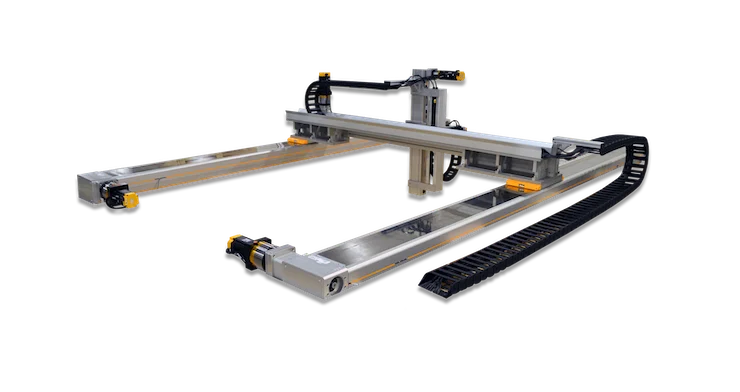
Differential Performance in Multi-Axis Systems: Gantry systems, often employing two parallel linear belt and pulley actuators, present unique integration challenges. Beyond the need for precise parallelism, these actuators require their travel lengths to be meticulously tuned to match each other. Variations in belt tension, even subtle ones, can alter the effective distance per revolution of the pulley. While seemingly minor over short distances, this variance can accumulate significantly over longer travels. For instance, a 0.1% difference in effective travel per revolution could lead to a 2mm variance between two actuators over a 2-meter stroke, an unacceptable error in applications demanding micron-level synchronization. This differential travel can induce damaging racking forces, lead to system skew, and ultimately compromise the integrity and precision of the overall motion profile.
-
Electrical Noise and Power Quality: Controllers and drives are frequently developed and tested in controlled laboratory environments, where electrical power is typically clean and stable. In such settings, shortcuts in grounding techniques, shielding, or the omission of Electromagnetic Compatibility (EMC) filters might go unnoticed. However, when these same systems are deployed into real-world industrial environments, they become susceptible to "dirty power" sources. Industrial settings are rife with electrical noise from motors, welding equipment, power surges, and radio frequency interference. Without proper grounding, robust shielding, and effective EMC filtering, these external electrical disturbances can corrupt low-power control signals, introduce noise into feedback loops, cause erratic system behavior, and even lead to component damage. The cost of addressing such issues post-deployment can be astronomically higher than implementing preventative measures during initial integration. According to a 2022 survey by the Electrical Apparatus Service Association (EASA), power quality issues are responsible for up to 15% of unexpected industrial equipment failures.
-
Thermal Expansion and Environmental Sensitivity: The operating environment itself is a critical, often underestimated, integration factor. A system assembled and calibrated in a temperate workshop can exhibit drastically different performance when deployed in a hot or rapidly changing thermal environment. Thermal expansion and contraction can directly impact mechanical alignments, induce stresses in components, and alter the performance characteristics of motors and sensors. For example, a 1-meter aluminum component can expand by approximately 24 microns for every degree Celsius increase in temperature. In high-precision applications, even a few degrees of temperature fluctuation can translate into significant positional errors, rendering the system incapable of meeting its performance specifications. Moreover, variations in humidity can affect certain materials and electronic components, while ambient vibrations can introduce noise into sensitive motion profiles.
Best Practices for Achieving Seamless Integration

To overcome these challenges and ensure high-precision motion control systems perform to their utmost, a systematic approach to integration, incorporating several key practices, is essential.
-
Precision Mounting and Alignment: The foundation of any high-precision system is its mechanical integrity. Mounting surfaces for actuators must be machined to meet or exceed the flatness and rigidity standards specified by the component manufacturers and demanded by the application. The use of precision dowel pins is highly recommended to ensure repeatable assembly and re-assembly, maintaining precise alignment even after maintenance or component replacement. For multi-axis systems, techniques such as shimming, precision grinding, and laser alignment tools are indispensable for achieving and verifying sub-micron level parallelism and orthogonality.
-
Encoder Integration and Calibration: Encoders, whether linear, rotary, or ring-type, are the eyes of the motion control system, providing critical feedback on position and velocity. Their proper alignment is paramount. This often necessitates specialized fixtures and advanced measurement tools, such as laser interferometers, autocollimators, and precision gauges, during the installation and calibration phases. Environmental factors like temperature stability during calibration are also crucial, as thermal gradients can introduce measurement errors. The mounting of the encoder reading head and scale must be free of stress and perfectly aligned to avoid cosine error or signal degradation.
-
Meticulous Cable Routing and Shielding: Cable management is a discipline often overlooked but critical for signal integrity. Best practices dictate strict separation of high-power cables (e.g., motor power) from low-power signal cables (e.g., encoder feedback, communication lines). These should ideally run in separate conduits or trays, or at the very least, cross perpendicularly rather than running in parallel over long distances to minimize electromagnetic interference (EMI). Proper shielding (e.g., braided or foil shields) and grounding techniques (avoiding ground loops) are vital to protect sensitive signals from external noise. Furthermore, coiling excess high-power cable should be avoided as it can create inductive loops that amplify electrical noise.
-
Environmental Control and Isolation: For ultra-high precision systems, isolating the motion platform from its surrounding environment is paramount. This includes:
- Vibration Dampening: Implementing active or passive vibration isolation systems (e.g., pneumatic isolators, elastomeric pads) to decouple the system from floor vibrations caused by nearby machinery or foot traffic.
- Temperature and Humidity Control: Operating within strictly temperature-controlled environments (e.g., cleanrooms) to mitigate thermal expansion effects. Humidity control can prevent condensation and protect sensitive electronics.
- Isolated Foundations: For the most demanding applications, the entire motion system may be mounted on a separate, dedicated foundation, structurally isolated from the rest of the facility to prevent transmission of ground-borne vibrations.
-
Comprehensive Testing and Validation: Integration is not complete until the entire system has undergone rigorous testing and validation. This includes not just functional testing but also acceptance testing, environmental stress screening, and long-term durability testing under simulated operational conditions. Data logging and analysis of key performance parameters (e.g., positional accuracy, repeatability, settling time, thermal drift) are crucial to verify that the integrated system meets or exceeds its specified performance targets.
Broader Impact and Implications
The emphasis on expert system integration carries significant implications across various sectors. Economically, neglecting integration leads to substantial costs associated with debugging, re-engineering, warranty claims, and production downtime. Conversely, investing in meticulous integration from the outset can yield significant returns through enhanced reliability, improved product quality, reduced operational expenses, and faster time-to-market for new products.
From a competitive standpoint, companies that master system integration gain a distinct advantage. Their ability to deliver truly high-precision solutions enables them to tackle more complex applications, enter niche markets, and innovate at a faster pace. This is particularly evident in fields like advanced robotics, where seamless integration allows for more agile and precise manipulation, or in additive manufacturing, where layer-by-layer accuracy is paramount.
Looking ahead, the convergence of advanced sensor technologies, artificial intelligence, and digital twin simulations promises to further enhance integration capabilities. AI and machine learning algorithms can analyze vast datasets from integrated systems to predict potential failures, optimize performance in real-time, and even adapt control parameters based on environmental conditions. Digital twins allow for comprehensive virtual prototyping and testing of integrated systems, identifying potential issues long before physical assembly.
Conclusion: The Systems Engineer’s Imperative
This series has underscored a fundamental truth in high-precision motion control: performance is a holistic characteristic, not merely a sum of individual component specifications. From the inherent stiffness of mechanical stages to the sophisticated algorithms of digital controls, and ultimately, to the meticulous integration of all these elements, every layer contributes to the final outcome. Corey Foster’s consistent message resonates deeply: the unasked questions and the overlooked details are precisely what will ultimately haunt a system’s performance.
In an era of ever-increasing demands for precision, engineers, designers, and system integrators must transition from merely selecting components to becoming true "systems engineers." This paradigm shift involves understanding the intricate interdependencies, anticipating potential points of failure, and meticulously planning every aspect of integration. It is only through this comprehensive, intentional approach that the elusive goal of true precision in motion control can be consistently achieved, driving innovation and unlocking new frontiers in technology.
Read the other installments in this series:
Part 1: Layers of performance and specifications in motion control
Part 2: Layers of performance and specifications in motion control
Part 3: Layers of performance and specifications in motion control