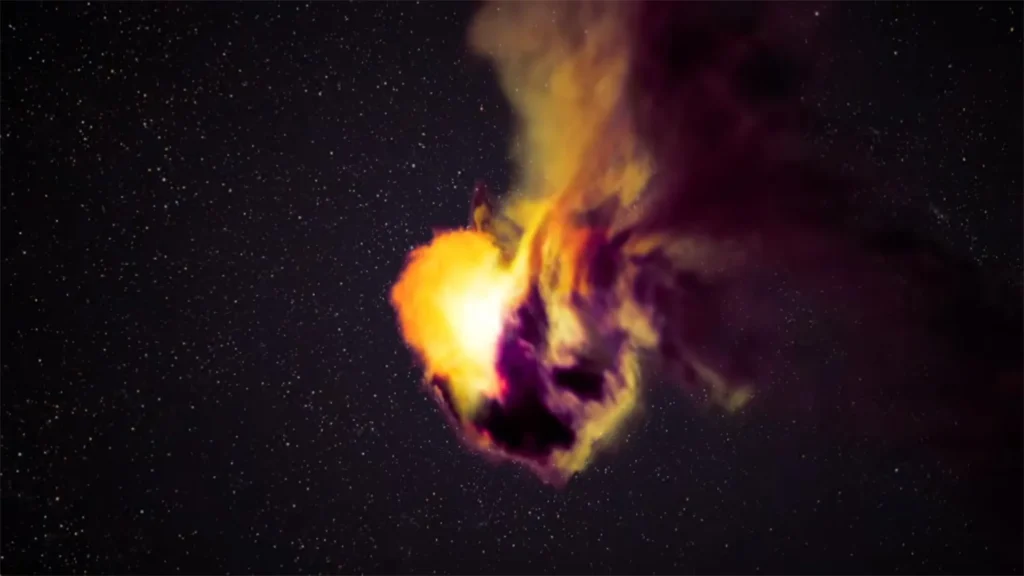
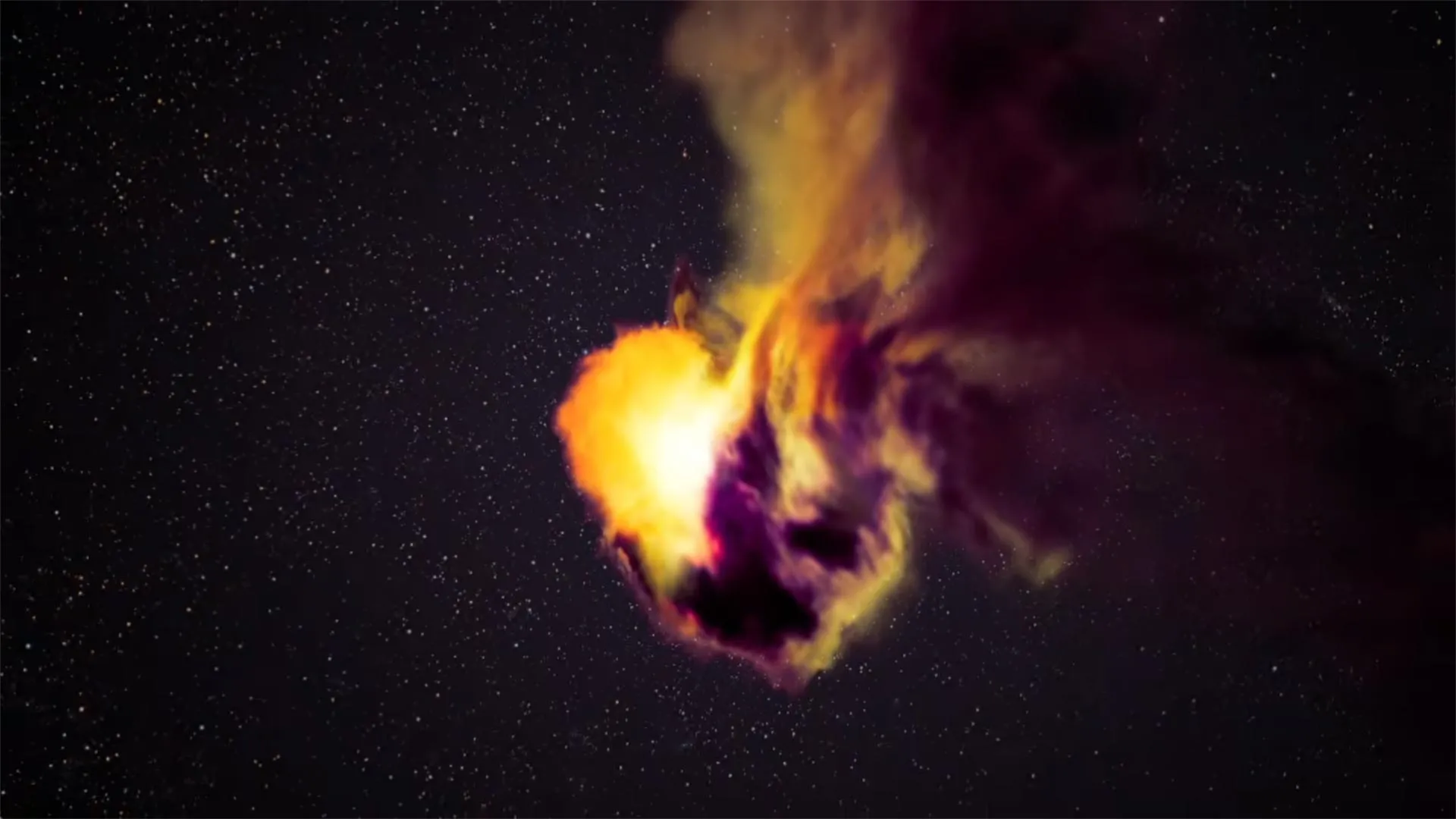
In a milestone discovery for stellar archaeology, a global team of researchers has successfully observed the innermost chemical layers of a massive star as it underwent a violent death. The event, identified as supernova SN 2021yfj, represents a rare class of stellar explosion known as an “extremely stripped supernova.” By capturing the spectral signature of this event, scientists have managed to peek behind the curtain of the outer gas layers that typically obscure the final stages of a star’s life, providing the first direct evidence of the silicon-rich environment that exists just moments before a core-collapse catastrophe.
The findings, led by Dr. Steve Schulze of Northwestern University and published in the journal Nature, offer a profound validation of the theoretical models that have guided astrophysics for decades. While the general progression of nuclear fusion within stars has been mathematically predicted, the opportunity to observe the deep interior of a star—specifically the layers formed in the final months and days of its existence—has remained elusive until now. SN 2021yfj has effectively provided a cross-section of a dying star, revealing the complex chemical factory that fuels the evolution of the universe.
The Mechanics of Stellar Nucleosynthesis
To understand the significance of SN 2021yfj, one must first examine the standard lifecycle of a massive star. Stars are effectively massive nuclear reactors, sustained by the delicate balance between the inward pull of gravity and the outward pressure generated by nuclear fusion. This process begins with the fusion of hydrogen into helium, a stage that can last for millions or even billions of years depending on the star’s initial mass.
As the hydrogen in the core is exhausted, the star contracts, increasing the temperature and pressure until it can begin fusing helium into carbon. This "onion-skin" model continues through a series of increasingly heavy elements. After carbon comes neon, then oxygen, and finally silicon. Each successive stage of fusion is significantly more efficient but shorter-lived than the last. While the hydrogen-burning phase represents the vast majority of a star’s life, the final transition—fusing silicon into iron—occurs with startling rapidity, often concluding in a matter of days.
The result of this process is a layered structure. The outermost shell consists of hydrogen, followed by helium, carbon, neon, oxygen, and silicon, all surrounding a core that is gradually filling with iron. Under normal circumstances, when a star explodes, the resulting supernova is dominated by the light from the outermost layers—usually hydrogen or helium. These layers act as a shroud, preventing astronomers from seeing the heavier elements being forged in the deep interior.
The Anomaly of SN 2021yfj
SN 2021yfj is distinct because it lacked these traditional outer shrouds. In most core-collapse supernovae, the explosion must punch through massive envelopes of hydrogen or helium. In "stripped-envelope" supernovae, these outer layers have been removed by stellar winds or other mechanisms. However, SN 2021yfj belongs to an even more extreme category.
According to the data presented by Schulze and his colleagues, the star that produced SN 2021yfj had been stripped down past its hydrogen, helium, and even its carbon and oxygen layers. When the explosion occurred, the material ejected into the surrounding space was dominated by silicon. This is an extraordinary observation because the silicon layer is the final stable layer produced before the iron core collapses.
The detection of a thick shell of silicon gas surrounding the supernova indicates that this material was expelled from the star a mere few months before the final explosion. In the context of a star that may have lived for ten million years, a few months is the blink of an eye. The discovery provides a rare "real-time" look at the final gasps of a massive star and confirms that the silicon-burning phase proceeds exactly as predicted by the laws of nuclear physics.
The Mystery of the Missing Layers
The primary question facing the research team was how a star could lose so much of its mass so quickly. While massive stars possess powerful stellar winds—streams of charged particles ejected from the upper atmosphere—these winds are generally not strong enough to strip a star down to its silicon layer. If stellar winds alone were responsible, the process would likely take far longer than the star’s remaining lifespan.
The most plausible explanation, according to the study, involves a "binary interaction." Most massive stars do not live in isolation; they are born in pairs or small groups. In a binary system, if two stars are sufficiently close, the gravity of the companion star can act like a vacuum, siphoning off the outer layers of its neighbor. This process, known as Roche lobe overflow, can rapidly denude a star of its hydrogen and helium.
In the case of SN 2021yfj, the stripping was so thorough that even the carbon and oxygen layers were removed or significantly diminished. This suggests a highly violent interaction, perhaps involving a common-envelope phase where the two stars briefly shared a single atmosphere, or a scenario where the companion star was a compact object like a neutron star or a black hole, exerting immense tidal forces on the dying primary star.
Chronology of the Discovery and Analysis
The detection of SN 2021yfj followed a rigorous timeline of observation and cross-institutional collaboration. The event was first flagged by automated transient surveys, which scan the night sky for sudden changes in brightness.
- Initial Detection (2021): The supernova was identified as a rapidly brightening point of light. Early spectroscopic analysis showed an unusual lack of hydrogen, immediately marking it as a candidate for a stripped-envelope supernova.
- Follow-up Observations: Over the following weeks, ground-based observatories, including those utilized by the Northwestern team, began capturing high-resolution spectra. This data revealed the presence of ionized silicon moving at high velocities.
- Data Synthesis (2022-2023): Researchers spent nearly two years modeling the light curve (the change in brightness over time) and the spectral evolution. They compared the data against thousands of other supernovae to confirm that the silicon signature was unprecedented in its purity and volume.
- Publication (2025): The final analysis, confirming the "extremely stripped" nature of the event and its implications for stellar evolution, was peer-reviewed and published in Nature.
Broader Implications for Galactic Evolution
The study of SN 2021yfj is not merely an exercise in stellar anatomy; it has fundamental implications for our understanding of the universe’s chemical history. Every atom in the human body, with the exception of hydrogen and some lithium, was forged inside a star. This concept, often summarized by the phrase "we are made of starstuff," relies on supernovae to distribute these elements into the interstellar medium.
Supernovae are the primary source of the universe’s oxygen, neon, magnesium, and silicon. These elements are essential for the formation of terrestrial planets and the biological molecules required for life. By observing the silicon layer of SN 2021yfj, astronomers can more accurately calculate the "yield" of a supernova—the specific amount of each element that is contributed to the galaxy upon a star’s death.
Furthermore, the discovery sheds light on the "early universe" paradox. In the first few billion years after the Big Bang, stars were composed almost entirely of hydrogen and helium. These early stars burned hotter and died faster, and the planets that formed around them (if any) would have been gas giants devoid of solid rocky surfaces. The transition from a universe of gas to a universe of rocks and life required billions of years of supernovae to "pollute" space with heavier elements. SN 2021yfj provides a blueprint for how this enrichment process occurred, showing how the deepest, most precious elements are finally liberated from their stellar cradles.
Scientific Consensus and Future Research
The astrophysics community has responded to the Northwestern study with considerable interest. Independent researchers note that SN 2021yfj may represent a "missing link" between standard Type Ic supernovae (which are stripped of H and He) and even more exotic events like kilonovae (the merger of two neutron stars).
"This observation bridges the gap between theoretical physics and observational astronomy," noted one independent reviewer. "We have had the math for silicon burning for decades, but seeing the physical evidence of that layer being cast off just before the core collapses is a transformative moment for the field."
Looking forward, the research team intends to use the James Webb Space Telescope (JWST) and the upcoming Vera C. Rubin Observatory to search for more "extremely stripped" candidates. If these events are more common than previously thought, it could change our estimates of how much heavy-element material is floating in the "void" between stars.
As technology improves, astronomers hope to catch a star in the act of losing these deep layers before the explosion occurs. Such a discovery would allow for a countdown to a supernova, providing a front-row seat to the most violent and creative act in the cosmos. For now, SN 2021yfj stands as a singular monument to the complex, layered history of the stars and the violent processes that made the modern universe possible.