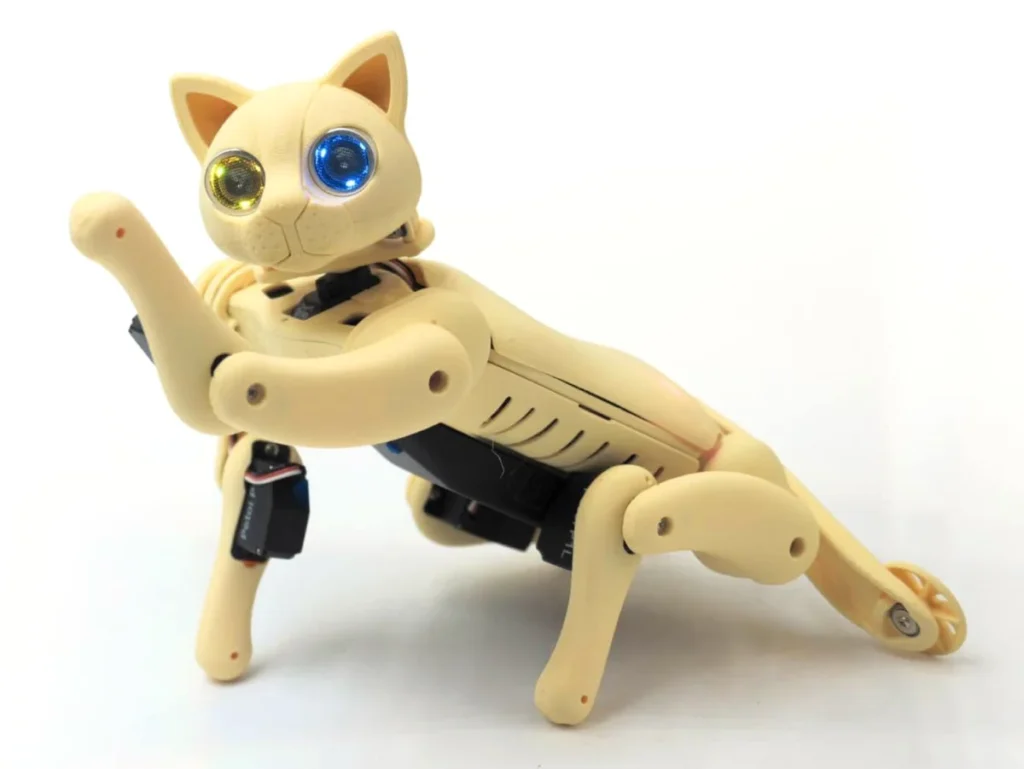
Petoi, a prominent manufacturer in the educational robotics sector, continues to push the boundaries of accessible, programmable robotics with its latest iterations, the Nybble Q robotic cat and the Bittle X V2 robotic dog. These palm-sized quadruped robots, reviewed at prices of $435 for the Nybble Q and $469 for the Bittle X V2 (including an optional arm), represent a significant advancement in offering sophisticated robotics to both enthusiasts and educational institutions. Featured in Make: Vol 94, these devices are designed not merely as impressive toys but as robust platforms for deep exploration into coding, mechanics, and artificial intelligence, bridging the gap between complex engineering and hands-on learning.
Deep Dive: Nybble Q – The Agile Feline
The Nybble Q, presented as the reviewer’s preferred demonstration piece, stands out with its intricate design and responsive functionalities. As a servo-packed, palm-sized robot, it comes pre-programmed with a diverse range of voice commands, allowing for immediate interactive engagement. This out-of-the-box functionality has proven to be a compelling feature, even inspiring educators to consider its integration into classroom settings as a dynamic teaching tool. The robot’s initial appeal lies in its immediate fun factor, but its true potential unfolds through its extensive programmability. Users can control Nybble Q via mobile and desktop applications, leveraging established programming languages and environments such as Arduino, Python, and Mind+ block coding. This multi-tiered approach caters to a broad spectrum of users, from beginners utilizing visual block coding to advanced developers writing custom scripts, supported by accompanying educational lessons designed to facilitate a structured learning path.
While the reviewer’s units arrived preassembled, illustrating Petoi’s commitment to user accessibility, minor troubleshooting was noted, such as a servo plug adjustment for the tail wagging function. This minor hiccup, quickly resolved, underscores the hands-on nature inherent in these "intermediate projects." A standout feature of the Nybble Q is its impressive voice recognition capabilities. Despite occasional amusing misinterpretations, the accuracy of audio commands proved sufficiently robust, often negating the need for the micro:bit-powered remote control. Furthermore, the integration of an onboard Inertial Measurement Unit (IMU) allows the robot to detect falls and intelligently attempt to self-right, a sophisticated behavior that adds to its realistic pet-like qualities, even if requiring a few seconds on smoother surfaces to regain balance.
The Nybble Q builds upon its predecessor, the wooden Nybble, which already offered a premium experience over the basic Bittle dog robot. Key enhancements in the Q model include an additional servo dedicated to tail wagging, integrated distance sensors, and color-changing eyes that subtly indicate different states or "moods." The Q variant further elevates the platform with a sleek, durable 3D-printed body, an upgraded control board, and enhanced servos for smoother, more precise movements. A significant technical upgrade is the servo feedback control, enabling users to manually manipulate the robot’s limbs to design and record custom actions, offering an intuitive method for choreographing complex movements. For those seeking even greater computational power, the Nybble Q supports integration with a Raspberry Pi, allowing for the distribution of cognitive load between the Raspberry Pi and the primary BiBoard V1.0, thereby expanding its potential for advanced AI and complex sensor processing. The value proposition is further bolstered by a comprehensive curriculum and an active online community, providing invaluable support and resources for users navigating hardware documentation or seeking creative inspiration.

Deep Dive: Bittle X V2 – The Versatile Canine
The Bittle X V2 robotic dog presents an equally compelling platform, distinguished by its own set of advanced features and modular expandability. This upgraded model, a successor to the basic Bittle, incorporates built-in voice control and an enhanced ESP32-based control board. While it lacks the ultrasonic eyes found on the Nybble Q, the Bittle X V2 compensates with versatile expansion capabilities. Its mouth area can accommodate a variety of modular sensors, including light, motion, and gesture sensors, allowing for customized interaction and environmental awareness. For advanced applications, an optional AI camera module can be integrated, opening avenues for computer vision projects and more sophisticated autonomous behaviors.
The Bittle X V2 also offers a unique, albeit pricier, configuration: a robot arm that replaces the traditional head. This arm, surprisingly robust, enables the robot to perform tasks such as picking up and tossing small objects using unlockable macros. While the arm demonstrates impressive strength and utility for specific manipulative tasks, the reviewer expressed a preference for the standard Bittle configuration with a head, citing its superior nimbleness and broader expandability for general robotics projects.
Similar to the Nybble Q, the Bittle X V2 is positioned as an "intermediate project," meaning it’s not a mere consumer toy but a semi-assembled, customizable platform. While circuit boards are pre-assembled, users are encouraged to interact with the internal components for upgrades or modifications. For instance, adding a Grove sensor might involve disassembling certain parts. The reviewer noted that accessing Nybble’s internal components to adjust a servo connector was tool-free and quick, though it exposed delicate internal ribbon cables, highlighting the balance between accessibility for modification and the need for careful handling. The Bittle X V2 kit, available without the arm, remains a robust and capable robot, offering a solid foundation for robotics exploration. The choice between Nybble Q and Bittle X V2 often comes down to specific project needs: Nybble’s integrated distance sensors and aesthetic appeal are ideal for autonomous navigation and interactive display, while Bittle’s modularity, especially with its sensor-ready mouth and optional arm, offers greater versatility for manipulative tasks and diverse sensor integration. Both platforms, however, serve as excellent starting points for individuals eager to delve into the world of robotics.
The Power of Programmability: A Gateway to STEM
Central to the appeal of Petoi robots is their robust programmability, which positions them as invaluable tools for STEM education. The availability of multiple programming interfaces – Arduino, Python, and Mind+ block coding – ensures accessibility for learners at various stages of their coding journey. Mind+ block coding, a visual programming language, provides an intuitive entry point for beginners, allowing them to grasp fundamental programming concepts through drag-and-drop blocks, similar to Scratch. This visual approach reduces the initial cognitive load, enabling younger students or those new to coding to quickly see their instructions translate into physical robot movements.

For intermediate users, Arduino offers a platform to delve into C++ based programming, interacting directly with the robot’s hardware and understanding low-level control. This is crucial for developing a deeper understanding of embedded systems and real-time control. Advanced users can leverage Python, a widely used language in robotics and AI, to implement complex algorithms, integrate machine learning models, and develop sophisticated autonomous behaviors. Python’s extensive libraries and ease of use make it ideal for experimenting with computer vision, pathfinding, and advanced sensor data processing. The structured curriculum accompanying these robots further enhances their educational value, guiding users through a series of lessons that progressively build their skills in robotics, programming, and problem-solving. This comprehensive educational framework is vital for fostering computational thinking, engineering design principles, and a foundational understanding of artificial intelligence, preparing students for future careers in technology and innovation.
Hardware Under the Hood: The Brains and Brawn
The advanced capabilities of Nybble Q and Bittle X V2 are underpinned by sophisticated hardware architectures. The Nybble Q’s upgraded board and the Bittle X V2’s ESP32-based board serve as the primary control units, managing servo movements, sensor inputs, and communication protocols. The ESP32, a powerful microcontroller with integrated Wi-Fi and Bluetooth, provides ample processing power for real-time control and connectivity, enabling wireless programming and command execution.
For users seeking to push the boundaries of their robots, the option to integrate a Raspberry Pi is a game-changer. The Raspberry Pi, a full-fledged single-board computer, offers significantly more computational horsepower than a typical microcontroller. This allows the robots to handle more complex tasks, such as on-board image processing from an AI camera module, running advanced AI inference models, or managing intricate multi-sensor fusion algorithms. By sharing the cognitive load between the Raspberry Pi and the BiBoard V1.0 (the core control board), Petoi robots transform from mere programmable toys into miniature research platforms capable of tackling challenging robotics problems. This dual-processor approach provides flexibility, allowing the microcontroller to handle time-critical motor control while the Raspberry Pi manages higher-level decision-making and perception tasks.
Designed for Engagement: User Experience and Community
Petoi robots are designed with user engagement at their core. The inclusion of voice control, as highlighted by its impressive accuracy, provides a natural and intuitive interface for interaction, making the robots feel more alive and responsive. The IMU’s self-righting capability, while occasionally taking a moment on smooth surfaces, is a testament to the intelligent design aimed at enhancing durability and user experience, minimizing frustration from frequent tumbles. These features contribute significantly to the robots’ appeal, transforming them from static programmable devices into dynamic, interactive companions.

Beyond the hardware and software, the strength of the Petoi ecosystem lies in its vibrant and active online community. This community acts as a crucial support system, offering solutions to hardware documentation queries, sharing custom code, and inspiring new project ideas. In the realm of open-source hardware and educational robotics, a strong community fosters collaboration, accelerates learning, and extends the lifespan and utility of the products. Furthermore, the provided curriculum is not merely an afterthought but a well-integrated component designed to guide users through the complexities of robotics, ensuring that the learning curve is manageable and rewarding. This combination of intuitive design, robust functionality, and strong community support creates a rich environment for both hobbyists and educators.
The Maker Ethos: Balancing Accessibility and Customization
Petoi’s philosophy aligns closely with the "maker ethos," promoting a balance between offering a functional, semi-assembled product and encouraging hands-on customization and deeper understanding. The designation of these robots as "intermediate projects" signifies that while the most challenging aspects of circuit board assembly and fundamental programming are handled by the manufacturer, users are not locked out from further exploration. The design facilitates easy access for modifications, such as adding Grove sensors or adjusting internal wiring, as demonstrated by the simple, tool-free access to Nybble’s back for servo adjustments. This approach empowers users to move beyond mere consumption of technology to active creation and modification, fostering a genuine engineering mindset.
This design choice has significant implications for education. It allows educators to introduce advanced robotics concepts without requiring students to start from scratch with electronics design, enabling them to focus on programming, control systems, and application development. For hobbyists, it provides a sophisticated platform that can be endlessly tweaked, upgraded, and programmed to perform new functions, tapping into the creative potential of the maker community. The durability offered by Bittle’s design for those seeking a more robust platform, versus Nybble’s sleeker, sensor-rich approach, further caters to diverse preferences within this community.
Market Position and Educational Impact
Petoi’s Nybble Q and Bittle X V2 are strategically positioned within the burgeoning educational robotics market. This sector has seen substantial growth in recent years, driven by a global emphasis on STEM education and the increasing recognition of robotics as a powerful tool for developing critical 21st-century skills. Market research indicates a compound annual growth rate (CAGR) for the educational robotics market, reflecting the demand for interactive learning tools that can demystify complex subjects like coding, engineering, and artificial intelligence. Petoi robots directly address this demand by offering platforms that are both engaging and technically capable.

The ability to program these robots using multiple languages, from visual blocks to Python, makes them suitable for a wide age range and skill levels, from elementary school students to university undergraduates and adult hobbyists. By providing a tangible, interactive medium, Petoi robots help translate abstract coding concepts into observable actions, making learning more concrete and enjoyable. The integration of sensors, voice control, and advanced computational options further prepares users for real-world applications of robotics and AI. The adoption of these robots in classrooms, as evidenced by the reviewer’s teacher friend, underscores their potential to revolutionize STEM education by providing hands-on, project-based learning experiences that foster innovation and problem-solving skills. Petoi is not just selling robots; it’s providing a comprehensive ecosystem for learning and creation in the exciting field of robotics.
In conclusion, Petoi’s Nybble Q and Bittle X V2 represent a compelling fusion of advanced robotics, educational utility, and open-ended programmability. These quadruped robots, with their sophisticated features, versatile programming options, and strong community support, stand as excellent entry points for anyone interested in robotics, whether for personal enrichment, academic pursuit, or creative exploration. By offering robust, customizable platforms that balance immediate fun with deep learning potential, Petoi continues to empower a new generation of makers, engineers, and innovators, solidifying its place as a key player in making advanced robotics accessible to a broader audience.