University of Maryland astronomers have achieved a groundbreaking discovery, identifying a dormant supermassive black hole situated an unprecedented distance from the center of its host galaxy. This landmark finding, published in The Astrophysical Journal Letters on July 27, 2026, marks the first time scientists have definitively located an inactive black hole so far removed from the gravitational nexus of a galactic core. The implications of this discovery are profound, challenging long-held assumptions about the distribution and behavior of these cosmic behemoths and opening new avenues for understanding galaxy evolution and black hole dynamics.
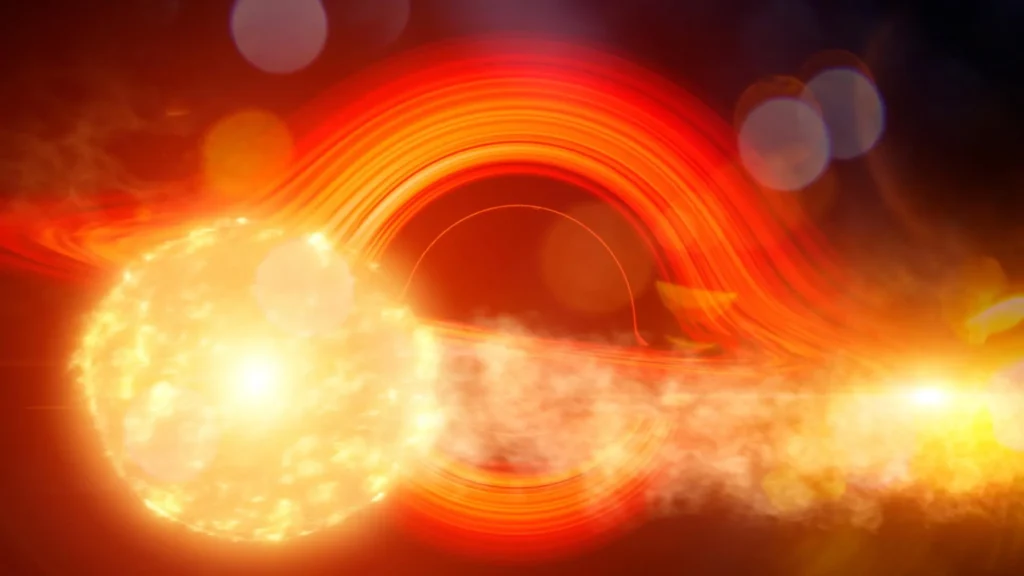
The black hole in question, a quiescent behemoth, would have remained invisible to astronomical observation. Its presence was only revealed through a dramatic and violent celestial event: the tidal disruption of a passing star. This catastrophic encounter, where the black hole’s immense gravitational pull ripped the star apart, unleashed a brief but intensely powerful burst of light, acting as a beacon that alerted researchers to the otherwise hidden object.
"This is a novel result," stated Suvi Gezari, an associate professor of astronomy at the University of Maryland and a co-author of the study. "What’s new is that, until now, we’ve started with the assumption that supermassive black holes reside in the centers of massive galaxies. This discovery will have a huge impact. It means that we’re going to find many more examples of wandering black holes, and we can understand how galaxies and their black holes merge and build up over time."
The Predicted but Elusive Wandering Black Hole
The existence of "wandering" or "rogue" black holes, displaced from their galactic centers, has been a theoretical prediction in astrophysics for decades. These colossal objects are thought to be ejected during cataclysmic galactic collisions and mergers, violent cosmic events where galaxies collide and coalesce. In these chaotic interactions, the gravitational dance of multiple black holes and vast stellar populations can result in the expulsion of one or more of these massive entities from the galactic core.
However, the extreme difficulty in detecting these wandering black holes has kept them largely in the realm of theory. Their quiescent nature – meaning they are not actively accreting matter and therefore not emitting detectable radiation – renders them effectively invisible to conventional telescopes. They can traverse the outer reaches of galaxies, blending into the cosmic background, without leaving any discernible energetic signature.
The breakthrough in this case was facilitated by the Zwicky Transient Facility (ZTF), a powerful sky survey instrument designed to scan vast portions of the universe. "The Zwicky Transient Facility ‘searches the whole universe’," explained Robert David Stein, the study’s lead author and a Neil Gehrels Prize Postdoctoral Fellow at the Joint Space-Science Institute, a research partnership between UMD’s Departments of Astronomy and Physics and NASA’s Goddard Space Flight Center (GSFC).
Artificial Intelligence Unlocks the Secret of a Stellar Flare
The ZTF, operating with two telescopes at the Palomar Observatory in San Diego County, California, conducts an exhaustive survey of the entire northern sky, completing a full sweep approximately every two days. This ambitious mission records hundreds of thousands of dynamic celestial events each night. The sheer volume of this data presents a significant challenge for human researchers, making it practically impossible to manually scrutinize every event for subtle signs of unusual activity, such as those indicative of a black hole’s presence.
To surmount this data deluge, the research team developed a sophisticated artificial intelligence (AI) program. This AI was meticulously trained to recognize the unique spectral and temporal signature of a tidal disruption event (TDE) – the telltale light pattern produced when a black hole tears apart a star. TDEs are transient phenomena that occur when a star ventures too close to a black hole and is overwhelmed by its tidal forces, leading to its disintegration. While TDEs have been observed before, they have predominantly been detected in the crowded environments near galactic centers. The AI system was specifically engineered to extend this search across the entire sky, irrespective of proximity to galactic nuclei.
The UMD researchers initiated the operation of this AI-driven search program in August 2025. Remarkably, within just three months, the AI flagged an event that would ultimately lead to the discovery of the wandering supermassive black hole.
Stein vividly recalled the moment of discovery: "I remember the moment we discovered it very clearly. It was a Saturday, and everyone was very excited to be messaging. We dropped everything and started triggering all kinds of other instruments to get more data. We weren’t really sure we would be successful so quickly, so it’s amazing that we found one so fast." This rapid success underscores the power of AI in accelerating astronomical discovery and the effectiveness of the developed algorithm.
A Supermassive Black Hole in an Unconventional Location
The identified supermassive black hole is located approximately 9.3 kiloparsecs (roughly 30,000 light-years) away from the center of its host galaxy. This distance is significant, placing it well into the galactic halo, far beyond the bustling stellar populations of the galactic disk and bulge. Its mass is estimated to be comparable to that of Sagittarius A*, the supermassive black hole at the heart of our own Milky Way galaxy, which has a mass of approximately 4 million solar masses.
Adding to the intrigue of this discovery is the apparent absence of a substantial, visible galaxy surrounding the black hole, according to Sylvain Veilleux, a UMD Astronomy Professor and co-author of the study. "To have such a big black hole outside of a galaxy is surprising to me," Veilleux commented. "There should be a Milky Way-like object around it — and that’s definitely not the case." This lack of a surrounding stellar population suggests a complex history for this object.
Researchers hypothesize that the black hole’s anomalous position is intricately linked to a past galactic merger event. Several plausible scenarios are being considered. One compelling explanation is that a larger galaxy has engulfed a smaller companion galaxy. Over eons, the dominant galaxy may have gravitationally stripped away nearly all the stars from the smaller galaxy, leaving behind only its dense central core and the supermassive black hole that once resided there.
Another, more dynamic possibility involves a chaotic three-body interaction between black holes. In this scenario, a galaxy might have initially hosted a binary black hole system at its center – two supermassive black holes locked in a close orbit. The subsequent arrival of a third black hole during another galactic merger could have triggered a complex gravitational exchange, resulting in the ejection of the smallest of the three black holes from the galactic nucleus. Further detailed observations of the tidal disruption event, particularly its light curve and spectral characteristics, may provide crucial data to differentiate between these proposed scenarios.
The Significance of Dormant Black Holes and Future Prospects
The study of dormant black holes, like the one now identified, is of paramount importance in astrophysics. The vast majority of known black holes are in a quiescent state, including the supermassive black hole at the center of our own Milky Way. Understanding their properties and prevalence is key to a complete picture of galactic evolution.
While the research team has not yet detected any wandering black holes in the outer regions of the Milky Way, Stein reassured the public that there is no cause for immediate concern regarding encounters with such objects. "We’re very unlikely to meet one, at least in our lifetime," he stated, emphasizing the immense scales of space and the rarity of such close encounters.
The ongoing quest to identify more wandering black holes holds immense potential for advancing our understanding of the cosmos. "Finding more of them could help scientists ‘understand how galaxies form and how many black holes are whizzing around’," Stein elaborated. This discovery also validates the efficacy of combining conventional sky surveys with machine learning techniques, offering a more accessible and cost-effective approach to identifying elusive astronomical phenomena compared to relying solely on specialized, high-cost observational methods.
"It is super exciting," Gezari remarked, highlighting the transformative power of artificial intelligence in astronomical research. "It’s an example of machine learning opening up a whole new area of research."
A New Era of Discovery with Advanced Observatories
The future for identifying wandering black holes appears exceptionally promising, with upcoming observatories poised to revolutionize the field. Stein anticipates that future searches conducted by the NSF-DOE Vera C. Rubin Observatory, which commenced operations in June 2026, will likely detect dozens, if not hundreds, of wandering black holes annually. This state-of-the-art observatory in Chile boasts the world’s largest digital camera, enabling it to capture unprecedentedly detailed views of the sky.
Furthermore, Veilleux pointed to the capabilities of the Lowell Discovery Telescope and its Rapid Infrared IMAger-Spectrometer (RIIDIR), which debuted in June 2025 as a collaborative effort between GSFC, the UMD Department of Astronomy, and Lowell Observatory. This advanced instrument is expected to enable scientists to detect tidal disruption events at distances far exceeding previous observational limits, potentially revealing a wealth of previously hidden celestial activity.
"This is the strongest case of a wandering black hole that we know," Veilleux concluded, underscoring the significance of the current discovery. "This is going to set the standard."
The study was co-authored by UMD Astronomy Adjunct Professor Stephen Bradley Cenko and postdoctoral associate Jillian Chin Rastinejad, alongside Stein, Gezari, and Veilleux. The research received substantial funding from a variety of national and international scientific organizations, including the U.S. National Science Foundation, the Gordon and Betty Moore Foundation, the W. M. Keck Foundation, the Heising-Simons Foundation, and various German and Australian research councils, reflecting a global collaborative effort in pushing the frontiers of astrophysical knowledge.