Representatives of the US Army’s DEVCOM Armaments Center trained Marines on the use of 3D printing for repairing electronic components during the recent Valiant Shield event in the Indo-Pacific. Shortly after, at the RIMPAC exercise, also held in the Indo-Pacific, additive manufacturing (AM) software provider 3YOURMIND partnered with Phillips Corp. to showcase AM-enabled distributed supply chain capabilities aboard the USS Essex. These demonstrations underscore a significant acceleration in the US military’s adoption of advanced manufacturing technologies, particularly in strategic regions requiring enhanced logistical flexibility and rapid on-demand production.
The strategic importance of these exercises cannot be overstated. The Indo-Pacific region presents unique logistical challenges due to vast distances and potential disruptions to traditional supply lines. By integrating 3D printing and additive manufacturing into its operational doctrines, the US military aims to bolster its ability to operate autonomously and respond effectively to contingencies, regardless of geographical barriers or the availability of conventional support infrastructure. This push towards expeditionary manufacturing signifies a paradigm shift, moving away from centralized production and towards a more resilient, decentralized model.
Valiant Shield 2026: Empowering Marines with Field Repair Capabilities
During Valiant Shield 2026, the DEVCOM Armaments Center’s initiative focused on equipping Marines with the skills to perform critical repairs on electronic components using 3D printing technology. This hands-on training is designed to empower forward-deployed units, enabling them to address equipment failures swiftly and efficiently, thereby reducing downtime and maintaining operational readiness. The ability to fabricate replacement parts on-site for complex electronics, which are often sensitive and require specialized manufacturing processes, represents a significant leap in battlefield sustainment.
The implications of this training extend beyond immediate repairs. By decentralizing the capability to produce essential electronic components, the military reduces its reliance on lengthy and potentially vulnerable supply chains. This is particularly critical in scenarios where rapid resupply might be impossible due to adversarial actions or environmental factors. The training at Valiant Shield signifies a proactive approach to addressing potential logistical bottlenecks and enhancing the survivability and effectiveness of Marine Corps operations in the Indo-Pacific.
RIMPAC 2024: Revolutionizing Supply Chains with Distributed Manufacturing
The Rim of the Pacific (RIMPAC) exercise, the world’s largest international maritime warfare exercise, provided a crucial platform for demonstrating the practical application of additive manufacturing in a distributed supply chain environment. The collaboration between 3YOURMIND and Phillips Corp. aboard the USS Essex aimed to prove that AM can be seamlessly integrated into naval operations, offering on-demand production of parts and components directly at sea.
This partnership showcased how advanced AM software can streamline the process of identifying, designing, and manufacturing necessary parts. By utilizing digital inventories and distributed manufacturing hubs, naval vessels can potentially bypass the need for extensive physical spare parts storage, leading to reduced logistical burdens and increased operational flexibility. The demonstration aboard the USS Essex was a critical step in validating these concepts in a realistic, high-stakes operational setting.
Manufacturing Attritable Systems at Scale (MASS): Expeditionary Printing in Action
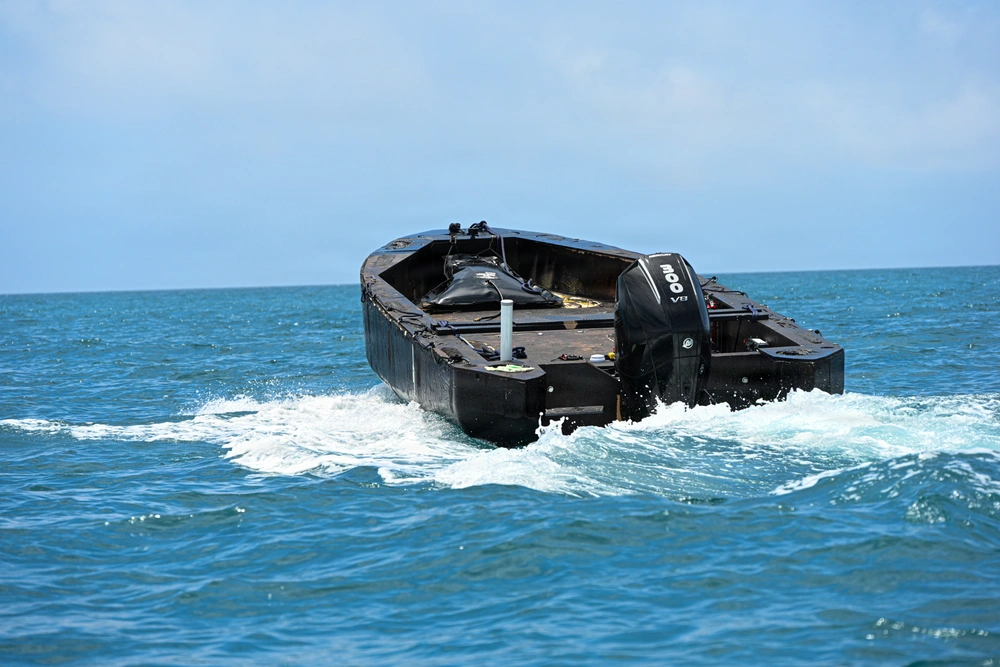
Beyond component repair and supply chain integration, additive manufacturing played a pivotal role in the Manufacturing Attritable Systems at Scale (MASS) initiative, a key component of the "Print on the Move" showcase. This effort specifically focused on the 3D printing of vessels, encompassing both manned and unmanned platforms, highlighting the potential for expeditionary manufacturing to produce larger, more complex structures in forward-deployed locations.
Marines, in collaboration with experts from the Naval Surface Warfare Center Carderock (NSWCC), utilized a large-format polymer 3D printer alongside a spray foam and coating system to produce multiple iterations of a seven-meter raiding craft. The NSWCC team brought valuable experience from developing a similar five-meter hull. Initially, the production of this smaller hull took 16 hours and cost approximately $11,000 in materials. However, through optimization and leveraging advanced 3D printing techniques, the process was made significantly more cost-effective and faster than traditional manufacturing methods.
Marissa Stecko, an engineer at NSWCC, highlighted the ambitious future potential of this technology. "We have reason to believe that, once fully scaled, we could manufacture a 5-meter platform every four hours with a team of 12, and a 7-meter platform every six hours," Stecko stated. "We’re still in the prototyping phase, but there’s a tremendous amount of potential." This projection suggests a future where large marine craft can be produced rapidly and efficiently in operational theaters, drastically altering deployment and sustainment strategies.
The most ambitious phase of the MASS initiative involved printing a vessel in transit. The team initiated the printing process en route to the White Beach Naval Facility in Japan. Subsequently, the 3D printer was transferred to the partially printed vessel, allowing production to continue while the craft was in motion. This remarkable feat demonstrates the true essence of "print on the move" – the ability to manufacture critical assets concurrently with their deployment and operational use, blurring the lines between production and immediate operational readiness.
Firestorm Labs: Containerized Manufacturing at the Forefront
The US military’s strategic focus on expeditionary manufacturing in the Indo-Pacific is further exemplified by its accelerated adoption of containerized manufacturing systems. Firestorm Labs has emerged as a significant player in this domain, demonstrating its unique capabilities during the lead-up to RIMPAC. The company utilized its xCell containerized manufacturing unit to train service members from the Army, Navy, and Marine Corps on printing parts while aboard the USS Essex, even while the ship was underway.
This demonstration marked the first time the xCell was deployed and operated at sea. Over a two-week period, the system successfully produced over 1,000 functional parts. Among these outputs were a dozen of Firestorm’s Squall FPV drones. Upon arrival in Hawaii, these drones were flown by Marines as part of a counter-unmanned aerial system (C-UAS) exercise, providing compelling validation of the practical applications and effectiveness of Firestorm’s integrated manufacturing ecosystem.
Dan Magy, CEO of Firestorm Labs, emphasized the critical need for such solutions in addressing real-world logistical challenges. "The Indo-Pacific logistics problem is real, and most of the answers on offer live in a pitch deck," Magy remarked. "We printed flight-ready aircraft and the parts a crew actually needed, in the conditions they’d actually face. That’s what manufacturing at the edge looks like when it works." His statement underscores the practical, mission-critical nature of their technology, moving beyond theoretical concepts to tangible battlefield solutions.
Broader Implications and Future Trajectory
The extensive 3D printing activities observed during Valiant Shield and RIMPAC, alongside other military engagements throughout the summer, signal a critical inflection point. These demonstrations are not merely technological showcases; they represent a direct response to the Pentagon’s urgent need to accelerate the acquisition and production of essential military assets. The consistent progress demonstrated by US military services and their partners, primarily small startup companies, in building organic 3D printing capacity over the past several years appears to have reached critical mass.
Comparing current advancements to past exercises provides a clear perspective on the rapid evolution of this technology within the military. In RIMPAC 2022, the US Navy conducted its first-ever demonstration of 3D printing at sea aboard an operational vessel, the USS Essex. Fast forward just four years, and the same platform has seen the production of over 1,000 functional parts within a two-week period using a different, more advanced system. This evolution highlights an exponential increase in capability and operational integration.
Similarly, the progress in maritime drone technology is striking. Four years ago, such systems were relatively nascent. Today, US service members are not only printing various iterations of watercraft capable of serving as both manned and unmanned systems but are actively producing components for these vessels while they are operational. This capability moves beyond conceptualization to real-time, in-mission manufacturing support.
The Path Forward: Scaling for Global Impact
While the achievements demonstrated are significant, the next crucial challenge lies in scaling these advanced manufacturing capabilities to meet the full spectrum of global operational demands. The ability to produce critical components and entire systems rapidly and on-demand in diverse and often austere environments is paramount. The US military’s investment in and validation of these technologies suggest a commitment to overcoming the logistical complexities inherent in global power projection.
The continued integration of additive manufacturing into military doctrine promises to enhance readiness, reduce costs, and provide a decisive advantage in future conflicts. As these technologies mature and become more widespread, they will undoubtedly reshape how military hardware is designed, produced, deployed, and sustained, ushering in an era of unprecedented operational agility and resilience. The successful demonstrations at Valiant Shield and RIMPAC are not just milestones; they are foundational steps toward a future where the battlefield itself can become a manufacturing floor.