Published: August 12th, 2026
Mitsubishi is on the cusp of a significant revival, with the highly anticipated return of its legendary Pajero SUV. Teased extensively for the upcoming year, the off-road icon is poised to re-enter the global market, with a U.S. debut expected several months later under the familiar Montero moniker. This launch represents more than just a new model; for many observers, it is seen as Mitsubishi’s last, best hope to regain relevance and a distinct identity in an increasingly competitive automotive landscape. The stakes are undeniably high, and the success of the new Pajero/Montero could very well determine the brand’s future trajectory.
A Legacy Forged in Dakar and Rugged Terrain
The Pajero nameplate carries a storied legacy, most notably its unparalleled dominance in the grueling Dakar Rally. With an unmatched seven manufacturer titles, the Pajero proved itself to be a titan of endurance and capability. This history imbues the upcoming model with immense expectations for off-road prowess. While the official Japanese debut is slated for September, early insights suggest a robust, body-on-frame construction, a fundamental characteristic for serious off-roading. This architecture is expected to be complemented by Mitsubishi’s advanced "Super All Wheel Control" (S-AWC) system, a testament to the brand’s engineering heritage in all-wheel-drive technology.
Engineering for the Extreme: Unpacking the Pajero’s Underpinnings
Rumors and leaked information paint a picture of a vehicle designed to tackle the toughest challenges. The new Pajero is reportedly set to borrow heavily from the platform of the recently unveiled Mitsubishi Triton pickup, a model lauded for its dependability and competitive pricing. Furthermore, it’s believed to share underpinnings with Nissan’s forthcoming Xterra SUV, a move that leverages the synergies within the Renault-Nissan-Mitsubishi Alliance.
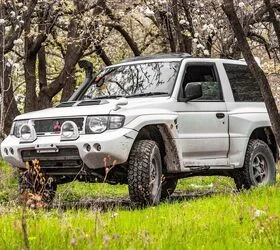
Spy shots and Mitsubishi’s own teaser imagery reveal a vehicle with substantial ground clearance. Crucial underbody components are notably protected, either by robust skid plates or strategically tucked away to minimize the risk of damage on challenging terrain. The generously sized wheel wells further indicate an intention for buyers to equip the vehicle with large, all-terrain tires, signaling that the manufacturer anticipates and encourages genuine off-road use.
Beyond its structural design, the Pajero is expected to feature a mechanically locking rear axle and a two-speed transfer case, core components for serious off-road capability. These hardware additions will likely be augmented by advanced electronic aids, including brake-oriented torque vectoring, further enhancing its performance and control in diverse conditions. This combination of robust mechanicals and sophisticated electronic systems suggests a vehicle that aims to bridge the gap between traditional ruggedness and modern refinement.
A Tumultuous History: Mitsubishi’s North American Rollercoaster
To understand the significance of the Pajero’s return, it’s crucial to examine Mitsubishi’s complex and often challenging history in the North American market. The brand experienced a meteoric rise in regional sales following its later entry compared to competitors like Honda, Subaru, Mazda, Toyota, and Nissan, who had established a decade-long head start in building dealer networks and brand loyalty.
Mitsubishi initially navigated the U.S. market through rebadged models sold via Chrysler, a strategy that allowed them to gain insights into American consumer preferences with mitigated risk. Upon establishing its own independent U.S. dealer network in 1982, Mitsubishi made a bold entrance. While the brand initially emphasized affordability, its commitment to global motorsport, particularly the Dakar Rally, fueled the development of numerous performance-oriented vehicles. This potent combination of value and performance allowed Mitsubishi to outsell both Mazda and Subaru by the late 1990s, a testament to its successful strategy.
The Shift Away from Performance: A Brand Identity Lost?
However, Mitsubishi’s ambition to transcend its "niche" automaker status led to a strategic pivot. The company began expanding its lineup to directly compete with established giants like Honda and Toyota. While many of these new models were competent, they struggled to match the unwavering reliability that Toyota and Honda had cultivated over decades. This proved to be a critical turning point for Mitsubishi. Despite being part of the colossal Mitsubishi Group, the automotive division was perceived by leadership as a secondary venture, lacking the full backing of its parent company.
The subsequent overextension of its product portfolio, coupled with insufficient corporate support, led to a significant downturn. Sales plummeted throughout the 2000s, and Mitsubishi’s North American lineup became increasingly sparse. In an effort to stem the bleeding, the brand shifted its focus towards subprime customers and moved away from its motorsport heritage. The 2008 financial crisis delivered another severe blow, reducing Mitsubishi’s sales to a mere fraction of their 1990s peak.
While the brand has seen some recovery since then, it has struggled to reclaim its former glory, its original identity, or its previous sales volumes. Instead, Mitsubishi has largely concentrated on producing affordable vehicles tailored for markets in Southeast Asia and developing regions in South America.
Rekindling the Flame: The Pajero as a Symbol of Revival
Despite its struggles, a dedicated segment of Western automotive enthusiasts harbors fond memories of Mitsubishi’s performance-oriented past. These enthusiasts have long hoped for a return of that spirited character. However, Mitsubishi has, at times, seemed to squander this goodwill, most notably by reintroducing the Eclipse nameplate – synonymous with the brand’s iconic American sports car – onto a rather unremarkable crossover.
Currently, Mitsubishi’s strategy in North America revolves around SUVs and offering compelling value propositions, including competitive pricing and extended warranties. This approach has yielded some sales gains, but the question remains: does Mitsubishi aspire to be more than just a value-oriented provider in a segment already crowded by brands like Kia and Hyundai, who excel in this space?
Powertrain Prospects: Balancing Tradition and Modernity
The path forward for Mitsubishi in North America is complex. One potential strategy involves leaning into reliability while directly challenging South Korean automakers on price. However, modern tariffs on vehicles manufactured in Japan could complicate this approach, as many of Mitsubishi’s popular models are still produced there. Without a significant shift in strategy, the current trajectory suggests Mitsubishi may do little more than maintain its current market position.
The Pajero/Montero, however, has the potential to alter this landscape, provided it lives up to the considerable hype surrounding its return. Global powertrain rumors suggest the base engine will be the 2.4-liter turbodiesel found in the current Mitsubishi Triton. While Japan will likely receive this robust diesel variant, the U.S. market may miss out on what many consider the most desirable and durable powertrain option.
Instead, U.S. consumers are expected to see the Montero equipped with a gasoline engine, potentially incorporating some form of hybridization. It’s plausible that the SUV will utilize hardware shared with the upcoming Nissan Xterra, which is anticipated to feature a hybridized V6. Another possibility is a plug-in hybrid (PHEV) version of the Triton, whose powertrain could find its way into the Pajero/Montero.
However, the adoption of PHEV technology in the U.S. market, particularly for off-road-oriented vehicles, presents challenges. PHEVs add significant weight and complexity, factors that typically detract from the off-road experience. Furthermore, Mitsubishi’s plug-in drivetrain is not expected to debut until 2028-2030, potentially delaying its availability for the initial Montero launch. This suggests that the brand will likely rely on powertrains shared with the forthcoming Xterra, such as a naturally aspirated V6 (perhaps an updated version of the 3.8-liter found in the current Nissan Frontier) and a similarly sized hybrid. The robustness of these units will be critical for Mitsubishi’s success.
The Alliance Factor and Technological Considerations
Mitsubishi’s position within the broader Renault-Nissan-Mitsubishi Alliance presents both opportunities and constraints. While the alliance facilitates shared development and cost efficiencies, it also means Mitsubishi may not have the autonomy to pursue entirely in-house projects.
Technological integration is another area of concern. As modern off-road vehicles incorporate advanced driver-assistance systems (ADAS), there’s a growing trend among enthusiasts and off-roaders towards more tactile, physical controls rather than relying solely on touchscreens. Mitsubishi would be wise to incorporate traditional, robust switchgear, recognizing that while modern technology is useful, ease of use and durability in harsh environments are paramount for this segment.
A Defining Moment for Mitsubishi
The return of the Pajero, and subsequently the Montero in the U.S., is undeniably a pivotal moment for Mitsubishi. It represents a critical opportunity to re-establish its identity and recapture the enthusiasm of a market that has largely moved on. There remains a significant base of drivers with fond memories of the brand’s past glories, and a successful launch of the new Pajero/Montero could indeed pave the way for future growth and expansion.
Conversely, a poorly executed relaunch, characterized by uninspired design, inadequate performance, or a failure to meet the expectations of off-road enthusiasts, could prove to be the final nail in the coffin for Mitsubishi’s aspirations in North America. The fate of this iconic SUV is intrinsically linked to the future of the brand in one of the world’s most important automotive markets. The coming months will reveal whether Mitsubishi can translate its legendary heritage into a compelling present and a promising future.
[Images: Mitsubishi Motors; Shahzadali/Shutterstock; WE_Si/Shutterstock; Grzegorz Czapski/Shutterstock; WE_Si/Shutterstock]
Become a TTAC insider. Get the latest news, features, TTAC takes, and everything else that gets to the truth about cars first by subscribing to our newsletter.