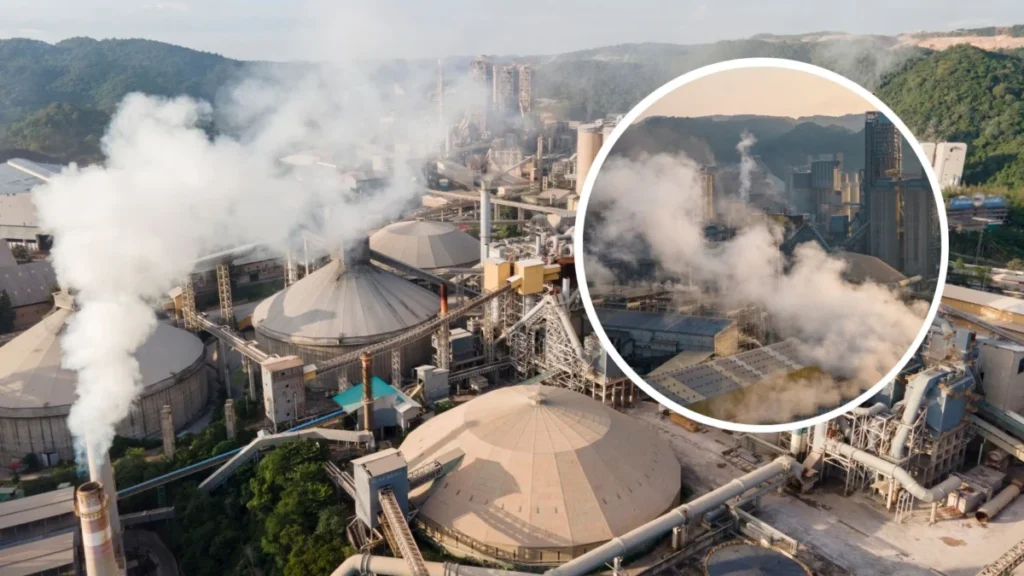
A groundbreaking new approach developed by researchers at ETH Zurich could fundamentally alter the environmental footprint of cement plants, transforming them from significant emitters of carbon dioxide into facilities capable of actively removing the greenhouse gas from the atmosphere. This innovation, detailed in the journal Chem Circularity, offers a potentially pivotal strategy for one of the world’s most challenging industries to decarbonize, integrating cement production with advanced Direct Air Capture (DAC) technology.
Cement, the fundamental binder in concrete, is an indispensable material for modern civilization, underpinning vast swathes of global infrastructure from roads and bridges to homes and offices. Its pervasive use, however, comes with a substantial environmental burden. The manufacturing process of cement is currently responsible for an estimated 5 to 8 percent of global carbon dioxide (CO2) emissions, a figure comparable to the emissions of entire nations or the global aviation industry. This substantial contribution to atmospheric CO2 underscores the urgent need for innovative solutions within the sector. The ETH Zurich team’s research presents a compelling vision where cement production not only mitigates its own emissions but also serves as a critical component in broader carbon removal efforts.
The Dual Challenge of Cement’s Carbon Footprint
To understand the significance of the ETH Zurich breakthrough, it’s crucial to grasp the dual nature of cement’s carbon problem. Firstly, the production of clinker—the key component of cement—is an intensely energy-demanding process, requiring temperatures exceeding 1,450 degrees Celsius. Historically, these kilns have been fueled predominantly by fossil fuels like coal and petroleum coke, leading to substantial emissions from combustion. While there has been a global push towards adopting alternative fuels and electrifying these processes, this addresses only one part of the problem.
Secondly, and more fundamentally, carbon dioxide is an inherent byproduct of the chemical reaction that converts limestone (calcium carbonate, CaCO3) into quicklime (calcium oxide, CaO), a process known as calcination. When limestone is heated, it chemically decomposes, releasing CO2 regardless of the energy source used. This "process emission" accounts for approximately two-thirds of cement’s total CO2 output, making it notoriously difficult to eliminate through conventional decarbonization strategies alone. This inherent chemical release of CO2 is precisely why the cement industry is classified as one of the "hard-to-decarbonize" sectors, alongside steel and heavy chemicals.
Global cement production currently stands at over 4 billion metric tons annually, a figure projected to rise significantly with ongoing urbanization and infrastructure development, particularly in emerging economies. The sheer scale of the industry means that even incremental improvements in its environmental performance can have a profound global impact. The Intergovernmental Panel on Climate Change (IPCC) has repeatedly stressed the necessity of not only drastically reducing emissions across all sectors but also actively removing billions of tons of legacy CO2 from the atmosphere to meet the Paris Agreement’s goal of limiting global warming to well below 2 degrees Celsius, preferably to 1.5 degrees Celsius. It is within this critical context that the ETH Zurich research, led by PhD student Vittoria Bolongaro and supervised by Professor André Bardow, gains paramount importance.
Integrating Direct Air Capture with Calcium Looping
The ETH Zurich study, published in Chem Circularity, proposes an innovative integration of cement production with Direct Air Capture (DAC) technology, specifically leveraging a process known as calcium looping. DAC systems are designed to extract CO2 directly from ambient air, offering a pathway to reverse historical emissions. While various DAC technologies exist, including those using solid sorbents or liquid solvents, calcium looping presents a particularly synergistic connection with cement manufacturing due as both processes fundamentally involve the transformation of calcium compounds and the heating of limestone.
In the proposed integrated system, limestone is first heated to produce quicklime, a process that also releases CO2. Crucially, instead of allowing this process-derived CO2 to escape, the system is designed to capture and separate it. Subsequently, water is added to the quicklime to produce slaked lime (calcium hydroxide, Ca(OH)2). This slaked lime is then directed to the DAC stage, where it acts as a highly effective sorbent, absorbing additional CO2 directly from the surrounding atmosphere. As the slaked lime absorbs CO2, it gradually converts back into limestone. This newly formed limestone, now containing both process CO2 and atmospheric CO2, can then be fed back into the cement production process.
This elegant cyclical process allows the calcium material to function as a reusable carrier for atmospheric CO2. The more times this calcium material cycles through the air-capture stage before being permanently incorporated into cement or stored, the greater the net amount of CO2 removed from the atmosphere. "From a climate perspective, the combination of DAC and cement production is very promising," stated Vittoria Bolongaro, the lead author of the publication, highlighting the dual benefit of emissions reduction and active carbon removal.
The Crucial Distinction: Emissions Reduction vs. Carbon Removal
It is vital to understand the nuanced distinction between reducing emissions and actively removing carbon from the atmosphere. Many efforts within the cement industry currently focus on the former:
-
Emissions Reduction: This involves strategies like replacing fossil fuels with biomass or waste fuels, improving energy efficiency in kilns, or utilizing alternative raw materials that require less calcination (e.g., using fly ash or blast furnace slag as clinker substitutes). These measures aim to lower the CO2 released per ton of cement produced. Traditional Carbon Capture and Storage (CCS) also falls under this category, where CO2 emitted from the plant’s flue gases is captured and stored underground, preventing it from entering the atmosphere. While critical, these approaches primarily address the industry’s direct emissions.
-
Carbon Removal: The ETH Zurich approach goes a significant step further. By integrating DAC with calcium looping, the system not only captures the CO2 generated during cement production but also actively draws down additional CO2 that is already present in the ambient air. This atmospheric CO2, once captured, can be compressed and transported for permanent geological storage, effectively reducing the overall concentration of greenhouse gases in the atmosphere.
Consequently, if the integrated system is operated efficiently and powered by low-carbon energy sources, a cement plant could potentially become "net-negative" – meaning it removes more CO2 from the atmosphere than the entire system emits over its lifecycle, including indirect emissions from energy consumption and material transport. This transformative potential shifts the industry’s role from a major climate problem to a part of the climate solution.
Performance Projections and Energy Demands
The researchers meticulously modeled how this integrated system could perform under various future scenarios. Their calculations indicate that by electrifying the cement kiln and directly capturing CO2 through the calcium-looping DAC system, the climate impact of cement production could be reduced by up to 78 percent by 2050. This impressive figure underscores the potential of the technology to drastically alter the industry’s environmental footprint.
However, the study also highlights a critical dependency: the actual performance and net-negative potential are heavily reliant on the source of electricity used to power the system. Direct Air Capture is an energy-intensive process. If the electricity required to operate the DAC system, as well as the electrified cement kiln, comes from carbon-intensive sources (e.g., coal-fired power plants), a significant portion of the benefits from capturing atmospheric CO2 would be negated by the upstream emissions generated to produce that electricity.
Conversely, when the integrated system is powered by low-carbon or entirely renewable electricity—such as solar, wind, or hydropower—its performance improves considerably. The study estimates that by 2050, depending on the specific energy mix, calcium-looping DAC could achieve an impressive 85–96 percent CO2-removal efficiency. In practical terms, this means that for every ton of CO2 captured and permanently stored from the atmosphere, approximately 40–150 kilograms of CO2 might still be generated elsewhere in the process chain, encompassing all lifecycle emissions. While not a perfect zero, this level of efficiency represents a profound shift towards net-negative operations, especially when compared to the current emissions profile of cement manufacturing.
Broader Implications and Future Outlook
The implications of this research extend far beyond the cement industry itself. The development of scalable and economically viable carbon removal technologies is increasingly recognized as indispensable for achieving global climate targets. By offering a pathway for an essential, hard-to-abate industry to become a carbon sink, the ETH Zurich approach presents a compelling case for accelerating investment and research in integrated industrial decarbonization solutions.
Economic and Policy Implications: Implementing such integrated systems will require significant capital investment in new infrastructure, including electrified kilns, DAC units, and CO2 transport and storage facilities. However, these costs could be partially offset by potential revenue streams from carbon credits or carbon markets, especially as carbon pricing mechanisms become more robust globally. Governments and international bodies will likely need to provide strong policy support, including subsidies, tax incentives, and clear regulatory frameworks for carbon capture, utilization, and storage (CCUS) projects, to de-risk early-stage deployment and accelerate commercialization. The Global Cement and Concrete Association (GCCA), representing the leading cement and concrete companies worldwide, has already committed to achieving net-zero concrete by 2050, and innovations like the ETH Zurich proposal will be critical to meeting such ambitious targets.
Technological Challenges and Scalability: While the modeling results are highly promising, real-world deployment will face challenges. These include ensuring the long-term durability and efficiency of the calcium looping material over many cycles, optimizing energy integration to minimize overall consumption, and developing robust CO2 transport and permanent storage infrastructure at scale. The geographical proximity of cement plants to suitable geological storage sites will also be a factor in determining the economic viability of carbon storage. Further research will be needed to refine the process, explore different calcium sources, and optimize the integration with existing cement plant layouts.
Environmental Benefits Beyond CO2: Beyond direct CO2 removal, a more energy-efficient and integrated cement production process could also lead to reductions in other atmospheric pollutants associated with traditional fossil fuel combustion in kilns, such as sulfur dioxide (SO2) and nitrogen oxides (NOx), contributing to improved local air quality.
The research from ETH Zurich represents a significant step towards a future where industrial processes are not merely less harmful, but actively beneficial for the environment. By reimagining cement plants as strategic assets in the global fight against climate change, this innovative approach could provide a crucial tool for achieving net-zero emissions and stabilizing the Earth’s climate for future generations. The success of this vision will hinge on continued research, supportive policies, and substantial investment to bring these integrated carbon removal solutions from the laboratory to industrial scale.