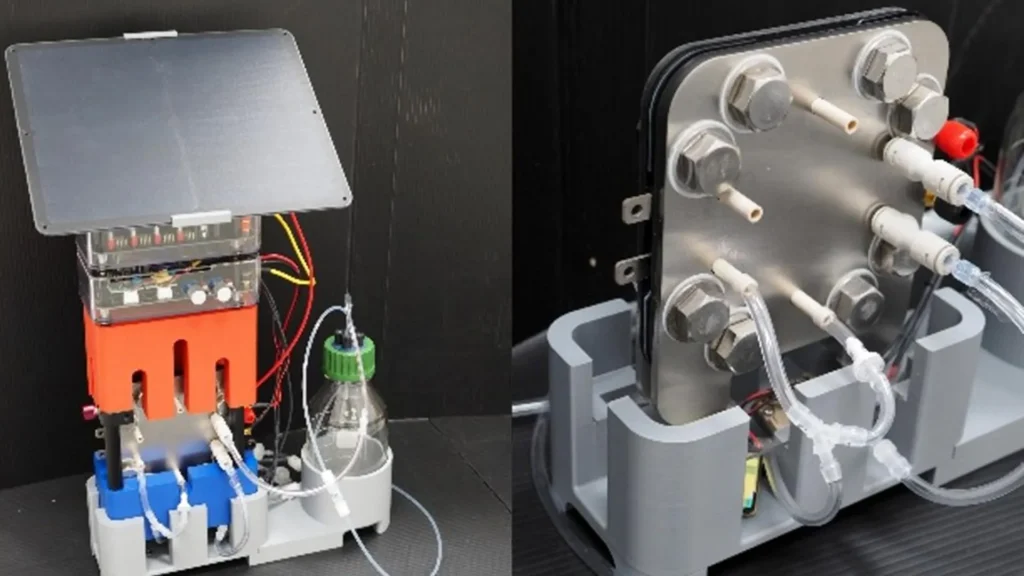
OSAKA, JAPAN – Researchers at Osaka Metropolitan University have achieved a significant breakthrough in the field of artificial photosynthesis, developing a novel system capable of generating solar fuel with unprecedented consistency while entirely eliminating the conventional reliance on battery-based control equipment. This pivotal advance stems from the ingenious integration of a self-regulating chemical component directly into the electrolyzer, a core element of artificial photosynthesis, thereby drastically reducing both system complexity and overall cost. The innovation promises to accelerate the transition towards a more sustainable and decentralized energy future, particularly in regions where grid infrastructure is limited or costly.
The Quest for Artificial Photosynthesis: Mimicking Nature’s Efficiency
The concept of artificial photosynthesis draws profound inspiration from nature’s most fundamental energy conversion process: the photosynthesis carried out by plants. In this biological marvel, sunlight, water, and carbon dioxide are meticulously transformed into energy-rich compounds, essentially storing solar energy in chemical bonds. Scientists worldwide have been striving for decades to replicate and improve upon this process, aiming to produce "solar fuels" – energy carriers derived directly from sunlight, water, and often, atmospheric carbon dioxide. These fuels offer a compelling pathway to decarbonize various sectors, from transportation to industrial manufacturing, by providing a renewable alternative to fossil fuels.
One of the most promising products of artificial photosynthesis is formic acid. A simple organic compound, formic acid holds significant potential as a chemical feedstock, a hydrogen carrier, and a direct fuel for certain types of fuel cells. Its relative ease of storage and transport, compared to hydrogen, makes it an attractive candidate for a sustainable energy economy. The ability to produce formic acid from abundant resources like water and CO2, powered solely by sunlight, represents a grand challenge in chemistry and engineering.
Understanding the Core Mechanism: Electrolyzers and the Challenge of Intermittency
At the heart of any artificial photosynthesis system designed to produce chemical fuels is an electrolyzer. This electrochemical device utilizes electricity, typically supplied by solar cells, to drive chemical reactions that convert source materials (like water and CO2) into energy-rich chemical compounds. The electricity generated by solar photovoltaic (PV) panels is thus transformed into chemical energy, which is then stored in the form of fuels such as formic acid, hydrogen, or syngas.
However, a major hurdle in deploying solar-driven artificial photosynthesis systems at scale has always been the inherent intermittency of sunlight. Solar irradiance fluctuates constantly throughout the day due to changing weather conditions, cloud cover, and the sun’s angle. This variability presents a significant challenge for maintaining the efficient and stable operation of the electrolyzer. To address this, many conventional artificial photosynthesis systems incorporate a sophisticated control strategy known as Maximum Power Point Tracking (MPPT).
MPPT is an electronic control technique designed to continuously adjust the voltage and current output from solar cells to ensure they operate at their "maximum power point," thereby delivering the highest possible power output to the load (in this case, the electrolyzer). While highly effective in optimizing energy harvest, traditional MPPT setups typically rely on a complex array of external electronic components, including DC-DC converters, inverters, and, crucially, batteries. These batteries serve to smooth out the energy flow, buffering the intermittency of solar power and ensuring a consistent supply to the electrolyzer. While technically viable, these additions significantly increase the overall cost, introduce considerable system complexity, and add to the maintenance burden and material footprint of the system. The need for battery replacement and the environmental impact of battery disposal are also growing concerns.
The Osaka Metropolitan University Breakthrough: A Self-Regulating Electrolyzer
Recognizing these limitations, a dedicated team of researchers at the Research Center for Artificial Photosynthesis at Osaka Metropolitan University, led by Associate Professor Yasuo Matsubara and Professor Yutaka Amao, embarked on a mission to fundamentally redesign the electrolyzer. Their goal was to imbue the electrolyzer itself with the intelligence to manage solar intermittency, thereby obviating the need for external electronic controls and batteries. This ambitious project saw a crucial collaboration with Iida Group Holdings Co., Ltd., a partnership that helped bridge academic innovation with practical application.
Their groundbreaking approach centers on a specially engineered solid electrolyte built directly into the electrolyzer device. This innovative design allows the electrolyzer to automatically perform the MPPT function intrinsically, through its own material properties, rather than relying on external electronic circuits or battery-based buffering systems. This represents a paradigm shift from active electronic control to passive, self-regulating chemical-physical control.
The mechanism behind this self-regulation is elegantly simple yet profoundly effective. The electrolyzer is designed such that its electrical characteristics—specifically its electrical resistance—are inherently linked to its temperature. As sunlight intensity increases, the solar cells generate more power, which is then fed into the electrolyzer. This increased power input causes the electrolyzer to naturally heat up. The key innovation lies in the material properties of the integrated solid electrolyte: its electrical resistance is designed to drop as its temperature rises.
Professor Yutaka Amao elucidated this ingenious feedback loop: "As sunlight increases, the electrolyzer naturally heats up. The system is designed so that this warming causes the electrical resistance to drop, allowing electricity to flow more freely and efficiently into the chemical reaction chamber. This makes the system automatically adjust its electrical behavior to match the optimal power output from the solar cells, effectively performing the MPPT function without external intervention." This intrinsic thermal-electrical coupling ensures that the electrolyzer always operates near its optimal power point, despite fluctuations in solar input.
Professor Amao further emphasized the broader implications of this self-regulating behavior: "This self-regulating behavior helps keep fuel production more stable throughout the day and automates the system, while significantly reducing dependence on expensive and environmentally impactful batteries and costly external electronic components. It simplifies the entire system, making it more robust and potentially more accessible for widespread deployment."
Rigorous Validation Under Real-World Conditions
The true test of any renewable energy technology lies in its performance under actual outdoor conditions, where environmental variables are unpredictable and often challenging. The Osaka Metropolitan University team subjected their innovative system to rigorous testing, exposing it to real-world solar fluctuations. The results were highly encouraging: the system consistently produced formic acid from water and CO2, even as sunlight levels varied dramatically throughout the day. This robust performance underscores the efficacy of the self-regulating mechanism and its potential for practical applications.
The confidence in this technology was further bolstered by its early showcase. Professor Yasuo Matsubara noted, "We were confident that it would be successful, as we previously showcased this research at the ‘Joint Pavilion Iida Group × Osaka Metropolitan University’ exhibition as part of the Osaka Kansai Expo 2025. It successfully generated enough formic acid to power a miniature diorama in the pavilion, vividly demonstrating its potential as an efficient artificial photosynthesis system that could eventually be used to charge applications in our homes and contribute to decentralized energy solutions." This public demonstration provided tangible proof of concept and garnered early attention for the breakthrough.
The detailed findings of this pioneering research have been formally published in EES Solar, a prestigious peer-reviewed scientific journal, underscoring the scientific rigor and significance of the work.
Broader Implications and a Future of Decentralized, Sustainable Energy
The development of this self-regulating artificial photosynthesis system holds profound implications across several dimensions:
- Economic Impact: By eliminating the need for expensive batteries and complex electronic control systems, the new design significantly lowers both the capital expenditure (CapEx) and operational expenditure (OpEx) associated with artificial photosynthesis. This cost reduction could be a critical factor in making solar fuel production economically viable on a larger scale, potentially opening up new markets for sustainable chemicals and fuels. Simplified maintenance requirements further enhance its economic attractiveness.
- Environmental Benefits: This innovation directly contributes to global efforts in decarbonization. By efficiently converting CO2 into a valuable fuel, it offers a pathway for carbon capture and utilization (CCU), transforming a greenhouse gas into a resource. Reduced reliance on fossil fuels, coupled with the elimination of electronic waste from batteries and complex circuitry, enhances the overall environmental footprint of energy production.
- Technological Advancement: The breakthrough demonstrates a novel approach to managing energy intermittency, moving beyond traditional electronic solutions. This concept of intrinsic, material-driven self-regulation could inspire similar innovations in other areas of renewable energy technology, fostering the development of more robust, simplified, and resilient energy systems. It pushes the boundaries of how chemical engineering can interface with energy conversion.
- Societal and Decentralization Potential: The reduced complexity and cost make this technology particularly well-suited for decentralized energy production. Imagine homes, communities, or even remote industrial sites producing their own solar fuels directly from sunlight and ambient CO2, without needing a robust grid connection or complex battery installations. This could lead to greater energy independence, enhanced energy security, and improved access to clean energy in underserved regions, aligning with the United Nations Sustainable Development Goals.
- Industrial Applications of Formic Acid: Beyond fuel, formic acid is a versatile industrial chemical used in livestock feed preservation, leather tanning, dyeing, and as a reducing agent. Producing it sustainably from CO2 and water could revolutionize these industries, reducing their carbon footprint and dependence on fossil-derived precursors.
Challenges and the Path Forward
While this breakthrough marks a monumental step, the journey towards widespread adoption of artificial photosynthesis continues. Key challenges remain, including further optimizing the overall energy conversion efficiency of the system, demonstrating long-term durability and stability under diverse environmental conditions, and scaling up the technology from laboratory prototypes to industrial-scale reactors. Research will also focus on exploring the production of other solar fuels, such as hydrogen or methane, using similar self-regulating principles.
The collaboration between Osaka Metropolitan University and Iida Group Holdings Co., Ltd. exemplifies the critical role of industry-academia partnerships in translating fundamental scientific discoveries into practical, deployable technologies. This innovative self-regulating artificial photosynthesis system from Osaka Metropolitan University represents a beacon of hope in the global endeavor to combat climate change and secure a sustainable energy future, paving the way for a world powered by the sun, one self-regulated chemical reaction at a time.