As China aggressively expands its footprint in advanced technological domains, the nation has unveiled plans to integrate sophisticated robotic quadruped systems, colloquially termed "robotic dogs," into its burgeoning lunar exploration initiatives. This strategic move aims to leverage autonomous and semi-autonomous robotics to enhance maintenance, construction, and operational capabilities at the proposed International Lunar Research Station (ILRS), fundamentally reshaping the paradigm of long-duration human presence beyond Earth. The ambitious proposal, detailed by researchers in the Chinese Space Science and Technology journal, underscores a growing global trend towards augmenting human endeavors in space with highly capable robotic assistants, particularly in environments as hostile and resource-intensive as the Moon.
The Vision for Lunar Robotics: More Than Just Companions
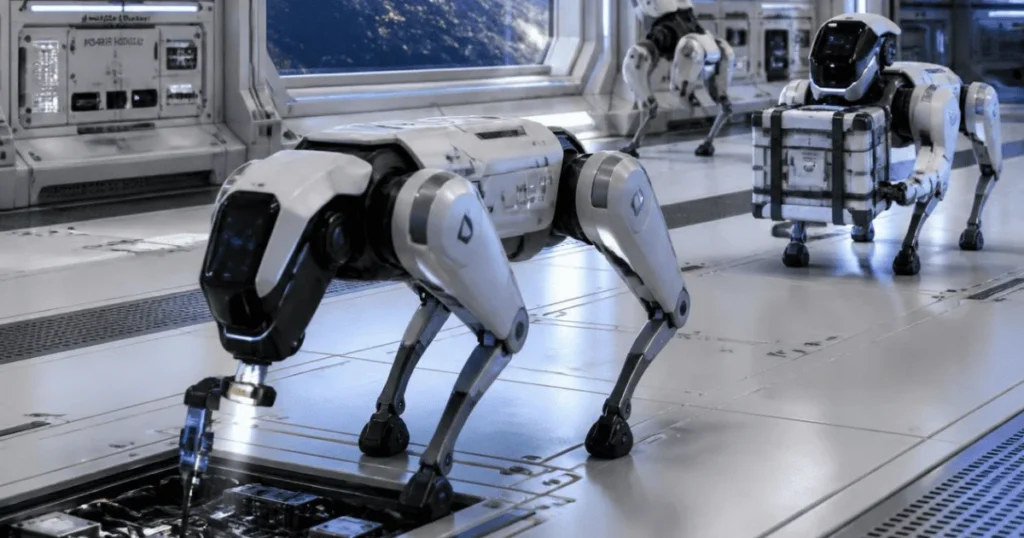
The core of China’s proposal centers on deploying advanced robotic quadruped platforms as integral components of the ILRS, which is projected for initial completion around 2035. These "robotic dogs" are envisioned to serve a multifaceted role, extending far beyond simple companionship. Their primary functions would encompass acting as autonomous or semi-autonomous assistant and patrol units for astronauts, capable of independent navigation across the lunar base, conducting environmental inspections, and relaying critical data back to human crews. This foundational capability positions them as vital eyes and ears, offering astronauts real-time insights into their immediate surroundings and alerting them to potential anomalies.
Beyond surveillance, these robotic systems are designed to bolster the security infrastructure of the lunar outpost. By continuously monitoring the lunar environment, they could detect and respond to a spectrum of potential dangers, including unexpected rock falls, abrupt shifts in temperature, fluctuations in air quality within pressurized habitats, or other unforeseen hazards that could compromise astronaut safety. The versatility of these platforms, however, is projected to extend significantly further, encompassing a broad range of scientific and logistical tasks.
During scientific missions, various robotic dog units could be assigned specialized tasks, working in tandem with human explorers. For instance, one variant might be engineered for traversing particularly challenging lunar terrains, mapping geological features, or exploring difficult-to-reach craters. Another could be tasked with the precise collection of rock and regolith samples, utilizing advanced manipulators and analytical instruments. A third might specialize in intricate technical work, such as deploying scientific instruments, calibrating sensors, or performing delicate adjustments to experimental setups. This division of labor would maximize scientific output while minimizing human exposure to hazardous conditions and freeing up astronaut time for higher-level research and decision-making.
A critical long-term objective of the robotic quadruped deployment is to aid in preparing the Moon for sustained human settlement. This involves a spectrum of activities crucial for self-sufficiency and expansion. Researchers foresee these robots playing a pivotal role in resource extraction, specifically targeting water ice from the lunar poles—a vital commodity for propellant production, life support systems, and potential manufacturing. They could also be deployed for mining valuable minerals and constructing foundational infrastructure using locally sourced materials, a process known as in-situ resource utilization (ISRU). This capability is paramount for reducing the logistical burden and cost of transporting materials from Earth.
Furthermore, these robots could undertake numerous practical, routine tasks essential for the daily operation of a lunar base. This includes continuous monitoring of environmental parameters like air quality and temperature within habitats, performing general maintenance and inspections of equipment, cleaning living and working areas, tending to hydroponic or aeroponic plant systems designed for food production, and potentially even assisting in food preparation. The aim is to offload mundane yet necessary chores from astronauts, allowing them to focus on scientific research, mission-critical operations, and strategic planning.
Intriguingly, the proposal also highlights a less conventional, yet profoundly significant, role for these robotic systems: providing psychological and emotional support to astronauts. Extended periods of isolation, confinement, and the immense stress of living and working in an extraterrestrial environment can profoundly impact human psychological well-being. The presence of an interactive robotic companion, capable of responding to human interaction and perhaps even exhibiting rudimentary ‘personality’ traits, could offer an invaluable source of engagement and alleviate feelings of loneliness during protracted missions, thereby contributing to crew morale and mental resilience.
Navigating the Lunar Frontier: Technological Imperatives
Before these sophisticated robotic systems can be effectively deployed to the lunar surface, significant technological advancements and rigorous development efforts are required across several key domains. Operating autonomously or semi-autonomously in an environment as alien and demanding as the Moon presents unique challenges that differentiate it starkly from Earth-based robotics.
Foremost among these challenges is the development of highly advanced Artificial Intelligence (AI) and robust autonomous navigation systems. Unlike terrestrial robots that often rely on extensive datasets, well-established communication infrastructures, and global positioning systems, lunar robots will operate in a GPS-denied environment with limited, often delayed, communication links to Earth. Their AI must be capable of processing novel sensory data, learning from unfamiliar environments, making complex decisions in real-time without constant human oversight, and adapting to unpredictable terrain and situations. This necessitates sophisticated machine vision, environmental mapping, hazard avoidance algorithms, and robust decision-making frameworks.
Communication systems must be resilient to deep-space distances and potential solar interference, ensuring reliable data transmission and command reception. Navigation systems will likely rely on a combination of inertial measurement units, visual odometry, celestial navigation, and local beacon networks established by the ILRS itself. The processing power onboard the robots must be substantial enough to handle these complex calculations locally, minimizing reliance on Earth-based computational resources.
Beyond intelligence, the physical design and engineering of these robots must contend with the Moon’s extreme environment. Lunar temperatures fluctuate wildly, from scorching highs of approximately +120°C during the day to frigid lows of -170°C at night. The vacuum of space, micrometeoroid bombardment, and pervasive, abrasive lunar dust—which is electrostatically charged and can damage seals, optics, and mechanical components—all pose formidable challenges to material selection, thermal management, and mechanical durability. Robotic systems will need specialized shielding, robust dust mitigation strategies, and materials capable of withstanding these harsh conditions for extended operational periods.
Furthermore, the Moon’s low gravity (approximately one-sixth that of Earth) profoundly impacts locomotion. Quadruped designs must be optimized for this reduced gravitational pull, ensuring stable movement over varied terrain, including rocky surfaces, deep regolith, and crater slopes, without losing traction or becoming unstable. Efficient power systems, likely incorporating advanced solar panels for lunar day operations and robust battery storage or even radioisotope thermoelectric generators (RTGs) for surviving the long, dark lunar nights, are crucial for sustained operations.
China’s Lunar Program: A Chronology of Ambition

China’s current proposal for robotic dogs is not an isolated initiative but a logical progression within its rapidly accelerating and increasingly ambitious space program. The nation has steadily built its capabilities over decades, culminating in a series of impressive milestones:
- 1970: Launch of its first satellite, Dong Fang Hong I.
- 2003: Yang Liwei becomes China’s first astronaut, aboard Shenzhou 5, making China the third nation to independently send a human into space.
- 2007-2013: The Chang’e lunar orbiter program begins with Chang’e 1, followed by Chang’e 2 (orbiter), and Chang’e 3 (lander and Yutu rover), marking China’s first soft landing on the Moon.
- 2019: Chang’e 4 achieves the historic first soft landing on the far side of the Moon, deploying the Yutu-2 rover, which continues to operate years beyond its design life.
- 22020: Chang’e 5 successfully conducts China’s first lunar sample return mission, bringing back over 1.7 kg of lunar regolith. This demonstrated crucial capabilities for future resource utilization efforts.
- 2021-Present: Construction and full operational status of the Tiangong Space Station, a permanent modular space station hosting long-duration human missions.
- Future Missions (e.g., Chang’e 6, 7, 8): These missions are designed to further explore the lunar South Pole, investigate its resources, and test technologies for future human missions and the ILRS. Chang’e 6, for instance, aims to return samples from the far side of the Moon.
The ILRS itself is a cornerstone of China’s long-term lunar strategy. Planned as a collaborative international endeavor, it is envisioned to develop in phases, with an initial lunar base established around 2035. This will eventually expand into a larger, comprehensive orbital and surface complex by 2045, supporting sustained human presence and extensive scientific research. A significant focus of upcoming missions and the ILRS will be the lunar South Pole, a region of immense scientific and strategic interest due to the confirmed presence of water ice in permanently shadowed craters. This water ice could serve as an invaluable in-situ resource, providing drinking water, breathable oxygen, and propellant (hydrogen and oxygen) for rockets, drastically reducing the cost and logistical complexity of future deep-space missions.
Why Robots Blossom in Space Applications: A Strategic Imperative
China’s enthusiasm for integrating robotic systems, particularly quadruped platforms, into its lunar exploration strategy is rooted in a clear understanding of the inherent difficulties and dangers associated with human operations in space. The strategic advantages offered by robotics are manifold, promising safer, more efficient, and more ambitious space missions.
Enhanced Safety and Hazard Mitigation:
One of the most compelling arguments for robotic deployment is the significant reduction in risks to human life. Extravehicular Activities (EVAs), or spacewalks, are among the most perilous aspects of spaceflight. Astronauts performing EVAs must wear pressurized suits with a limited oxygen supply, and the risk of accidental untethering, leading to an astronaut drifting uncontrollably into space, is ever-present. Robotic systems, however, can be designed to eliminate many of these risks. A robot could be equipped with electromagnetic feet or other robust attachment mechanisms to securely fasten itself to a spacecraft or lunar habitat, negating the need for traditional tethers. Programmed to swiftly navigate a spacecraft’s exterior, identify damage, monitor critical systems, and even perform complex repairs, robots could undertake many tasks currently performed by humans in EVAs, dramatically enhancing crew safety.
Beyond EVAs, space itself is a profoundly hazardous environment for human biology. Astronauts are exposed to elevated levels of cosmic radiation and solar radiation, which can damage DNA, increase cancer risk, and cause other debilitating health issues. Unlike humans, robots do not suffer from motion sickness, do not require food, water, or oxygen, and are impervious to many of the biological threats posed by radiation. While radiation can still damage electronics, robots can be designed with radiation-hardened components or shielding, and their lifespan is not intrinsically limited by biological susceptibility. Micrometeoroids, tiny particles traveling at enormous velocities, pose another significant threat, capable of causing serious damage to spacecraft and equipment. While robots are not immune to such impacts, their loss does not carry the same human cost, and they can be designed with redundancy or greater resilience to damage.
Operational Efficiency and Resource Optimization:
Robotic systems offer unparalleled advantages in operational efficiency and resource conservation. Human missions are inherently resource-intensive, requiring substantial mass and volume for life support systems, living quarters, food storage, exercise equipment, and other amenities essential for human survival and well-being. Robots, in stark contrast, require none of these. This fundamental difference translates into enormous savings in payload mass, launch costs, and logistical complexity.
Furthermore, robots can be designed to be highly compact. If capable of being folded or stored in densely stacked configurations, a single human crew member’s allocated space could potentially accommodate dozens of robotic units. This exponential expansion of operational capacity without increasing the number of humans exposed to the dangers of space represents a profound strategic advantage. It means that routine maintenance, exhaustive inspections, and repetitive tasks—which currently consume a significant portion of astronaut time—can be offloaded to robotic systems. This allows human astronauts to dedicate their invaluable time and cognitive abilities to critical decision-making, complex scientific experimentation, and addressing situations that genuinely demand human intelligence, judgment, and adaptability.
Robots also excel in endurance and specialization. They can operate continuously for extended periods, potentially through long lunar nights (with appropriate power solutions), without experiencing fatigue, boredom, or the psychological strain inherent to human long-duration missions. They can be equipped with highly specialized manipulators, sensors, and tools tailored for specific tasks, often exceeding human capabilities in terms of precision, strength, or ability to operate in confined or hazardous spaces.
Broader Implications and the Future Trajectory of Space Exploration
The integration of advanced robotic quadruped systems into lunar operations, as proposed by China, signifies a pivotal shift in the trajectory of space exploration. This move is not merely an incremental technological upgrade but a fundamental redefinition of how humanity will establish a sustained presence beyond Earth.
A Paradigm Shift in Exploration:
By blending human ingenuity and adaptability with the unwavering endurance and precision of increasingly capable robotic systems, future missions promise to become safer, more efficient, and vastly more ambitious. This hybrid approach enables the pursuit of objectives that would be unfeasible or prohibitively dangerous for humans alone. The deployment of "robotic dogs" on the Moon is a tangible step towards a future where autonomous agents serve as the vanguard of exploration, preparing the ground, mitigating risks, and gathering data, allowing humans to arrive in environments already made more habitable and productive.
Catalyst for a Lunar Economy:
The envisioned roles of these robots in harvesting water ice, mining minerals, and constructing infrastructure using ISRU are critical for kickstarting a genuine lunar economy. Access to lunar resources, particularly water for propellant, could dramatically reduce the cost of space transportation, making journeys to Mars and beyond more viable. A robust robotic workforce could lay the foundation for lunar manufacturing, energy generation, and even space tourism infrastructure, transforming the Moon from a destination for scientific research into an economic hub within the Earth-Moon system. This vision aligns with global efforts to establish a multi-planetary economy and leverage extraterrestrial resources for the benefit of humanity.
Paving the Way for Mars and Beyond:
The technologies developed and refined for lunar robotic operations—particularly in AI, autonomous navigation, environmental resilience, and self-repair—will be directly transferable and indispensable for future human missions to Mars and other deep-space destinations. Mars, with its even greater communication delays, harsh environment, and longer mission durations, will demand an even higher degree of robotic autonomy and capability. The Moon serves as an invaluable testbed for these foundational technologies, perfecting them before they are deployed on even more challenging frontiers.
Ethical and Societal Considerations:
While the immediate focus remains on technical and operational advantages, the increasing sophistication of autonomous robotic systems in space also prompts broader ethical and societal discussions. These include the nature of human-robot collaboration, the psychological impact of highly interactive AI companions on isolated crews, and the long-term implications of relying on autonomous systems for critical infrastructure management in extraterrestrial environments. However, for now, the overwhelming benefits in terms of safety, efficiency, and expanded capability firmly place advanced robotics at the forefront of humanity’s ambitious journey into the cosmos.
As China advances towards its 2035 target for the initial ILRS, the integration of robotic quadruped systems represents a bold commitment to a future where machines and humans collaboratively push the boundaries of space exploration, unlocking unprecedented possibilities for scientific discovery, resource utilization, and the eventual establishment of humanity as a multi-planetary species.