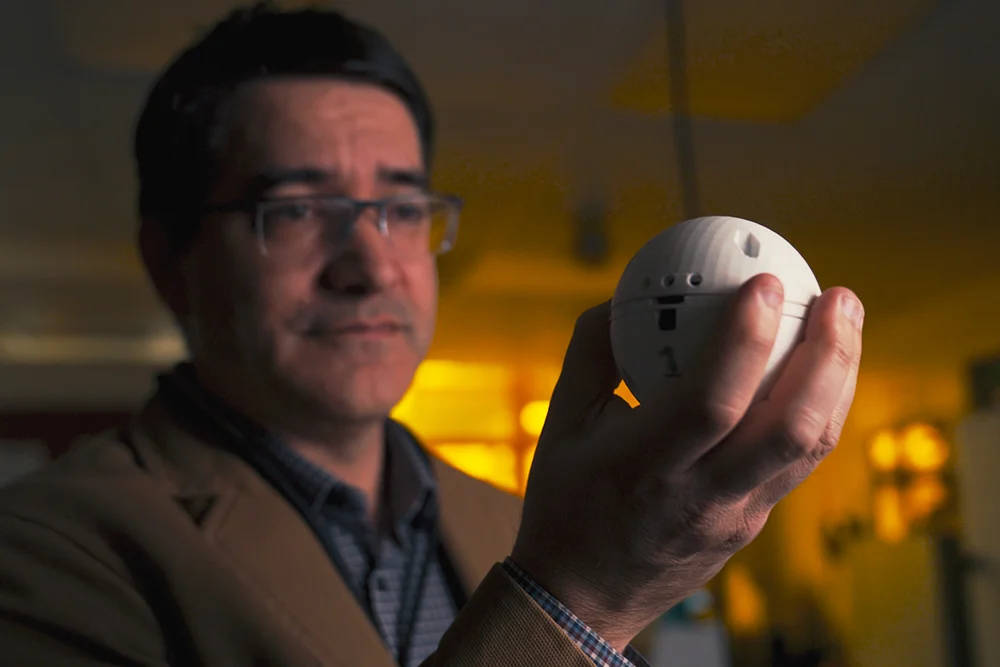
Researchers at MIT Lincoln Laboratory have unveiled a groundbreaking advancement in chemical threat detection with the development of the Tactical Optical Spherical Sensor for Interrogating Threats, or TOSSIT. This innovative, baseball-sized device is engineered to provide critical early warnings to military service members, first responders, and law enforcement personnel regarding the presence of hazardous vapors and aerosols. The TOSSIT system represents a significant leap forward in portable and deployable sensing technology, addressing an urgent need for rapid and reliable detection of chemical agents and dangerous airborne particles in critical situations.
The TOSSIT device offers a novel approach to chemical sensing. Its spherical design, roughly the size of a baseball, makes it highly versatile for deployment. It can be manually tossed into an area of concern, dropped from a drone, or even launched via specialized systems. Once deployed, TOSSIT actively samples the surrounding air. At its core, the sensor utilizes a removable dye card that undergoes a color change when exposed to specific chemical compounds. An internal camera then captures and analyzes these color shifts. This visual analysis allows TOSSIT to identify the presence of a range of threats, from potent nerve and blister agents to hazardous emissions from industrial chemical accidents or even dangerous airborne particles like fentanyl dust. Upon detection, the TOSSIT system immediately alerts users through a dedicated mobile application or via audible alarms integrated directly into the sensor itself, providing crucial real-time information for decision-making and protective actions.
"TOSSIT fills an unmet need, providing a low-cost sensing option for vapors and solid aerosol threats – think toxic dust particles – that would otherwise not be detectable by small deployed sensor systems," states Principal Investigator Richard Kingsborough. This statement underscores the device’s potential to enhance situational awareness in scenarios where traditional, more complex sensing equipment might be impractical or too slow to deploy. The ability to detect both gaseous and particulate threats broadens its applicability across a wider spectrum of potential dangers encountered in military operations, emergency response, and public safety interventions.
Background and Development Context
The genesis of TOSSIT can be traced to the persistent challenges faced by military and civilian personnel when confronting potential chemical hazards. Existing detection methods often require direct sampling by trained personnel, involve bulky and expensive equipment, or lack the speed and portability needed for immediate threat assessment in dynamic environments. The development at MIT Lincoln Laboratory, a federally funded research and development center sponsored by the U.S. Department of Defense, highlights a strategic effort to equip personnel with advanced, user-friendly tools capable of mitigating risks associated with chemical warfare agents, industrial accidents, and the increasing threat of illicit substance dispersal.
The project’s timeline, culminating in its current readiness for transfer to the U.S. military, suggests a rigorous development and testing phase. While specific dates of initial concept and development are not detailed, the recent publication date of July 9, 2026, indicates that TOSSIT has progressed through laboratory research, prototype development, and extensive field trials. This transition to military adoption signifies a successful validation of its performance, reliability, and effectiveness in real-world conditions. The emphasis on a "low-cost sensing option" is particularly significant, as it suggests TOSSIT could be deployed in large numbers, creating a distributed network of sensors for comprehensive area coverage, a capability that is often cost-prohibitive with existing technologies.
Technological Innovation and Functionality
The core innovation of TOSSIT lies in its integrated system of chemical reactivity, optical sensing, and digital communication. The dye cards, a critical component, are likely engineered with specialized chemical indicators that react specifically with target compounds. This specificity is paramount to minimize false positives and ensure accurate threat identification. The use of an internal camera to read these color changes, rather than requiring human visual interpretation, introduces a layer of objective data acquisition. This automated process is faster, more precise, and less susceptible to environmental factors or operator fatigue.
Furthermore, the integration with a mobile app or onboard alarms signifies a commitment to user-centric design. This allows for immediate dissemination of threat information to the individual operative or a command center, facilitating rapid response protocols. The app could potentially provide detailed information about the detected threat, its concentration, and recommended safety measures. The ability to remotely monitor multiple TOSSIT units deployed across an area would offer an unprecedented level of real-time situational awareness for commanders and incident managers.
Supporting Data and Performance Metrics
While the article provides a qualitative description of TOSSIT’s capabilities, a comprehensive understanding would benefit from supporting quantitative data. For instance, information regarding the detection limits of the sensor for various chemical agents would be invaluable. This would include parameters like the Minimum Detectable Concentration (MDC) for nerve agents such as Sarin or VX, blister agents like Sulfur Mustard, and common industrial chemicals or illicit substances. Similarly, the response time of the sensor – how quickly it can detect and alert to a threat after exposure – is a critical performance metric. Typical response times for such devices can range from seconds to a few minutes, depending on the concentration of the agent and the specific sensor technology.
The operational range of the TOSSIT device, both in terms of its deployment distance and the effective communication range of its alerts, is another key piece of data. The durability and operational lifespan of the sensor, particularly the dye cards and internal components, under various environmental conditions (temperature, humidity, dust, shock) would also be crucial for assessing its practicality in diverse operational theaters. The "removable dye card" aspect suggests a consumable element, and information on the number of detections per card or the card’s shelf life would inform logistical planning for its widespread deployment.
Reactions and Implications from Related Parties
The transfer of TOSSIT technology to the U.S. military implies a positive evaluation and endorsement from defense and security agencies. While direct quotes from military officials or first responder organizations are not included, the proactive adoption of the technology suggests a strong perceived value. Military strategists would likely view TOSSIT as a force multiplier, enhancing the survivability of personnel operating in contaminated environments and enabling more confident mission execution. For first responders, it represents a tool that can significantly improve safety during hazardous material incidents, allowing for quicker containment and evacuation efforts.
The broader implications of TOSSIT extend beyond immediate tactical applications. In the civilian sector, advancements in portable chemical detection could revolutionize emergency preparedness for industrial accidents, natural disasters involving hazardous materials, or even public spaces where the risk of chemical or biological attacks is a concern. The development of such accessible technology could also lead to increased public awareness and preparedness for chemical threats. The "low-cost" aspect is particularly important here, as it opens possibilities for deployment by local fire departments, HAZMAT teams, and even public health agencies that may have limited budgets for specialized equipment.
Future Trajectory and Broader Impact
The successful integration of TOSSIT into military operations is likely to pave the way for further advancements in portable sensing technology. Future iterations could incorporate broader detection capabilities, enhanced data analytics, and improved power efficiency for extended deployment times. The technology could also be adapted for use in other critical domains, such as environmental monitoring, industrial safety inspections, and even border security applications.
The development of TOSSIT by MIT Lincoln Laboratory exemplifies the critical role of advanced research institutions in addressing national security and public safety challenges. By focusing on practical, deployable solutions, such as this throwable sensor, researchers are directly contributing to the protection of lives and the enhancement of operational effectiveness in environments fraught with unseen dangers. The ongoing collaboration between research laboratories, military branches, and first responder communities will be vital in ensuring that these technological innovations translate into tangible benefits on the front lines. The strategic importance of such devices in an era of evolving threats cannot be overstated, positioning TOSSIT as a significant development in the ongoing effort to safeguard against chemical hazards.