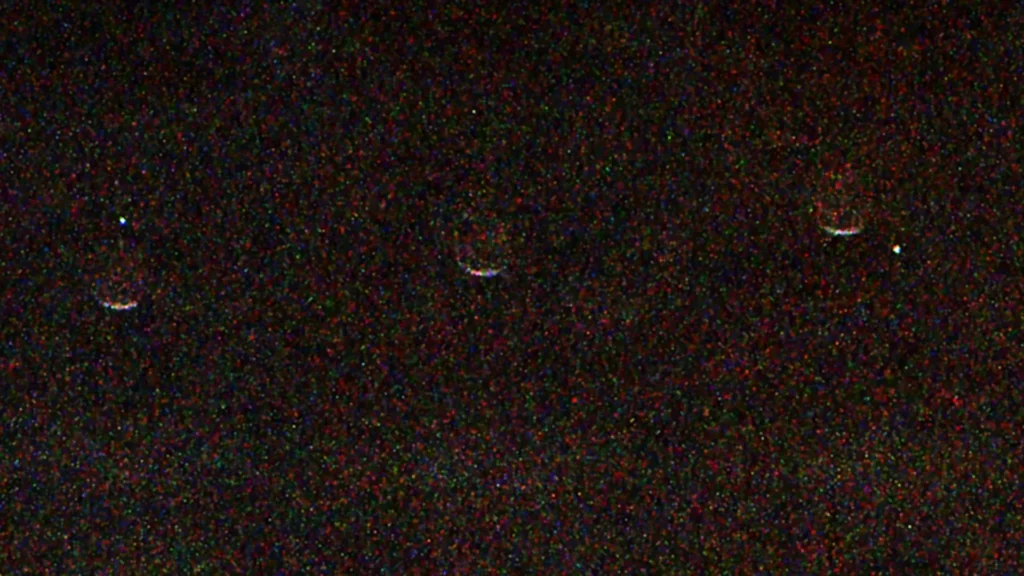
NASA’s Perseverance Mars rover has achieved a historic first, capturing an unprecedented celestial spectacle: the planet Earth momentarily disappearing from view as it was obscured by Phobos, Mars’ larger moon, in the Martian evening sky. This groundbreaking observation, documented through a sequence of images, marks the first time humanity has recorded Earth vanishing behind another celestial body from the surface of a world beyond our own. The images reveal Earth as a diminutive point of light, dwarfed by the transit of Phobos, offering a unique perspective on our home planet from the vast expanse of interplanetary space.
A Fleeting Interplanetary Eclipse
The remarkable event unfolded on July 2, the 1,907th Martian day, or sol, of the Perseverance mission. As twilight settled over the Martian landscape, at approximately 7 p.m. local solar time, the rover’s sophisticated Mastcam-Z instrument was trained on the evening sky. The captured sequence illustrates a cosmic ballet: Earth, a distant blue marble, traces a diagonal path from the upper left towards the lower right of the frame. Simultaneously, Phobos, Mars’ irregularly shaped moon, traverses the sky in the opposite direction, moving from the lower left to the upper right. The critical moment arrives in the third image of the series, where the two celestial bodies align perfectly. For a brief period, Earth is completely hidden behind the shadowed edge of Phobos, an event astronomers classify as an occultation.
"The composite image makes for a unique Earth self-portrait, taken from the surface of another planet, with a Phobos photobomb," stated Justin Maki, the Mastcam-Z deputy principal investigator and imaging scientist for Perseverance at NASA’s Jet Propulsion Laboratory (JPL) in Southern California. This sentiment underscores the profound scientific and emotional significance of the observation, providing a tangible connection to our distant home from an alien world.
A Tiny Earth, An Enormous Distance
From Perseverance’s vantage point on the rim of Mars’ Jezero Crater, the apparent sizes and distances of Earth and Phobos present a stark contrast. Phobos, a celestial body of irregular shape and approximately 17 miles (27 kilometers) across at its widest point, orbits Mars at a remarkably close proximity of about 4,850 miles (7,800 kilometers). This proximity means that from the Martian surface, Phobos appears significantly larger than Earth’s Moon does to observers on Earth. In the images captured by Perseverance, Phobos occupied roughly one-third of the field of view that Earth’s Moon would typically occupy from Earth.
In stark contrast, Earth was a staggering 195 million miles (314 million kilometers) away at the time of the observation. At such an immense distance, our entire planet, a vibrant world teeming with life, was reduced to a mere single-pixel-sized point of light within the Mastcam-Z’s frame. This dramatic disparity in apparent size highlights the vastness of the solar system and the scale of interplanetary distances.
"Phobos crosses the Martian sky three times a day, and Earth is visible for months at a stretch, but catching one directly behind the other takes planning and a little luck," explained Mark Lemmon, a Mastcam-Z co-investigator at the Space Science Institute in Boulder, Colorado. Lemmon, who played a key role in planning the observation and assembling the composite image, emphasized the meticulous effort involved in capturing such a rare event. The alignment of Phobos and Earth is not a common occurrence, requiring precise calculations and opportune timing.
Understanding Celestial Alignments: Occultations, Eclipses, and Transits
The event witnessed by Perseverance is technically termed an occultation. This astronomical phenomenon occurs when one celestial object, appearing larger from the observer’s perspective, completely blocks the view of a more distant object. In this instance, the relatively close and larger-appearing Phobos obscured the tiny, distant point of light representing Earth.
It is important to distinguish this from other celestial alignments:
- Eclipses: An eclipse occurs when one object enters the shadow cast by another. A lunar eclipse, for example, happens when Earth’s Moon passes through Earth’s shadow. Conversely, a solar eclipse occurs when one object, appearing roughly the same size, blocks the light from another. The most familiar example is the Moon passing in front of the Sun as seen from Earth.
- Transits: A transit is the inverse of an occultation. It happens when a smaller-appearing object moves across the face of a larger-appearing object. Perseverance has previously observed transits on Mars, such as when Phobos or Deimos, Mars’ other moon, pass in front of the Sun, an event sometimes informally referred to as a "Martian solar eclipse."
The distinction is crucial for scientific accuracy, and Perseverance’s observation of an occultation of Earth by Phobos adds another layer to our understanding of planetary dynamics and observational astronomy from different worlds.
The Significance of the "Earth Photobomb"
The capture of this occultation by Perseverance is more than just a fascinating astronomical observation; it carries significant implications for planetary science, astrobiology, and our perception of humanity’s place in the cosmos.
1. Validation of Observational Techniques: The successful capture of this event validates the advanced capabilities of the Mastcam-Z instrument and the strategic planning employed by the Perseverance mission team. It demonstrates the ability to conduct complex, long-duration observational campaigns from another planet, opening doors for future studies of celestial mechanics and atmospheric phenomena.
2. Comparative Planetology: Observing Earth from Mars provides a unique opportunity for comparative planetology. By studying how our home planet appears from a different world, scientists can gain new insights into its atmospheric properties, brightness, and overall spectral signature. This can inform models used to detect and characterize exoplanets in other star systems.
3. Astrobiological Context: While this specific event did not involve the search for life, the ability to observe Earth as a point of light from Mars underscores the challenges and possibilities of searching for biosignatures on exoplanets. Understanding how a planet like Earth would appear from a distant vantage point is crucial for refining search strategies for extraterrestrial life.
4. Enhanced Understanding of Phobos and Deimos: The precise timing and observation of Phobos’ transit provide valuable data for refining our understanding of the orbits and physical characteristics of Mars’ moons. This contributes to the broader effort to map and characterize the Martian system.
5. Public Engagement and Inspiration: Events like this have a profound impact on public interest in space exploration. The image of Earth being "photobombed" by a Martian moon serves as a powerful reminder of our shared cosmic journey and inspires future generations of scientists and engineers. It fosters a sense of wonder and encourages continued investment in space science.
Background: The Perseverance Mission and its Scientific Goals
The Perseverance rover, a marvel of engineering, landed in Jezero Crater on February 18, 2021. Its primary mission is to seek signs of ancient microbial life and collect samples of Martian rock and regolith for potential return to Earth. The rover is equipped with a suite of sophisticated scientific instruments, including the Mastcam-Z, a pair of powerful cameras capable of capturing high-resolution panoramic and multispectral images.
The Mastcam-Z instrument, a collaborative effort led by Arizona State University with Malin Space Science Systems in San Diego, plays a critical role in documenting the Martian landscape and conducting scientific investigations. Its ability to zoom, focus, and capture images across a wide spectrum of light allows for detailed geological analysis, atmospheric monitoring, and, as demonstrated by this event, captivating celestial observations.
The Mars Exploration Program, managed by NASA’s Science Mission Directorate in Washington, oversees the Perseverance mission, with JPL in Southern California responsible for the rover’s development and operations. This successful capture is a testament to the meticulous planning, advanced technology, and dedication of the hundreds of individuals involved in the mission.
The Chronology of the Observation
- Mission Sol 1907 (July 2, 2023): Perseverance rover is operational in Jezero Crater.
- Approximately 7 p.m. local solar time: The Mastcam-Z instrument is activated to observe the evening sky.
- Observation Period: A sequence of images is captured as Earth and Phobos move across the Martian sky.
- Third Image in Sequence: Earth is observed to be fully obscured by the shadowed edge of Phobos – an occultation.
- Post-Observation: The captured image sequence is processed and analyzed by the mission team.
- Recent Release: NASA publicly announces and releases the composite image and accompanying details, marking a historic first in interplanetary astronomical observation.
Broader Implications for Interplanetary Observation
This achievement signifies a new era in our ability to observe celestial events from beyond Earth. As robotic missions continue to explore the solar system, the potential for capturing unique perspectives on our own planet and other celestial bodies expands exponentially. Future missions to the moons of Jupiter and Saturn, or even further afield, could provide even more extraordinary views of Earth and the solar system.
The data gathered from this observation will contribute to a deeper understanding of:
- Orbital Mechanics: Refined models of the precise orbits of Phobos and Deimos, and their interactions with Mars.
- Atmospheric Refraction: Potential subtle effects of the Martian atmosphere on the apparent position of Earth during the occultation.
- Light Curve Analysis: While Earth appeared as a single pixel, sophisticated analysis could potentially reveal variations in its brightness over the brief occultation period, offering clues about its surface and atmospheric conditions.
In conclusion, the Perseverance rover’s capture of Earth disappearing behind Phobos is a landmark achievement in space exploration. It not only provides a breathtaking visual testament to the vastness of space but also represents a significant step forward in our capacity for interplanetary observation, enriching our scientific understanding and inspiring a renewed sense of wonder about our place in the universe. This "Earth photobomb" serves as a powerful reminder that even from millions of miles away, our home planet remains a focal point of our curiosity and a beacon of life in the cosmos.