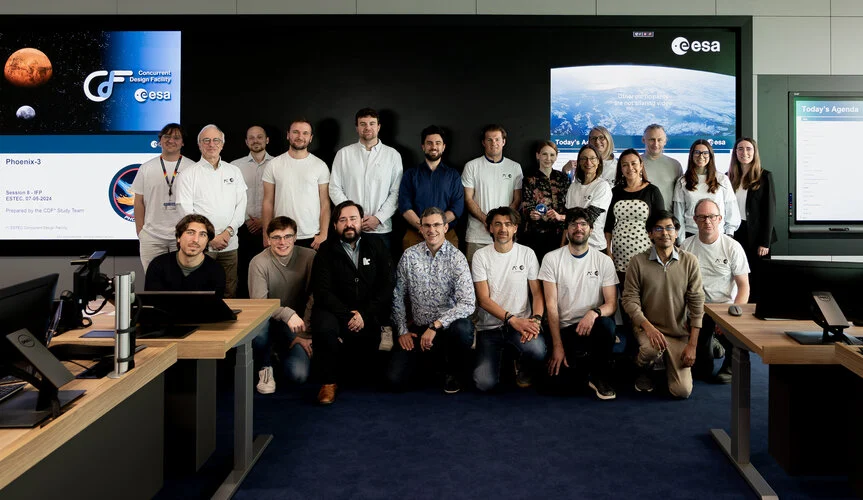
Engineers from the European Space Agency (ESA) and its industry partners have successfully concluded an intensive concept study for Phoenix 3, a groundbreaking reusable spacecraft designed to transport scientific and commercial experiments into microgravity environments and ensure their safe return to Earth. This rigorous evaluation, conducted within ESA’s state-of-the-art Concurrent Design Facility (CDF), marks a significant step forward in the development of European capabilities for orbital logistics and in-orbit servicing.
A European Vision for Reusability Takes Shape
The Phoenix 3 concept, spearheaded by the European startup ATMOS Space Cargo, envisions a fully European orbital return vehicle. The comprehensive study, which commenced earlier this year, saw the ESA’s Concurrent Design Facility transform into a dynamic, multidisciplinary think-tank. Its primary objective was to meticulously assess the feasibility and potential of ATMOS’s innovative design. The CDF, located at ESA’s technical heart in ESTEC, the Netherlands, is a globally recognized hub for rapid, collaborative engineering assessments. Equipped with an advanced network of computers, multimedia devices, and specialized software tools, it allows diverse teams of experts to converge their knowledge and address complex design challenges in a matter of weeks, a stark contrast to the many months traditional sequential design processes would require.
The core of the Phoenix 3 concept centers on a reusable spacecraft designed to ferry payloads to low Earth orbit (LEO), typically around an altitude of 350 kilometers. Once in orbit, it is intended to support a variety of commercial and scientific endeavors, including microgravity manufacturing, fundamental research, and the in-orbit demonstration and validation of new space technologies. After an operational period in orbit, which could range from several months to up to a year, Phoenix 3 is designed for a controlled deorbit and atmospheric entry, followed by recovery, refurbishment, and preparation for subsequent missions. This inherent reusability is a cornerstone of ATMOS’s strategy, aiming to significantly reduce the cost and environmental impact of accessing space for experimental purposes.
Rigorous Evaluation at the Concurrent Design Facility
During the CDF study, a dedicated team of specialists meticulously reviewed the Phoenix 3 concept against a set of established ESA templates and rigorous engineering guidelines. This process involved identifying critical trade-offs, potential risks, and key areas requiring further investigation. The outcome of this intensive study provides ATMOS with a foundational concept and a clearly defined set of design drivers for their reusable spacecraft.

Enrico Tormena, ESA’s lead for the study, elaborated on the reference scenario utilized: "For this study, we focused on a scenario where Phoenix 3 would be launched into low Earth orbit, to an altitude of around 350 km. There, it would support commercial microgravity manufacturing, science experiments and in-orbit demonstration and validation of new technologies. After several months to one year in orbit, it would perform a controlled deorbit and atmospheric entry before being recovered, refurbished and prepared for a new launch." This defined operational profile allowed the engineers to conduct a thorough analysis of the spacecraft’s performance, structural integrity, and operational logistics.
The configuration assessed within the CDF encompassed a vital service module, responsible for providing power and propulsion to the Phoenix 3 spacecraft. Additionally, a pressurized cabin area was considered, designed to replicate Earth-like atmospheric conditions. This cabin is envisioned to accommodate payloads weighing over 1000 kilograms, catering to a diverse range of scientific and commercial applications. It is important to note that this configuration served as a reference point for the study and is not considered final. Key design decisions and trade-offs remain open for exploration in Phase A, the subsequent phase in a space mission’s lifecycle, which focuses on detailed concept development and preliminary design.
Innovative Deceleration Technology at the Forefront
A pivotal element of ATMOS’s approach, and a key focus of the study, is the development and integration of an inflatable decelerator. This advanced technology, which ATMOS has been actively maturing and flight-testing across its Phoenix family of vehicles, plays a crucial role in the spacecraft’s reentry and landing sequence.
Jeffrey Hendrikse, Chief Technology Officer and Co-Founder of ATMOS Space Cargo, highlighted the significance of this technology: "During reentry, the spacecraft uses its Inflatable Atmospheric Decelerator to slow down through the atmosphere ahead of a safe recovery. What pleases me most is that the study confirmed we can maintain the modularity of the microgravity platform, serving our customers from late access before launch to early access after return, as well as the communication bandwidth they need in orbit." This modularity and enhanced communication capability are crucial for meeting the evolving demands of commercial space endeavors.
The confirmation of the inflatable decelerator’s efficacy in slowing the spacecraft during atmospheric entry is a significant validation for ATMOS. This technology offers a potentially lighter and more efficient alternative to traditional rigid heat shields, contributing to the overall reusability and cost-effectiveness of the Phoenix 3 system. The ability to offer "late access" before launch and "early access" after return also signifies a commitment to customer convenience and mission flexibility, essential for commercial operations.

Charting the Path Forward: Phase A and Beyond
The CDF study not only validated the core concept but also pinpointed critical areas that require further attention in the upcoming phases. Daniela Lomanto from ESA’s Concurrent Engineering and Future Missions section emphasized this forward-looking aspect: "The CDF study also identified key trade-offs and risks to be addressed next, providing a solid starting point for Phase A, in which ATMOS will focus on the optimisation of aerodynamics, stability and thermal design, and on improving entry modelling and guidance to increase landing accuracy."
This systematic approach ensures that the Phoenix 3 project progresses with a clear understanding of its challenges and a robust plan to overcome them. The focus on aerodynamics, stability, and thermal design is paramount for a successful atmospheric reentry and landing. Enhancing entry modeling and guidance systems will be crucial for achieving high landing accuracy, minimizing recovery time, and ensuring the integrity of the returned payloads.
ESA’s commitment to supporting the Phoenix 3 study aligns perfectly with its fundamental mandate: to foster and accelerate the competitiveness of European industry. By providing access to its unparalleled technical expertise and advanced facilities like the CDF, ESA empowers emerging companies and established players alike to develop innovative space solutions. This support is strategically deployed precisely when and where it is most impactful, acting as a catalyst for technological advancement and market growth.
Fostering European Sovereignty and Sustainability
Ilaria Roma, Head of the CDF, underscored the strategic importance of the collaboration: "ATMOS has created a win-win scenario for the future of European space exploration, so their vision and this specific mission assessment is supported by ESA’s Directorate of Human and Robotic Exploration." This endorsement highlights the alignment of ATMOS’s ambitions with ESA’s broader strategic goals for space exploration and utilization.
A central theme driving the Phoenix 3 initiative, and indeed much of modern space development, is sustainability. The study’s focus on defining a new, scalable class of reusable return vehicles directly addresses the urgent need for circularity in orbit and a reduced environmental footprint in space operations. As space debris becomes an increasingly pressing concern, the development of reusable systems like Phoenix 3 is not just economically advantageous but environmentally imperative.

"Central to this collaboration is the topic of sustainability," stated Roma. "By defining a new, scalable class of reusable return vehicles, the study addresses the urgent need for circularity in orbit and reduced environmental footprint in space operations. At the same time, ATMOS is developing concepts and solutions that will directly benefit industrialisation capabilities and sovereign infrastructure within Europe." This dual focus on environmental responsibility and the strengthening of Europe’s indigenous space capabilities positions Phoenix 3 as a project with significant geopolitical and economic implications.
Marta Oliveira, Chief Operating Officer and Co-Founder of ATMOS Space Cargo, praised the collaborative process facilitated by the CDF: "The value of the CDF is the ability to examine every major subsystem and interface at the same time. Bringing specialists from across disciplines into one concurrent process helped us identify dependencies that would be difficult to resolve through sequential engineering work." This testament to the CDF’s effectiveness underscores the power of concurrent engineering in accelerating complex design processes and mitigating potential integration issues early on.
The Third Party Activity Initiative: A Gateway for Innovation
The successful completion of the Phoenix 3 CDF study is a prime example of the tangible benefits derived from ESA’s Third Party Activity (TPA) initiative. This crucial program extends ESA’s extensive consultancy and testing infrastructure to the broader industrial ecosystem, encompassing everything from agile startups to large, established enterprises. By democratizing access to these high-level resources, ESA fosters a more dynamic and competitive European space sector, encouraging innovation and the development of new space applications and services. The TPA initiative acts as a vital bridge, enabling companies like ATMOS to leverage ESA’s expertise and facilities to mature their concepts and bring them closer to fruition, ultimately contributing to Europe’s leadership in space. The continued development of Phoenix 3, building upon the robust foundation laid by this intensive CDF study, promises to be a significant contributor to the future of European space logistics and scientific exploration.