For over a century, the universe’s most energetic particles, cosmic rays, have presented a profound astrophysical mystery. These incredibly powerful particles traverse the cosmos at extreme energies, far surpassing anything achievable in terrestrial accelerators. Despite decades of intense scientific scrutiny, fundamental questions persist regarding their genesis and the mechanisms that propel them to such staggering velocities. Now, an international team of researchers, leveraging data from the DAMPE (Dark Matter Particle Explorer) space telescope, has unearthed a critical new clue. Their groundbreaking findings, meticulously detailed in a recent publication in the prestigious journal Nature, reveal a common feature shared across various types of cosmic ray nuclei, offering an unprecedented insight that could fundamentally reshape our understanding of their enigmatic origins and journey through interstellar space.
The Enduring Enigma of Cosmic Rays
The saga of cosmic ray discovery began in the early 20th century with Austrian physicist Victor Hess. In a series of pioneering balloon flights starting in 1911, Hess ascended to altitudes of several kilometers, carrying ionization chambers designed to measure atmospheric radiation. To his surprise, he observed that the level of radiation increased with altitude, rather than decreasing as expected if it originated solely from Earth’s radioactivity. This groundbreaking observation led him to conclude that a penetrating radiation was entering Earth’s atmosphere from outer space. For this monumental discovery, Hess was awarded the Nobel Prize in Physics in 1936.
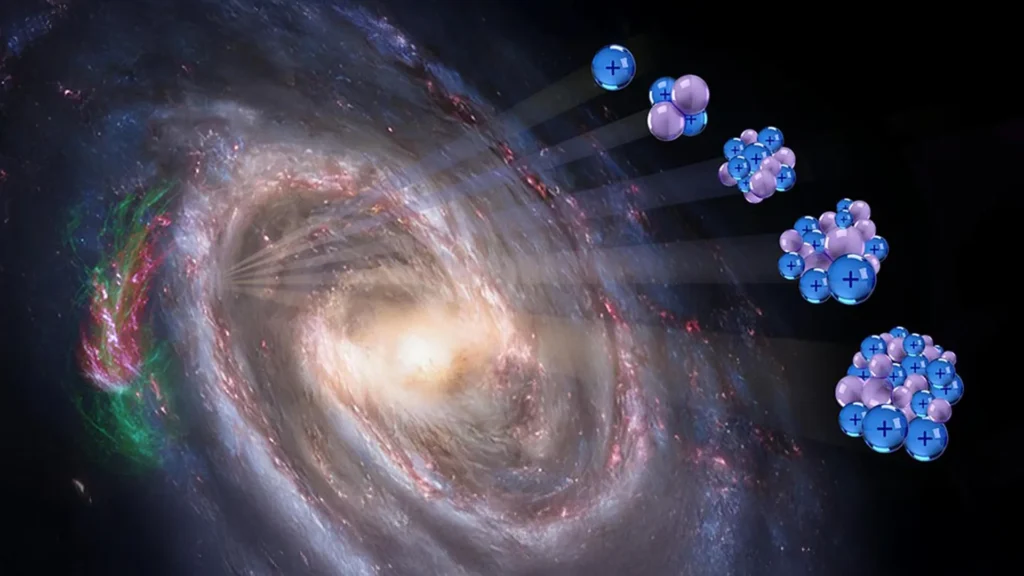
Since Hess’s pioneering work, scientists have pieced together a more detailed picture of these celestial messengers. Cosmic rays are primarily composed of atomic nuclei – roughly 90% protons (hydrogen nuclei), 9% helium nuclei, and about 1% heavier nuclei, including carbon, oxygen, and iron, along with a small fraction of electrons, positrons, and antiprotons. Their energy spectrum is vast, spanning more than twelve orders of magnitude, from mega-electronvolts (MeV) to energies exceeding 10^20 electronvolts (EeV) – energies equivalent to a well-hit tennis ball, but packed into a single subatomic particle. These extreme energies are far beyond the capabilities of even the Large Hadron Collider (LHC), the most powerful particle accelerator on Earth.
The sheer energy of cosmic rays points to some of the most violent and energetic phenomena in the universe as their accelerators. Leading candidates include supernova remnants – the expanding shells of gas and dust left behind after massive stars explode – which are thought to be the primary sources of galactic cosmic rays up to energies of around 10^15 eV (the "knee" in the cosmic ray spectrum). For the highest-energy extragalactic cosmic rays, potential sources include active galactic nuclei (AGN), which harbor supermassive black holes at their centers, and powerful gamma-ray bursts (GRBs). The exact mechanisms by which these cosmic behemoths accelerate particles to such incredible energies, often referred to as "cosmic accelerators," remain a central puzzle in astrophysics. Furthermore, how these particles propagate through the complex and turbulent magnetic fields of our galaxy and beyond, eventually reaching Earth, is another layer of this cosmic riddle.
DAMPE: A New Eye on the Cosmic Sky
The challenge of studying cosmic rays from Earth’s surface is immense. The vast majority of incoming cosmic rays interact with particles in the atmosphere, creating cascades of secondary particles (air showers) that reach ground-based detectors. While these air showers provide indirect evidence of the primary cosmic rays, directly observing the pristine particles before atmospheric interaction requires space-based instruments.
Enter the Dark Matter Particle Explorer (DAMPE), affectionately nicknamed "Wukong" after the mythical Monkey King, a symbol of wisdom and courage in Chinese culture. Launched on December 17, 2015, from the Jiuquan Satellite Launch Center in China, DAMPE is a cutting-edge space telescope designed specifically to address these profound questions. Orbiting Earth in a sun-synchronous orbit at an altitude of approximately 500 kilometers, DAMPE’s primary scientific objectives are twofold: to measure the precise energy spectra of high-energy electrons and gamma rays to search for signatures of dark matter annihilation, and to accurately measure the energy spectra of cosmic ray nuclei.
The DAMPE instrument is a sophisticated stack of detectors, each playing a crucial role in identifying and measuring incoming particles. It comprises a Plastic Scintillator Detector (PSD) for charge identification and anticoincidence, a Silicon-Tungsten Tracker (STK) for precise trajectory reconstruction and charge measurement, a Bismuth Germanate (BGO) Electromagnetic Calorimeter for energy measurement, and a Neutron Detector (ND) to help distinguish between electrons and hadrons. The mission is a testament to international scientific collaboration, with major contributions from institutions in China (led by the Purple Mountain Observatory of the Chinese Academy of Sciences), Switzerland, and Italy.
Unveiling a Universal Pattern: The Spectral Softening
The DAMPE collaboration’s recent breakthrough stems from an in-depth analysis of highly precise data collected by the telescope over several years. By meticulously examining the energy spectra of primary cosmic ray nuclei, ranging from lightweight protons to significantly heavier iron nuclei, researchers uncovered a remarkable and universal pattern.
"Cosmic rays are primarily composed of protons, but also of helium, carbon, oxygen, and iron nuclei," explains Andrii Tykhonov, associate professor at the Department of Nuclear and Particle Physics (DPNC) in the Faculty of Science at the University of Geneva (UNIGE), and a co-author of the seminal study. "These particles are also categorised according to their energy: low, up to a few billion electron-volts; intermediate, from a few billion to several hundred billion electron-volts; and high, from 1,000 billion electron-volts and beyond."
The core discovery revolves around an effect known as "spectral softening." For every type of nucleus investigated, the number of observed particles begins to drop much more rapidly after reaching a specific energy threshold. While it is generally expected that higher-energy cosmic rays are less common as energy increases (a power-law decrease), DAMPE’s observations revealed a dramatically steeper decline beyond a certain critical point. This critical point was identified as a rigidity of approximately 15 TV (teraelectron-volts).
Rigidity is a fundamental concept in cosmic ray physics, describing how strongly a charged particle’s path resists being bent by magnetic fields. It is defined as momentum per unit charge (R = pc/Ze, where p is momentum, c is the speed of light, Z is the atomic number, and e is the elementary charge). Particles with higher rigidity are less deflected by magnetic fields. The fact that this spectral softening appears consistently across many different types of particles – protons, helium, carbon, oxygen, and iron – and at the same rigidity rather than the same total energy, is profoundly significant.
The Rigidity Hypothesis: A Paradigm Shift
This universal spectral softening at a common rigidity provides compelling evidence that cosmic ray acceleration and their subsequent movement through the vast expanse of space are primarily controlled by rigidity-dependent processes. This finding strongly supports theoretical models that posit the maximum energy achievable by cosmic ray sources, or the escape of these particles from their acceleration regions, is dependent on their rigidity.
Crucially, the DAMPE data largely rules out competing explanations based on energy per nucleon (E/A), which is the total energy of a particle divided by its mass number (number of protons and neutrons). If the softening were dependent on energy per nucleon, it would manifest at different total energies for different types of nuclei, given their varying mass numbers. However, the observed consistency across different nuclei at the same rigidity provides a resounding refutation of such E/A-dependent models. According to the researchers, the statistical confidence level against these alternative models reaches an astonishing 99.999%, effectively dismissing them as viable explanations for the observed phenomenon.
This discovery significantly constrains the theoretical landscape for cosmic ray acceleration. For instance, in the widely accepted model of diffusive shock acceleration (DSA), often applied to supernova remnants, particles gain energy by repeatedly crossing the shock front. The maximum energy a particle can attain in this process is typically limited by the size and strength of the magnetic fields within the acceleration region. If this limit is rigidity-dependent, it means that heavier nuclei, with their higher charge, would reach the softening at higher total energies compared to protons, but at the same rigidity, precisely what DAMPE observed. This implies that the magnetic confinement or escape conditions within these cosmic accelerators are key determinants of the particles’ ultimate energy spectra.
Geneva’s Pivotal Role: AI and Advanced Instrumentation
The University of Geneva (UNIGE) played a particularly vital role in this international breakthrough. Researchers from the Department of Nuclear and Particle Physics (DPNC) made substantial contributions across several critical areas, from instrument development to advanced data analysis.
One of Geneva’s key contributions was the development of sophisticated artificial intelligence (AI) and machine learning methods. These advanced algorithms were indispensable for reconstructing particle events detected by the telescope, filtering out background noise, accurately identifying particle types, and precisely measuring their energies and trajectories. The complex environment of space, coupled with the high energies and diverse nature of cosmic rays, necessitates highly robust and intelligent data processing techniques to extract meaningful scientific information from raw detector signals. The UNIGE team’s expertise in this domain was crucial for achieving the high precision required for this discovery.
Beyond data analysis, the Geneva group also led the development of one of DAMPE’s cornerstone instruments: the Silicon-Tungsten Tracker (STK). This detector is essential for two primary functions: accurately tracing the paths of incoming cosmic rays and precisely determining their electrical charge. The STK’s ability to measure the charge (Z) of a particle is critical for distinguishing between different types of nuclei (e.g., protons, helium, carbon, iron) and, crucially, for calculating their rigidity. Without the high-fidelity tracking and charge measurement provided by the STK, the precise determination of the spectral softening at a common rigidity would not have been possible. The UNIGE team also played a significant role in important measurements involving proton and helium fluxes and contributed significantly to the analysis of carbon nuclei data, further solidifying their central position in the collaboration.
Looking Ahead: Refining Our Cosmic Understanding
The findings from DAMPE mark an important and transformative advance in our understanding of how cosmic rays are created, accelerated, and how they travel through the complex magnetic tapestry of our galaxy. By firmly establishing the rigidity-dependent nature of the spectral softening, these new results place tighter limits on existing models of particle acceleration in astrophysical sources and significantly improve our comprehension of how high-energy particles propagate through the interstellar medium.
"This uniform behavior across different cosmic ray species, defined by rigidity, is a powerful indicator," states one of the DAMPE collaboration scientists, emphasizing the implication for astrophysical models. "It suggests that the mechanisms governing the maximum energy particles can reach, or how they escape from their acceleration sites, are fundamentally tied to how magnetic fields interact with these charged particles, rather than simply their total energy or mass."
The implications extend beyond just understanding cosmic ray origins. DAMPE’s secondary objective is to search for dark matter, a mysterious substance believed to constitute about 27% of the universe’s mass. Precise knowledge of cosmic ray backgrounds is absolutely critical for distinguishing potential dark matter annihilation signals from the much more abundant flux of conventional cosmic rays. By refining our models of cosmic ray spectra, this discovery aids in improving the sensitivity of dark matter searches, not only for DAMPE but also for future missions.
The Broader Astrophysical Impact
This discovery is a testament to the power of dedicated space missions and international collaboration in unraveling the universe’s deepest secrets. It provides a crucial piece of the puzzle in the century-long quest to understand cosmic rays. The observed universal spectral softening at 15 TV rigidity represents a new benchmark for theoretical models, challenging them to incorporate this specific energy-dependent behavior across all primary nuclei.
Future research will undoubtedly build upon these findings. Scientists will now work to refine models of supernova remnants and other potential cosmic ray sources, ensuring they can reproduce this rigidity-dependent spectral feature. This will involve more detailed simulations of magnetic field structures and particle interactions within these extreme environments. Furthermore, the results will guide the design and data analysis strategies of next-generation cosmic ray observatories, both in space and on the ground, enabling even more precise measurements and potentially uncovering further nuances in the cosmic ray spectrum.
Ultimately, the DAMPE mission’s latest revelation brings us closer to a comprehensive understanding of the high-energy universe, shedding light on the processes that shape galaxies, influence star formation, and perhaps even hold clues to the nature of dark matter itself. It underscores that even after more than a hundred years, cosmic rays continue to be a fertile ground for discovery, pushing the boundaries of human knowledge about the cosmos.