On August 12, 2026, a rare and breathtaking astronomical event will grace the skies over parts of Europe: a total solar eclipse. For a fleeting period, the Moon will align perfectly with the Sun, casting a shadow that will plunge regions of Greenland, Iceland, Spain, and Portugal into an ethereal twilight. This celestial dance, while a spectacle for the naked eye, presents a crucial window for scientists to probe the Sun’s elusive outer atmosphere, the solar corona, a region that is the very genesis of space weather.
The significance of this event transcends mere visual wonder. The solar corona, normally obscured by the Sun’s overwhelming brilliance, becomes visible during totality, revealing intricate structures and dynamic phenomena that hold the key to understanding the Sun’s influence on our solar system and, critically, on Earth. It is from this region that the solar wind emanates, a constant stream of charged particles that buffet our planet, and where powerful solar flares and coronal mass ejections (CMEs) erupt, capable of disrupting vital technological infrastructure.
The Corona: Cradle of Space Weather
The solar corona, extending millions of kilometers into space, is a region of extreme temperatures and complex magnetic fields. It is here that the plasma is heated to millions of degrees Celsius, far hotter than the Sun’s visible surface. This superheated plasma is then accelerated outwards to form the solar wind, a constant flow that permeates the heliosphere. When magnetic field lines in the corona reconnect explosively, they can unleash immense bursts of energy and particles in the form of solar flares and CMEs.
These solar phenomena are not merely academic curiosities; they have tangible impacts on our increasingly technology-dependent world. Disruptions to satellite communications, navigation systems like GPS, power grids, and even airline operations can occur when a significant solar event interacts with Earth’s magnetosphere. Understanding the processes that drive these events is therefore paramount for enhancing our ability to forecast and mitigate their effects, a field known as space weather prediction.
The Rarity of Natural Eclipses and the Rise of Artificial Occultations
Observing the full solar corona from Earth during natural total solar eclipses has historically been a fleeting opportunity. These events, while spectacular, are geographically confined and last at most a few minutes. The rarity and brevity of these natural occurrences have long challenged scientists seeking sustained, in-depth study of the corona. A total solar eclipse is a prime example of a natural "solar occultation," where an celestial body—in this case, the Moon—blocks the direct light from the Sun.
To overcome the limitations of natural eclipses, scientists have developed innovative techniques. One such method involves the use of coronagraphs, sophisticated telescopes equipped with an internal occulter. This disc precisely blocks the Sun’s bright disc, mimicking the Moon’s action and allowing the fainter corona to be observed. However, even traditional coronagraphs often struggle to capture the inner regions of the corona, close to the Sun’s surface, leaving a critical observation gap.

ESA’s Proba-3: An Artificial Eclipse on Demand
The European Space Agency (ESA) has taken a pioneering step in this endeavor with its Proba-3 (Project for On-Board Autonomy – Technology Demonstration) mission. Proba-3 is not a single spacecraft but a meticulously coordinated pair of satellites operating in unison, effectively creating an artificial eclipse in space. The mission comprises an "Occulter" spacecraft and a "Coronagraph" spacecraft, positioned 150 meters apart in orbit.
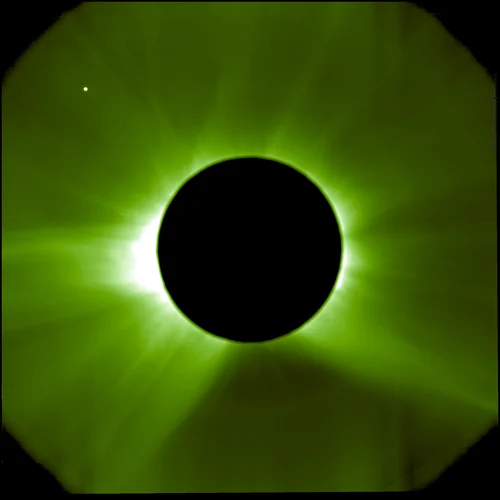
The Occulter spacecraft is designed to precisely position itself between the Sun and the Coronagraph spacecraft, acting as an artificial Moon to occult the Sun. This ingenious setup allows the Coronagraph spacecraft to utilize its advanced scientific instrument, ASPIICS (Advanced Coronagraph for Imaging of the Sun), to capture high-resolution images of the solar corona for extended periods, often for several hours at a time. This capability dramatically extends the observation window compared to natural eclipses.
Andrei Zhukov, the principal investigator for the ASPIICS instrument at the Royal Observatory of Belgium, highlighted the mission’s recent achievements. "This is the 62nd eclipse of Proba-3’s nominal operations—a part of the mission during which we acquire coronal images," Zhukov stated. He further elaborated on a particularly significant observation: "What makes this one unique is that it was taken about two weeks before the upcoming natural eclipse on August 12. It takes the Sun two weeks to rotate halfway around its axis, so if we mirror the image horizontally, we get a prediction of what the corona will look like during the natural eclipse seen from Earth two days from now. The overall large-scale coronal structure usually doesn’t change much during that time." This demonstrates Proba-3’s remarkable predictive power, offering insights into future coronal appearances.
Solar Orbiter: A Unique Perspective on the Sun’s Magnetic Heart
Complementing the artificial eclipses created by Proba-3, ESA’s Solar Orbiter mission is also undertaking a dedicated observation campaign in anticipation of the August 12th total solar eclipse. Unlike most solar observatories that orbit near Earth, Solar Orbiter follows a unique trajectory around the Sun, providing a vantage point that offers a different perspective on solar activity.
The totality of a solar eclipse provides a rare opportunity to observe structures in the corona that are sculpted by the Sun’s intricate magnetic field. This allows scientists to rigorously test and validate the accuracy of their computer models, which aim to simulate the Sun’s magnetic environment and predict its behavior.
"A total solar eclipse lets us verify that our models are correct by comparing forecasts with actual observations," explained Jorge Amaya, ESA’s Space Weather Modelling Coordinator. He emphasized the importance of multi-point observations: "Most solar observations are made from near Earth, providing only a limited view of a vast three-dimensional system. Luckily, Solar Orbiter follows a different path around the Sun than other solar observatories. Today, the spacecraft is facing the side of the Sun that will soon roll into Earth’s view, giving observers on the ground the opportunity to decide which targets to focus on during the eclipse."
Crucially, Solar Orbiter’s Polarimetric and Helioseismic Imager (PHI) instrument is capturing detailed magnetic maps (magnetograms) of the Sun’s visible surface. These data, thanks to the spacecraft’s unique position, provide modellers with a more comprehensive understanding of the Sun’s magnetic field. For instance, PHI has recently detected a newly emerging active region, a dynamic area on the Sun’s surface likely to influence the corona’s appearance during the upcoming eclipse. Such an observation would not have been possible from Earth-bound telescopes alone.

Amaya further illustrated the benefit of these diverse perspectives: "The magnetic field lines that we see in simulations are like hairs in a fuzz ball. Observing the Sun from multiple viewpoints allows us to determine their orientation in three dimensions. That is the key to dramatically improving forecasts of how solar activity will affect our technology." The data gathered by Solar Orbiter is also serving as a preview of what ESA’s future space weather forecasting mission, Vigil, will observe. Vigil, scheduled for launch in 2031, is designed to maintain a constant watch on the Sun from a position trailing Earth, providing continuous, near real-time data.
Miho Janvier, ESA’s project scientist for both Proba-3 and Solar Orbiter, summarized the synergy between these missions: "With Proba-3 and Solar Orbiter, we have an unprecedented view of our star. Both missions are contributing to our understanding of the Sun, from its surface to its extended atmosphere. The upcoming total solar eclipse offers a chance to see how this knowledge comes together, comparing observations with modelling."
Virtual Totality: Predictive Models and Public Engagement
The scientific community is leveraging the upcoming eclipse not only for direct observation but also for validating and refining sophisticated predictive models. Predictive Science Inc., in collaboration with ESA’s Solar Orbiter team, is using the mission’s unique data to generate highly accurate predictions of the solar corona’s appearance during the August 12th event. These cutting-edge predictions can be accessed online, offering the public a glimpse into the scientific forecasting process.
In parallel, KU Leuven is collaborating with ESA’s Space Weather Office to provide its own predictions for the eclipse. This multi-faceted approach underscores the collaborative nature of modern space science, where different institutions and instruments work together to achieve a common goal.
Witnessing the Event: Livestream and Safety Precautions
For those unable to witness the total solar eclipse in person, ESA will be broadcasting a live stream of the event on August 12th between 19:30 and 20:45 CEST. This broadcast will provide an accessible way for people worldwide to experience this rare astronomical phenomenon.
Crucially, ESA emphasizes the importance of safe solar viewing practices. Looking directly at the Sun without proper protection, even during partial phases of an eclipse, can cause severe and permanent eye damage. Standard sunglasses are insufficient and unsafe for eclipse viewing. Certified eclipse glasses that meet international safety standards are essential and must be worn at all times when observing the Sun, except during the brief period of totality when the Sun’s disc is completely obscured by the Moon. As soon as the Sun begins to re-emerge, eclipse glasses must be immediately put back on. ESA provides detailed guidance on safe observation methods to ensure that the public can enjoy the eclipse without risking their vision.
Broader Implications for Space Weather Preparedness
The August 12, 2026, total solar eclipse represents more than just a captivating astronomical event; it is a critical scientific opportunity. The combined efforts of missions like Proba-3 and Solar Orbiter, coupled with advanced modeling techniques and dedicated observation campaigns, are pushing the boundaries of our understanding of the Sun. The data gathered and the insights gleaned will directly contribute to improved space weather forecasting, enabling better protection of our vital technological infrastructure and ensuring the continued advancement of our increasingly interconnected world. As the scientific community prepares to scrutinize the Sun’s corona, the lessons learned from this celestial spectacle will undoubtedly resonate for years to come, shaping our preparedness for the dynamic and often unpredictable nature of our star.