Researchers at the Massachusetts Institute of Technology (MIT) have developed a groundbreaking system that promises to revolutionize the creation of interactive objects. Dubbed ShiftLens, this innovative platform allows for the fabrication of a wide array of dynamic objects that do not rely on delicate electronic circuits, opening doors for applications ranging from robust warning signs to intelligent packaging and intuitive artistic installations. The end-to-end system also significantly streamlines the rapid prototyping process for adaptable designs across artistic, architectural, and engineering disciplines.
The core innovation of ShiftLens lies in its ability to imbue objects with interactive capabilities through purely mechanical means. This approach circumvents the inherent fragility of electronic components, making the resulting objects far more resilient to environmental factors such as harsh weather, moisture, and physical stress. "With our system, an object can tell you whether you are using it properly, without the need for sensors or any complicated electronics," explained Yunyi Zhu, a graduate student in MIT’s Department of Electrical Engineering and Computer Science (EECS) and the lead author of a paper detailing the platform. "The interactive display is mechanical, so you can create a self-contained, multistate, interactive device that a user can control very intuitively."
The research, which was presented at the prestigious ACM Symposium on User Interface Software and Technology, represents a significant leap forward in the field of tangible interfaces and interactive design. The team behind ShiftLens includes Dingning Cao, an MIT undergraduate; Jeremy Mrzyglocki, a graduate student at the Technical University of Munich; Stefanie Mueller, an associate professor in EECS and the Department of Mechanical Engineering at MIT and a member of the Computer Science and Artificial Intelligence Laboratory (CSAIL); and Narjes Pourjafarian, a postdoctoral researcher at Northeastern University. Their collective expertise has culminated in a system that bridges the gap between digital design and physical realization in a remarkably robust and accessible manner.
Mechanically Switchable Surfaces: A Paradigm Shift in Object Interaction
The landscape of interactive products has long been dominated by screens and electronic displays that dynamically alter their appearance. However, these technologies are often susceptible to damage from environmental hazards. Exposure to water, corrosive chemicals, or even significant physical deformation like squishing or twisting can render electronic components inoperable. This vulnerability limits their application in demanding environments or in products designed for rigorous use.
Conversely, existing non-electronic methods for altering an object’s surface appearance typically rely on static optical effects. These might involve stickers or carefully shaped lenses that create visual illusions based on the viewer’s perspective. While these methods can offer some degree of visual variation, their interactivity is inherently limited, offering little to no dynamic responsiveness to user input or environmental changes.
ShiftLens addresses this dichotomy by offering a novel solution: a system that automatically transforms a user’s design into a 3D printable model of an object featuring a mechanically switchable surface. This means the object’s appearance can change in response to physical manipulation, without any need for batteries, wires, or complex circuitry.
The ShiftLens Mechanism: Layered Optics for Dynamic Displays
At the heart of ShiftLens is a clever optical design that utilizes two distinct layers on an object’s surface to create switchable appearances. The system places a layer of specialized lenses over an underlying patterned backplane. The interplay between these two layers, specifically their relative motion, dictates the visual state displayed by the object.
The upper layer comprises an array of tiny lenticular lenses. These are essentially miniature curved lenses, each designed to steer light in a specific direction based on the user’s viewing angle. The underlying backplane, on the other hand, is imprinted with strips of images. Each strip corresponds to a different visual state or appearance that the object’s surface can adopt.
When a user manipulates the object in a way that causes the lens layer to shift relative to the backplane, different sections of the backplane’s patterned images become visible through the lenses. The lenticular lenses then magnify these visible sections, effectively changing the perceived appearance of the object’s surface. This creates a seamless transition between different visual states, driven entirely by mechanical movement.
"The biggest challenge in this project was to make sure all moving parts align," Zhu stated. "We need to make sure that the optical effect, mechanical linkages, and computational graphics align with one another." Achieving this precise alignment is crucial for the system to function correctly and produce the intended visual transitions.
A Streamlined Design Process for Accessibility
Recognizing that not all designers or engineers possess deep expertise in optics or complex mechanical systems, the MIT researchers developed a user-friendly tool to simplify the design process. This software acts as an intelligent assistant, handling the intricate behind-the-scenes calculations and generating the necessary ShiftLens structure.
The tool requires minimal input from the user. They need to provide images representing the desired visual states for the object and specify the intended shape and curvature of the object’s surface. The software then automatically generates a ShiftLens design that integrates these requirements.
"Another challenge is to communicate to users who are not familiar with optics or mechanical structures and let them specify and achieve what they have in mind," Zhu elaborated. The team has carefully considered how to convey the capabilities and limitations of the ShiftLens design tool to ensure a positive user experience.
It’s important to note that ShiftLens is not universally applicable to all object designs. The system relies on a shifting motion to facilitate the interaction between the lens and pattern layers. Therefore, users must either incorporate ShiftLens into objects that inherently possess such a motion, like the twisting action of a lipstick tube or a dial, or integrate an external actuation mechanism. This mechanism could take the form of a switch, a knob, a roller, or any other component that can induce the necessary relative movement between the layers.
"With ShiftLens, users can control what an object looks like while they are using it," Zhu emphasized, highlighting the intuitive and direct nature of the interaction.
Demonstrating Versatility: Real-World Applications and Prototypes
To illustrate the practical utility and versatility of ShiftLens, the researchers fabricated a range of interactive objects. These prototypes serve as compelling examples of how the technology can be applied across various domains.
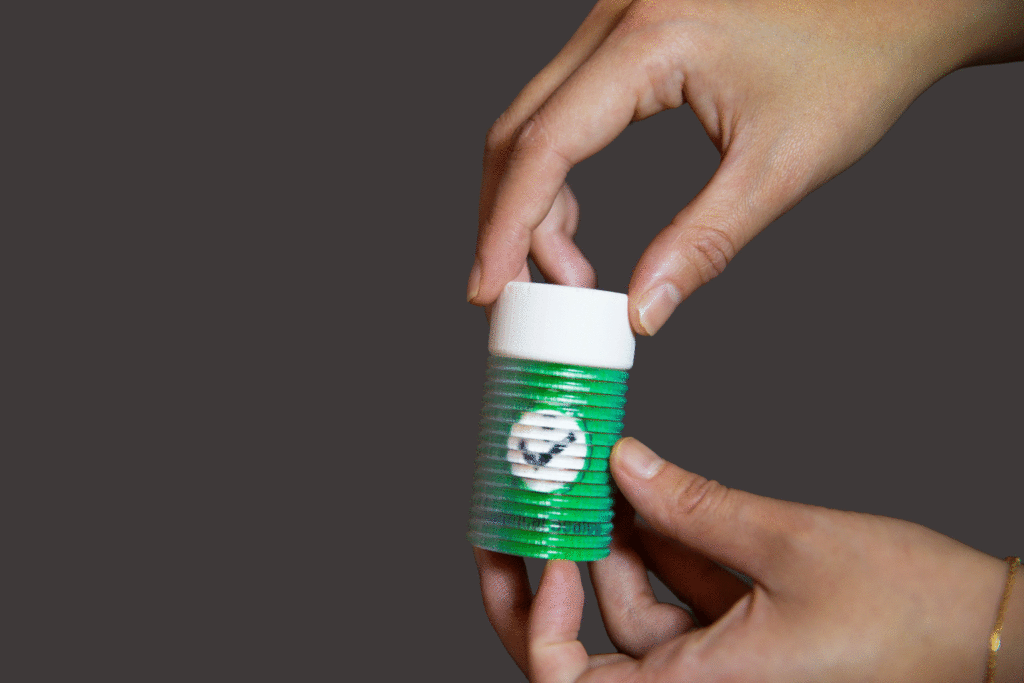
One notable demonstration involved a chemical bottle designed to provide a visual safety indicator. When the cap was securely tightened, the bottle’s surface turned green and displayed a check mark, signifying a proper seal. Conversely, if the cap was loose, the surface would turn red and display an exclamation mark, alerting the user to a potential issue. This application underscores the potential for ShiftLens in safety-critical products where clear, immediate feedback is essential.
Another compelling prototype was a tic-tac-toe game. In this instance, the squares of the game board could dynamically change their appearance. Depending on the direction a user turned a small integrated knob, each square could display a red ‘X’, a blue ‘O’, or remain blank. This showcased ShiftLens’s ability to create engaging and interactive game mechanics without relying on electronic displays or embedded processors.
The researchers also envision broader industrial and commercial applications. For example, ShiftLens could be employed in the design of piping systems. Damaged connections within a pipe could be visually signaled by a change in the pipe’s surface appearance, such as displaying a red warning or a specific symbol, making it easier to identify and address leaks or other malfunctions. Zhu humorously added, "The leaking sink in my apartment would be a lot easier to fix if it could tell me where the leak was coming from."
Future Directions and Broader Implications
The MIT team is already looking towards the future, with plans to further enhance the ShiftLens system. Future research will focus on exploring additional applications, pushing the boundaries of what is possible with mechanically interactive objects.
A key area of development involves refining the design algorithm. The researchers aim to create an algorithm capable of generating a ShiftLens structure with even fewer user inputs, further simplifying the design process and making it accessible to an even wider audience. Additionally, they plan to expand the capabilities of the design tool to support a broader range of actuation mechanisms, offering designers greater flexibility in how they integrate ShiftLens into their creations.
The implications of ShiftLens extend beyond mere novelty. By providing a robust and accessible method for creating interactive objects, the technology has the potential to democratize the creation of smart, responsive physical interfaces. This could foster innovation in fields such as education, accessibility, and consumer product design, where the cost and complexity of traditional electronics have often been a barrier.
The ability to create objects that can provide immediate, intuitive feedback without relying on power sources or complex programming could lead to more sustainable and user-friendly technologies. As the world continues to move towards greater integration of digital information into the physical realm, systems like ShiftLens offer a promising path towards creating that integration in a more resilient, intuitive, and environmentally conscious manner. The research team’s success in merging mechanical ingenuity with optical design principles marks a significant milestone, paving the way for a future where everyday objects can communicate and interact with us in entirely new and engaging ways.