A multi-institutional collaboration involving the CSIR-Central Salt and Marine Chemicals Research Institute (CSMCRI), the Indian Institute of Technology Gandhinagar (IITGN), Nanyang Technological University (NTU) in Singapore, and the S N Bose National Centre for Basic Sciences has announced the development of a groundbreaking filtration technology. The research, recently detailed in the prestigious Journal of the American Chemical Society (JACS), introduces a new class of crystalline membranes known as "POMbranes." This innovation is poised to address one of the most significant challenges in modern manufacturing: the high energy cost and environmental impact of industrial separation processes.
Industrial separation—the process of isolating specific chemicals, purifying drugs, or removing dyes from wastewater—is a cornerstone of global production. However, it is also a massive consumer of resources. Current estimates suggest that separation processes account for approximately 40% to 50% of all industrial energy consumption worldwide. By providing a more efficient, precise, and durable alternative to traditional methods, the development of POMbranes represents a major step toward the "green" transition of heavy industry.
The Crisis of Industrial Energy Consumption
To understand the significance of the POMbrane discovery, one must first look at the inefficiencies of current industrial standards. For decades, the pharmaceutical, textile, and chemical sectors have relied heavily on thermal separation methods such as distillation and evaporation. These processes involve heating large volumes of liquid to separate components based on their boiling points. While effective, these methods are notoriously energy-intensive and contribute heavily to the global industrial carbon footprint.
As global regulations on carbon emissions tighten and energy costs fluctuate, industries have increasingly looked toward membrane-based filtration as a "cold" and cleaner alternative. Unlike distillation, membrane filtration uses pressure to push liquids through a barrier that traps contaminants while allowing the desired solvent to pass through. However, conventional polymer-based membranes have significant drawbacks. Most plastic or polymer filters have uneven pore sizes and are prone to "swelling" or degrading when exposed to harsh chemicals or varying pH levels. Over time, these pores lose their shape, leading to a decline in filtration accuracy and necessitating frequent, costly replacements.
Engineering the POMbrane: A Molecular Masterpiece
The research team, led by scientists from CSMCRI and IITGN, sought to overcome these limitations by looking to nature for inspiration. They focused on biological systems like aquaporins—proteins that form tiny channels in cell membranes to regulate the flow of water with perfect precision. To replicate this level of control in a synthetic material, the researchers utilized polyoxometalate (POM) clusters.
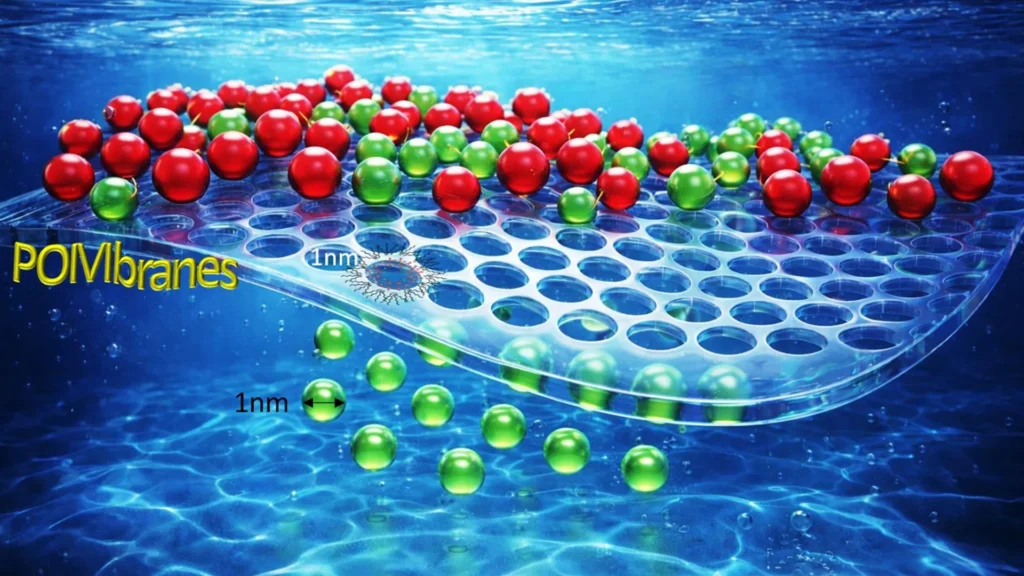
POMs are inorganic, crown-shaped metal clusters that possess a unique characteristic: a permanent, central hole that is exactly one nanometer in diameter. Unlike the pores in polymer membranes, which are formed during the casting process and vary in size, the holes in POM clusters are intrinsic to their molecular structure. This means every single pore in a POMbrane is identical and structurally rigid.
"To address these limitations, we engineered a new class of ultra-selective, crystalline membranes called ‘POMbranes,’ which contain pores that are about one nanometer wide, thousands of times thinner than a human hair," explained Dr. Shilpi Kushwaha, Senior Scientist at CSMCRI.
The primary challenge for the team was not just finding the right building blocks, but assembling them. To create a functional filter, billions of these tiny POM clusters had to be arranged into a continuous, ultrathin, and defect-free film. The researchers achieved this by chemically modifying the clusters with flexible organic chains. When these modified clusters were introduced to the surface of water, they underwent a process of self-assembly, spreading out to form a large-area film where the clusters were packed tightly together.
Unprecedented Precision and Performance Data
The resulting POMbranes have demonstrated performance metrics that far exceed current industry standards. In laboratory testing, the membranes showed the ability to distinguish between molecules that differ in weight by as little as 100 to 200 Daltons. This level of molecular "sieving" is nearly impossible for traditional membranes, which often allow smaller contaminants to leak through or larger, valuable molecules to get trapped.
According to Dr. Ketan Patel, Principal Scientist at CSMCRI, the results were definitive. "Our membranes show almost ten times better separation performance compared to existing technologies, while remaining flexible, stable, and scalable," he stated.
The data suggests that POMbranes are not only more precise but also more resilient. Because the POM clusters are inorganic and crystalline, they do not suffer from the structural instability seen in plastic filters. The research indicates that these membranes maintain their integrity across a wide range of acidity levels (pH ranges), making them suitable for the harsh chemical environments often found in the textile and pharmaceutical sectors.
Strategic Implications for the Textile Industry
The timing of this technological breakthrough is particularly relevant for India, a global hub for textile production. The Indian textile and apparel sector is a vital pillar of the national economy, contributing over 2.3% to the GDP and representing roughly 13% of total industrial production. With the domestic market valued at approximately $160-225 billion and projected to reach $350 billion by 2030, the environmental footprint of the industry has become a point of national concern.
Textile dyeing and finishing are among the most water-intensive industrial activities. These processes generate massive volumes of wastewater laden with complex dyes and chemicals that are difficult to treat. Current wastewater management often struggles to balance the cost of treatment with the need for water reuse.
POMbranes offer a potential solution to this dilemma. By utilizing the one-nanometer pores, textile manufacturers could selectively remove large dye molecules from wastewater while allowing water and essential salts to pass through for reuse. This "selective recovery" would significantly reduce the demand for fresh water and minimize the volume of chemical waste discharged into the environment. As India moves toward stricter "Zero Liquid Discharge" (ZLD) norms, such high-precision membranes could become essential infrastructure for sustainable textile manufacturing.
Advancing Pharmaceutical Manufacturing and Solvent Recovery
Beyond textiles, the pharmaceutical industry stands to benefit immensely from POMbrane technology. In drug manufacturing, the purification of active pharmaceutical ingredients (APIs) is a critical and sensitive step. Many life-saving drugs are heat-sensitive, meaning traditional distillation can damage the product.
Dr. Raghavan Ranganathan, Associate Professor at IITGN, and PhD scholar Vinay Thakur utilized molecular-level simulations to map exactly how molecules interact with the POMbrane surface. Their findings suggest that the membrane acts as a perfect sieve, allowing for the recovery of expensive solvents and the purification of drugs at room temperature.
"Processes like drug purification and solvent recovery are both energy-intensive and quality-sensitive," noted Mr. Vinay Thakur. "Highly selective membranes such as these can lower energy use while maintaining the stringent standards required in pharmaceutical production."
The ability to perform these separations without heat not only saves energy but also improves the overall yield and purity of the final pharmaceutical products, potentially lowering the cost of drug production in the long run.
A Scalable Platform for the Future
One of the most promising aspects of the POMbrane technology is its scalability. While many lab-based innovations struggle to transition to industrial-scale production, the self-assembly method used to create POMbranes is inherently scalable. The researchers have demonstrated that these membranes can be manufactured in large, flexible sheets, which is a prerequisite for integration into existing industrial filtration systems.
The collaborative nature of the project—spanning across premier Indian institutes like CSMCRI and IITGN to international partners at NTU Singapore—highlights the global importance of the research. By combining expertise in materials science, chemical engineering, and molecular simulation, the team has created a versatile "platform technology."
As the world grapples with the dual challenges of resource scarcity and climate change, the shift toward molecularly engineered materials like POMbranes offers a path forward. These membranes represent more than just a better filter; they are a manifestation of how nature-inspired design and precise chemical engineering can solve some of the most stubborn inefficiencies in modern industry.
Looking ahead, the research team plans to further test the durability of POMbranes in real-world industrial settings and explore additional applications in areas such as desalination and carbon capture. If the technology lives up to its laboratory potential, the "POMbrane" could soon become a standard component in the global quest for a more sustainable and energy-efficient industrial landscape.