Astronomers have identified an unprecedentedly luminous red object in the nascent universe, challenging current astrophysical models and hinting at a new class of cosmic phenomena. This object, provisionally designated MoM-BH-1, exhibits characteristics that defy conventional stellar explanations, leading researchers to propose the existence of "black hole stars" – celestial bodies potentially powered by supermassive black holes enshrouded in vast envelopes of gas. The discovery, detailed in a study published on August 12 in the prestigious journal Nature*, was made possible by the unparalleled observational capabilities of NASA’s James Webb Space Telescope (JWST).
The object, detected as a distinct bright red dot, existed mere hundreds of millions of years after the Big Bang, a period when the universe was still in its infancy. At first glance, its immense size, comparable to our solar system, might suggest an enormous star. However, its energy output is staggering, radiating approximately 100 billion times more energy than any known star could physically generate. This luminosity places its power output in a realm typically associated with the energetic processes surrounding black holes, sparking a profound re-evaluation of early cosmic structures.
A Cosmic Enigma: The Nature of MoM-BH*-1
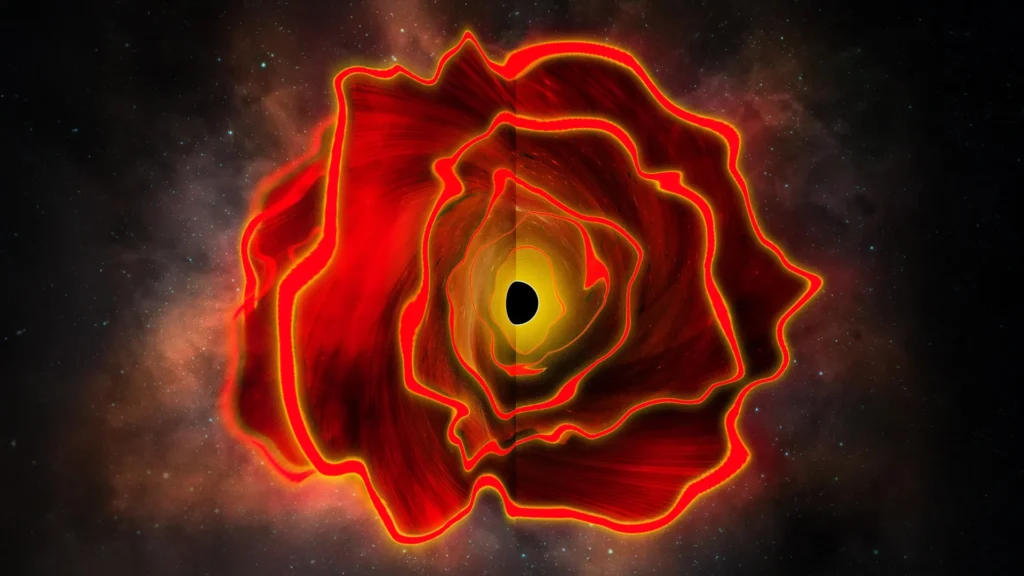
The most compelling hypothesis put forth by the research team, comprising astronomers from MIT and other leading institutions, suggests that MoM-BH*-1 is not a conventional star. Instead, it may represent a symbiotic system: a supermassive black hole at its core, actively accreting matter, and surrounded by an extraordinarily dense, star-like envelope of gas. This gas, rather than undergoing nuclear fusion as in ordinary stars, is energized by the intense gravitational pull and radiation emanating from the central black hole.
"Our understanding of this object is evolving at a remarkable pace," stated lead author Rohan Naidu, a NASA Hubble Fellow and Pappalardo Fellow at MIT’s Kavli Institute for Astrophysics and Space Research (Kavli Institute). "We hypothesize that a central black hole, approximately 100,000 times the mass of our Sun, is the engine. Encasing this black hole is a vast envelope of gas, spanning a region comparable in size to our solar system, which presents itself visually as a star."
This groundbreaking interpretation, if validated, could also shed light on a persistent puzzle that has emerged from JWST observations: the ubiquitous "little red dots" observed across numerous deep-field images of the early universe. These faint, red signals have been a subject of intense debate among astronomers since JWST began its observations.
"These little red dots appear to be prevalent in the early universe but largely absent in more recent cosmic epochs," Naidu elaborated. "Their precise nature has been one of the most significant unresolved questions of the JWST era."
The collaborative research effort involved key contributions from MIT, including MKI Director Robert Simcoe, the Bruno B. Rossi Professor of Experimental Physics, and Wendy Sun ’26, alongside researchers from a consortium of international institutions.
The "Mirage or Miracle" Survey: An Accidental Discovery
The genesis of this discovery lies not in a targeted search for exotic cosmic entities, but rather within the ambitious "Mirage or Miracle" (MoM) survey. This project, led by Naidu and his colleagues, aimed to meticulously identify and characterize some of the universe’s earliest and most distant galaxies. By leveraging JWST’s deep-sky observation capabilities, the team peered back in time to an era just a few hundred million years after the Big Bang, a period characterized by rapid cosmic evolution. The survey sought to differentiate between truly nascent galaxies and potential observational artifacts or distant objects that might appear as early galaxies.
"A persistent puzzle in cosmology has been the observation of numerous bright galaxies appearing at extremely early cosmic times," explained Naidu. "Our survey was designed to resolve this, determining whether these were genuine ‘miracles’ of early galaxy formation or merely ‘mirages’ – more distant objects masquerading as early structures."
It was during this systematic examination of JWST images that the team encountered an anomaly – a celestial source that stood out due to its intense redness and remarkable brightness, deviating from the expected signatures of typical early galaxies.
Deciphering the Red Hue: Beyond Dust and Ordinary Stars
The initial visual cue of extreme redness in astronomical objects often leads scientists to suspect the presence of dust, which can absorb and scatter shorter wavelengths of light, making objects appear redder. This phenomenon is akin to how wildfire smoke can lend a reddish tint to the sky.
"When we observe something exceptionally red in the universe, our immediate assumption is often the presence of intervening dust, akin to soot or ash," commented Simcoe. "Just as recent wildfire smoke from Canada caused the sky over Boston to appear vividly red, astronomical objects can exhibit a reddened appearance when viewed through a veil of dust."
However, the light spectrum of MoM-BH*-1 presented features that did not align with dust obscuration. A striking characteristic was a dramatic drop-off in its light intensity at specific wavelengths, a phenomenon known as a "Balmer break." This feature is typically associated with dense gas absorbing photons, a process observed in the atmospheres of stars that are a few hundred million years old. Even Vega, one of the brightest stars visible in our night sky, exhibits a similar spectral signature.
"The break we observed in this object is the most profound we have ever recorded in any celestial body, effectively ruling out ‘ordinary’ stars as the source," Naidu emphasized. "However, it did prompt us to consider the possibility of a novel type of ‘stellar atmosphere,’ but on a scale of unprecedented magnitude."
Further analysis revealed another peculiarity: the object’s light showed a distinct lack of metals and other elements, with hydrogen and helium being the dominant detectable constituents. "It was truly singular in its characteristics," Naidu added.
Theoretical Modeling: Constructing the "Black Hole Star"
To unravel the mystery behind MoM-BH*-1’s unusual appearance, the researchers embarked on a rigorous process of simulating various astrophysical scenarios and comparing the theoretical outputs with the empirical data gathered by JWST.
"We began by asking: Could we create something this red using only hydrogen, without any dust?" Simcoe recalled. "To our astonishment, we discovered that it is indeed possible if one possesses an extremely dense screen of hydrogen, so dense that it more closely resembles the surface of an enormous star than a diffuse interstellar nebula."
These simulations indicated that the red source could be powered by an exceptionally potent energy source concealed within a densely packed cocoon of hydrogen. Such a structure would explain the observed strong Balmer break and the scarcity of elements other than hydrogen and helium. However, a critical piece of the puzzle remained: the object’s extraordinary luminosity.
"We are observing something that superficially resembles a star, yet it is 100 billion times brighter," Naidu pointed out. "This immense luminosity cannot be accounted for by nuclear fusion, the fundamental energy generation process that powers all known stars."
The Black Hole Solution: Unveiling the Power Source
The prodigious energy output of MoM-BH*-1 strongly suggested a more powerful energy generation mechanism. Black holes, particularly actively accreting ones, are known to release vast amounts of energy. Consequently, the research team incorporated an active, accreting black hole into their simulations of the dense hydrogen cocoon. By adjusting the black hole’s mass and other parameters, they were able to match the simulated brightness with the JWST observations of the red dot.
The most successful model pointed unequivocally to a "black hole star" as the most plausible explanation. According to this model, MoM-BH-1 comprises a central black hole with a mass approximately 100,000 times that of the Sun, enveloped by a dense, star-like hydrogen atmosphere extending across a region comparable to our solar system. The researchers have formally named this object MoM-BH-1, reflecting its origin in the MoM survey, and have also bestowed upon it the descriptive moniker "black hole star – one," suggesting it may be the first of a potentially widespread population of such objects.
Implications for Early Universe Studies and Beyond
The discovery of MoM-BH-1 and the proposed "black hole star" model hold significant implications for our understanding of the early universe. Researchers now suspect that this newly identified class of objects could be responsible for many of the enigmatic "little red dots" observed by JWST. While these other objects are not as luminous as MoM-BH-1, they may share a similar underlying structure.
"Each of these little red dots is consistent with being a black hole star, embedded within a generic early galaxy," Naidu suggested. "What distinguishes MoM-BH*-1 is that its black hole star component completely outshines its surrounding host galaxy, allowing us to observe the pure light emitted by the black hole star itself."
If this interpretation holds true, MoM-BH*-1 could provide a crucial key to unlocking one of the most significant cosmological mysteries emerging from the JWST era. It also promises to reveal a novel type of cosmic object that astronomers had not previously encountered or directly observed. The existence of such objects at such an early stage of the universe’s development suggests that massive black holes may have formed and begun to grow much earlier than previously theorized, potentially influencing the formation and evolution of early galaxies.
The research leading to this discovery was supported by grants from the MIT Department of Physics, NASA, and the Space Telescope Science Institute, underscoring the collaborative and well-funded nature of cutting-edge astronomical research. Further observations and theoretical work will be crucial in confirming the existence and prevalence of these "black hole stars" and in fully understanding their role in shaping the early cosmos.