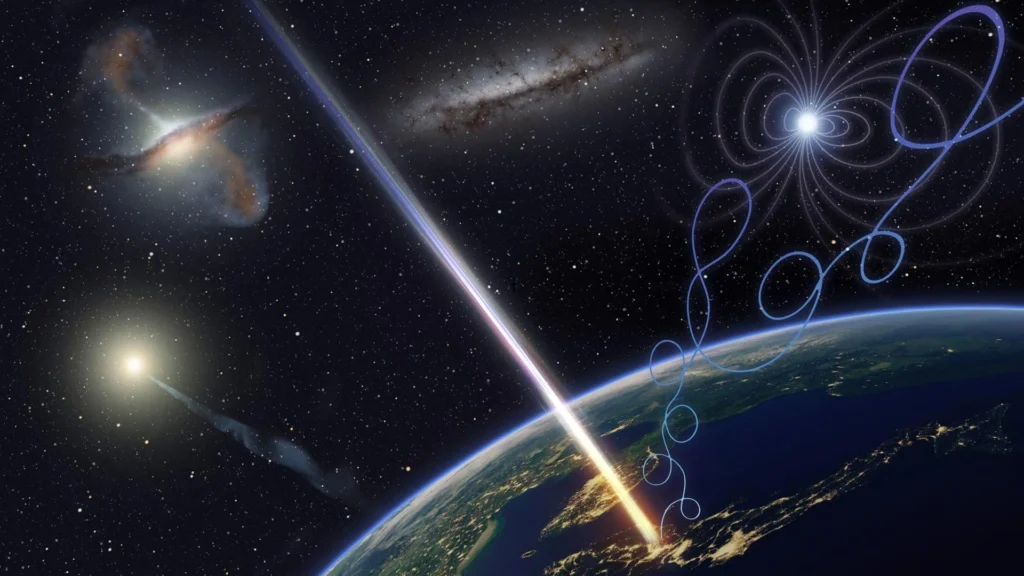
The vast reaches of the cosmos harbor phenomena so energetic that they defy the standard models of particle physics and challenge our understanding of the universe’s most violent environments. Among these mysteries, the origin of ultrahigh-energy cosmic rays (UHECRs) has remained an elusive "holy grail" for astrophysicists for over half a century. However, a groundbreaking study led by researchers at Pennsylvania State University suggests that the answer may lie in particles far heavier than previously suspected. By proposing that these cosmic projectiles are ultraheavy atomic nuclei—elements heavier than iron—scientists believe they have found a way to explain how such immense energy can traverse the "cosmic voids" of intergalactic space to reach Earth.
The Amaterasu Event and the Void Problem
In May 2021, the Telescope Array, a massive cosmic ray detector located in the high desert of Utah, recorded an event that sent shockwaves through the scientific community. A single subatomic particle struck the atmosphere with an energy of approximately 240 exa-electron volts (EeV). To put this in perspective, one EeV is a quintillion (10^18) electron volts. The particle, subsequently named "Amaterasu" after the sun goddess in Japanese mythology, possessed an energy level roughly 40 million times greater than the protons accelerated in the Large Hadron Collider (LHC) at CERN.
The Amaterasu particle is not an isolated anomaly but belongs to a rare class of ultrahigh-energy cosmic rays, the most famous of which was the "Oh-My-God" particle detected in 1991, which boasted an energy of 320 EeV. However, the Amaterasu particle presented a unique geographical problem. When astrophysicists traced its arrival direction back into the sky, they found it originated from the Local Void—a vast, empty region of space bordering the Milky Way that contains few, if any, galaxies or known high-energy astrophysical sources.
"The origins and acceleration mechanisms of ultrahigh-energy cosmic rays have been among the biggest mysteries in the field for more than 60 years, since the first example was reported," stated Kohta Murase, professor of physics and of astronomy and astrophysics at Penn State and the lead researcher on the study. Under traditional models, a particle with such high energy should point directly back to its source because its path is less deflected by magnetic fields. The fact that Amaterasu pointed to a void suggested that either our understanding of magnetic fields is flawed, or the particle itself is not what we thought it was.
A New Hypothesis: Beyond the Iron Limit
The prevailing theory for decades was that UHECRs were likely protons (hydrogen nuclei) or light nuclei like helium. However, the Penn State team, in collaboration with the Yukawa Institute for Theoretical Physics at Kyoto University and Virginia Tech, has introduced a paradigm shift. Their research, published in the prestigious journal Physical Review Letters, suggests that the highest-energy cosmic rays may be ultraheavy nuclei—atomic centers heavier than iron.
Atomic nuclei are incredibly dense, containing nearly all the mass of an atom within a fraction of its volume. Iron (atomic number 26) has long been considered the "end of the line" for standard stellar fusion. Elements heavier than iron, such as lead or gold, require much more violent environments to form, such as the explosive deaths of massive stars or the collision of neutron stars.
The team’s computer simulations revealed a critical physical advantage for these ultraheavy particles: they lose energy more slowly than protons or lighter nuclei while traveling through the intergalactic medium. As cosmic rays travel across millions of light-years, they interact with the Cosmic Microwave Background (CMB)—the afterglow of the Big Bang. These interactions usually sap the particle’s energy, a phenomenon known as the Greisen-Zatsepin-Kuzmin (GZK) limit.
"Our research showed that at energies comparable to that of the Amaterasu particle, ultraheavy nuclei lose energy more slowly than protons or intermediate-mass nuclei," Murase explained. This "sturdiness" allows ultraheavy nuclei to survive long-distance journeys across the universe without degrading to lower energy levels, potentially explaining how they can arrive at Earth with such extreme kinetic energy even after originating from distant, violent sources far beyond the Local Void.
The Engines of Acceleration: Where Do They Come From?
If these particles are indeed ultraheavy nuclei, the question then shifts to what kind of "cosmic cannon" could possibly fire them. The energy required to accelerate a particle to 240 EeV is staggering. For a single subatomic particle to carry the kinetic energy of a professional tennis ball served at 60 miles per hour, the source must be one of the most extreme environments in the known universe.
The research team points to three primary candidates for these cosmic accelerators:
- Binary Neutron Star Mergers: These are collisions between two ultra-dense remnants of dead stars. These events are so powerful they warp the fabric of spacetime, emitting gravitational waves that have been detected by facilities like LIGO. They are also known sites of "r-process" nucleosynthesis, where heavy elements are forged.
- Magnetars: These are a type of neutron star with an extremely powerful magnetic field—trillions of times stronger than Earth’s. The rotation and magnetic tension of a magnetar can act as a natural particle accelerator.
- Hypernovae: These occur during the collapse of a massive star into a black hole. These events often power gamma-ray bursts (GRBs), which are the brightest electromagnetic events observed in the universe.
"These violent cosmic phenomena can also power gamma-ray bursts that are among the most energetic explosions in the universe," Murase noted. The research suggests that these sources do not just produce energy; they are the literal forges of the heavy elements that eventually become the ultraheavy cosmic rays we detect.
Chronology of Discovery: A Thirty-Year Gap
The search for the origin of UHECRs has been a slow and painstaking process due to the rarity of these events. A detector the size of the Telescope Array (which covers about 700 square kilometers) might only see one particle with energy exceeding 100 EeV per year.
- 1991: The "Oh-My-God" particle is detected by the Fly’s Eye detector in Utah. At 320 EeV, it remains the highest-energy cosmic ray ever recorded.
- 2004: The Pierre Auger Observatory in Argentina begins full operations, providing the most comprehensive data on the "southern sky" and suggesting that cosmic rays might be composed of a mix of elements.
- 2008: The Telescope Array in Utah begins operations to monitor the "northern sky," eventually detecting a "hotspot" of high-energy events.
- 2021: The Amaterasu particle is detected by the Telescope Array, reigniting the debate over source locations and particle composition.
- 2024: The Penn State study provides a theoretical framework for ultraheavy nuclei, offering a potential resolution to the "void" problem and the energy-loss paradox.
Implications for Modern Astrophysics
The suggestion that UHECRs are ultraheavy nuclei has profound implications for how we map the universe. If these particles are indeed heavy, they would be more susceptible to deflection by intergalactic magnetic fields than protons would be. This means that the "source" of the Amaterasu particle might not be in the void where it seems to point, but rather hidden behind a galactic cluster, its path bent by the magnetic "fog" of the universe.
Furthermore, this research helps explain a long-standing discrepancy between observations in the Northern and Southern hemispheres. The cosmic ray spectrum—the distribution of energy levels—looks slightly different depending on which part of the sky is being observed. "A contribution from these sources could also help explain a possible difference seen between the northern and southern skies in the ultrahigh-energy cosmic-ray spectrum," Murase said. "If ultraheavy nuclei contribute significantly at the highest energies, future data should indicate a composition heavier than iron."
The Next Generation of Detection
The scientific community is now looking toward the next decade of observational technology to prove or disprove the ultraheavy nuclei hypothesis. Several projects are currently in the proposal or upgrade stages:
- AugerPrime: An upgrade to the Pierre Auger Observatory in Argentina designed specifically to improve "mass composition" sensitivity. By better distinguishing between protons and heavier nuclei, it will provide the data needed to test Murase’s simulations.
- The Global Cosmic Ray Observatory (GCOS): A proposed next-generation facility that would be significantly larger and more sensitive than current arrays, aiming to capture enough events to perform "cosmic ray astronomy."
- POEMMA (Probe of Extreme Multi-Messenger Astrophysics): A proposed space-based mission that would look down at the Earth’s atmosphere to detect the flashes of light (fluorescence) and radio signals produced when cosmic rays strike the air.
As these facilities come online, they will look for the specific "signatures" of heavy nuclei. When a heavy nucleus hits the atmosphere, it creates an "air shower"—a cascade of billions of secondary particles. The depth at which this shower reaches its maximum intensity (a value known as Xmax) is a telltale sign of the particle’s mass. Heavy nuclei tend to interact higher in the atmosphere than protons do.
The work of the Penn State team, alongside their international collaborators, has provided a new lens through which to view the most extreme events in our universe. By shifting the focus from simple protons to complex, ultraheavy nuclei, they have opened a path to finally identifying the cosmic engines that have been firing these high-speed projectiles at Earth for eons. Whether these particles are the remnants of colliding neutron stars or the final gasps of collapsing suns, they carry within them the secrets of the most violent and energetic corners of the cosmos.