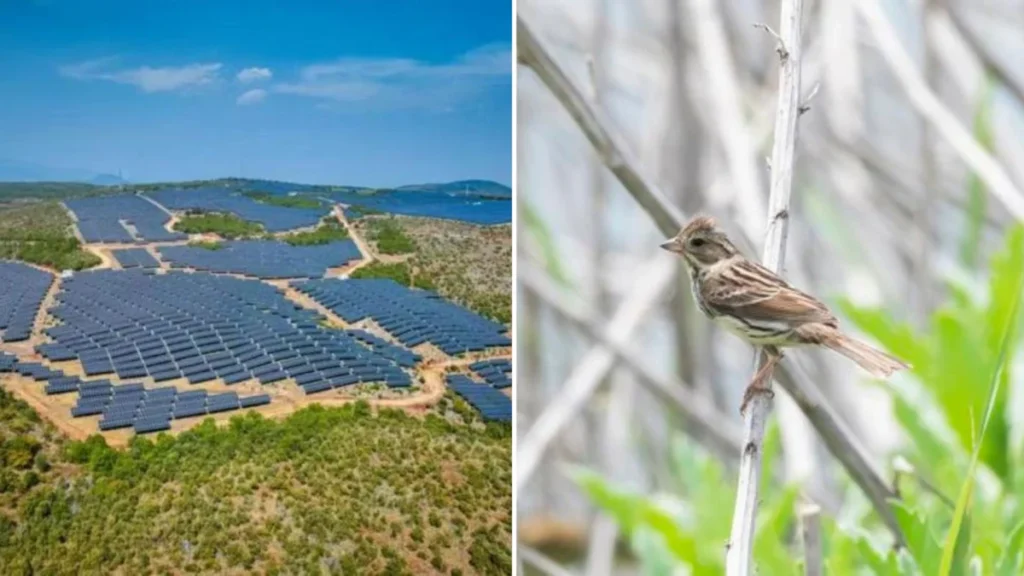
The global imperative to transition towards clean energy, while crucial for mitigating climate change, is revealing an unexpected and concerning ecological toll. While solar power stands as a cornerstone in the fight against global warming, its accelerating deployment, particularly in China, is associated with significant habitat destruction and fragmentation, leading to measurable declines in local bird diversity. A comprehensive, decade-long study spanning 2,344 Chinese counties has brought this critical trade-off into sharp focus, illustrating how aggressive solar energy policies are inadvertently driving down avian populations.
China’s Solar Ascendancy and the Research Context
China has unequivocally established itself as the global leader in renewable energy, dominating both the manufacturing and generation of solar power. This rapid expansion has been a central pillar of the nation’s ambitious climate strategy, with significant policy drives aimed at decarbonizing its energy grid and reducing air pollution. The country impressively surpassed its 2030 target of 1,200 gigawatts of combined solar and wind capacity years ahead of schedule, a testament to its unparalleled commitment and investment in the sector. However, this dizzying pace of deployment necessitates an immense physical footprint, transforming vast tracts of land into photovoltaic arrays.
The research, led by Huiming Zhang from Nanjing University of Information Science & Technology, examined nationwide bird observations, the expansion of solar infrastructure, and regional economic data from 2014 to 2023. This extensive period allowed researchers to track concurrent trends in policy implementation, physical development, and ecological response across a diverse geographical and socio-economic landscape. The study’s findings quantify a troubling trend: for every one-standard-deviation increase in a county’s solar-promoting policy intensity, local bird diversity indices dropped by 2.10 percent. The researchers explicitly stated, "The findings revealed that stronger policies promoting solar expansion were associated with significant declines in bird diversity – a one-standard-deviation increase in policy intensity corresponded to a 2.10% reduction in the bird biodiversity index." This correlation underscores a direct link between policy-driven solar expansion and avian population health.
Paving Over Paradise: Habitat Loss and Fragmentation
The core issue identified by the study is the extensive land conversion required for mega-scale photovoltaic installations. These projects demand vast, continuous spaces, leading to the rapid transformation of thousands of square kilometers of rural land. In China, where robust government policies often dictate both the scale and precise location of photovoltaic infrastructure, this transformation is occurring at an unprecedented rate. What were once open meadows, farmlands, and natural grasslands—vital habitats and foraging grounds for numerous bird species—are now being replaced by expansive fields of concrete foundations and glass panels.
Birds, being sensitive indicators of ecological health, often reflect broader environmental changes. The monitoring of their population shifts provides crucial insights, demonstrating that rapid solar development degrades critical vegetation and food sources, threatening local biodiversity in ways that other, less direct metrics might overlook. The study highlighted that the damage was most pronounced in wealthier, non-desert regions. Counterintuitively, rather than utilizing barren or degraded lands, developers frequently claimed ecologically rich grasslands and productive farmlands, thereby replacing thriving bird habitats with industrial infrastructure. Surprisingly, even widespread and common bird species, often considered more resilient, suffered the steepest losses, indicating a systemic impact rather than just a threat to niche species.
The Ecological Illusion of "Inferior Greening"
Adding another layer of complexity to this ecological challenge is a deceptive phenomenon the study termed "inferior greening." Satellite monitoring, specifically utilizing the Leaf Area Index (LAI)—a measure of the total area of green leaves per unit of ground area—often showed higher scores in solar installation areas, making them appear greener from orbit. This optical illusion can lead to a misinterpretation of environmental health from a macro perspective. However, ground-level observations revealed a stark contrast: despite the apparent increase in greenness from space, the actual vegetation diversity plummeted. Vibrant, complex ecosystems, rich in varied plant life and supporting diverse animal communities, were being replaced by simplified, degraded habitats, often consisting of monocultures or sparse ground cover beneath and around the solar panels. This "greening" is superficial, failing to provide the ecological services of a natural, biodiverse landscape.
Yuanning Liang, a researcher involved in an accompanying perspective on the study, noted, "Without such valuation, policy analysis gives insufficient weight to conservation." This statement underscores a critical gap in current policy frameworks: the economic value of biodiversity loss is rarely factored into the cost-benefit analysis of renewable energy projects. Experts are increasingly stressing that, much like carbon pricing has reshaped global manufacturing and energy policies, policymakers must assign a concrete economic value to the degradation of natural capital, ensuring that the pursuit of green energy does not inadvertently come at the irreversible cost of the natural world.
Broader Context: Renewable Energy’s Wider Environmental Footprint
The trade-offs observed with solar deployment in China are not isolated incidents but rather symptomatic of a broader challenge across the entire renewable energy sector. The global push for decarbonization, while essential for planetary health, frequently clashes with local ecosystem health, necessitating a more holistic and integrated approach to planning and implementation.
Wind energy, another vital component in replacing fossil fuels, also faces scrutiny regarding its environmental impact. Wind turbines, particularly large-scale installations, are known to cause bird and bat mortality through direct collisions with turbine blades. While technological advancements and strategic siting have worked to mitigate these impacts, the issue remains a significant concern for conservationists. Similarly, large-scale hydroelectric dams, historically a major source of renewable power, profoundly disrupt freshwater ecosystems. They fragment rivers, block the migratory paths of crucial fish species like salmon, alter natural sediment flows, and change water temperatures, often leading to significant biodiversity loss and ecosystem degradation.
These examples highlight a crucial lesson: "clean energy" does not automatically equate to "nature-positive" energy. The environmental benefits of reducing greenhouse gas emissions must be carefully weighed against and ideally integrated with the preservation of local ecosystems and biodiversity.
The Economic and Policy Dimension: Valuing Nature in the Green Transition
The economic implications of biodiversity loss are often underestimated. Healthy ecosystems provide invaluable "ecosystem services," such as pollination, water purification, climate regulation, and soil fertility, which are fundamental to human well-being and economic stability. When these services are degraded, there can be significant long-term economic costs, including reduced agricultural productivity, increased vulnerability to natural disasters, and diminished ecotourism potential.
The study from Nanjing University underscores the urgent need for a paradigm shift in how renewable energy projects are planned and evaluated. Current policy frameworks, heavily focused on carbon reduction targets and energy output, often fail to adequately account for the ecological footprint of large-scale infrastructure. This imbalance leads to what economists term "externalities"—costs borne by society or the environment that are not reflected in the market price of the goods or services. In this case, the external cost is the irreversible loss of biodiversity.
Policymakers face the complex task of integrating biodiversity conservation into energy policy. This could involve:
- Biodiversity Offsetting: Requiring developers to compensate for habitat loss by restoring or creating new habitats elsewhere.
- Spatial Planning and Zoning: Implementing stricter regulations on where solar farms can be built, prioritizing degraded lands, industrial sites, or urban rooftops over ecologically sensitive areas.
- Economic Incentives for Sustainable Practices: Offering subsidies or tax breaks for projects that adopt eco-friendly designs or co-locate with other compatible land uses.
Towards Sustainable Green Development: Innovations and Best Practices
To prevent climate solutions from inadvertently triggering a biodiversity crisis, green development requires smarter planning and innovative approaches. Several strategies are emerging to reconcile renewable energy expansion with ecological preservation:
- Agrivoltaics (Agri-PV): This involves co-locating solar panels with agricultural activities. Panels can be elevated to allow crops to grow beneath them, providing shade that can reduce water evaporation and improve yields for certain crops, while also potentially offering shelter for some wildlife. This dual-use approach minimizes land take and maximizes efficiency.
- Building on Degraded or Brownfield Land: Prioritizing the development of solar farms on sites that have already been disturbed or contaminated, such as former industrial sites, landfills, or mining areas. This revitalizes unproductive land without encroaching on natural habitats.
- Rooftop and Urban Solar: Maximizing solar installations on existing rooftops, parking lots (solar canopies), and other urban infrastructure significantly reduces the need for large-scale land conversion in rural areas.
- Eco-Friendly Infrastructure Design: Incorporating wildlife corridors, permeable surfaces, and native plantings into solar farm designs to minimize fragmentation and provide some ecological value. This can include designing perimeter fencing that allows for wildlife movement or planting pollinator-friendly vegetation beneath panels.
- Rigorous Environmental Impact Assessments (EIAs): Strengthening the requirements and enforcement of EIAs to ensure that potential biodiversity impacts are thoroughly evaluated before project approval, with provisions for adaptive management.
- Integrated Landscape Planning: Adopting a landscape-level approach to energy planning, where renewable energy projects are considered within the broader context of regional ecological networks, conservation priorities, and land-use plans. This allows for strategic siting that avoids critical habitats and ensures connectivity.
- Technological Innovations: Developing more efficient solar technologies that require less land per unit of energy generated, or exploring alternative forms of solar (e.g., floating solar on reservoirs) that have different ecological footprints.
Global Relevance and the Path Forward
The findings from China carry profound implications for the global renewable energy transition. As nations worldwide race to meet their climate targets, the lessons learned from China’s experience—both its successes in rapid deployment and its challenges in ecological impact—offer invaluable guidance. The study serves as a powerful reminder that the transition to a sustainable future must be truly holistic, addressing not only climate change but also biodiversity loss, resource depletion, and social equity.
International bodies, governments, environmental organizations, and industry stakeholders must collaborate to develop and implement best practices for "nature-positive" renewable energy development. This means moving beyond merely reducing carbon emissions to actively restoring and protecting natural ecosystems. The challenge is immense, but the opportunity to build a truly sustainable energy system, one that respects both planetary boundaries and ecological integrity, is within reach if informed by robust scientific understanding and guided by responsible policy. The future of our planet hinges not just on how much clean energy we deploy, but how we deploy it.