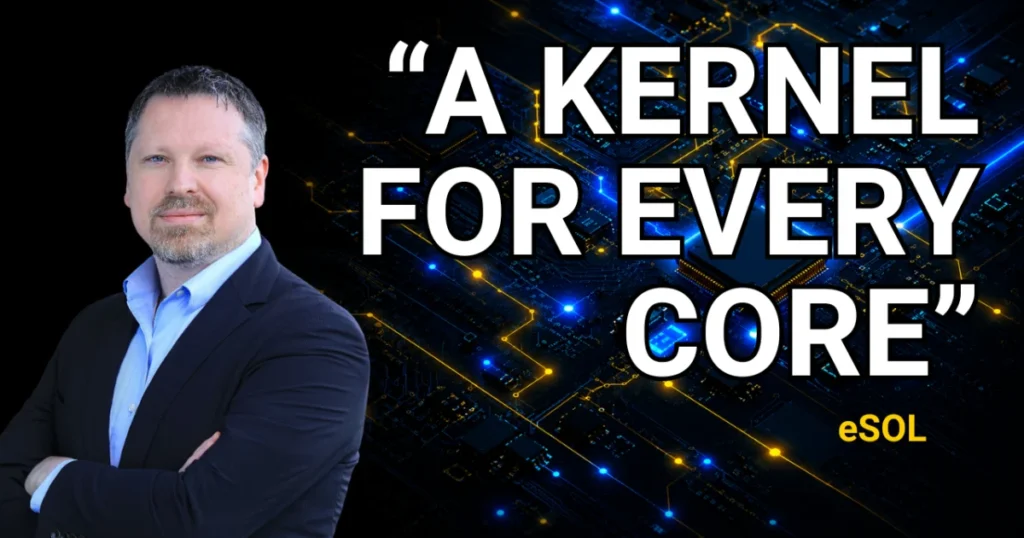
Real-time operating systems (RTOS) have long formed the bedrock of embedded design, providing the deterministic performance and predictable response times essential for critical applications. However, as processors increasingly integrate multiple cores and applications demand heightened levels of safety, isolation, and reliability, the foundational principles of traditional RTOS technology are undergoing a profound transformation. This critical evolution, and how companies like eSOL are pioneering next-generation solutions, was the central theme of a recent discussion on the Electropages Podcast, featuring Robin Mitchell and Philipp Viktorin, Director of Business Development at eSOL. Their conversation delved into the shifting landscape of RTOS and the pivotal role of eSOL’s eMCOS platform in shaping the future of embedded computing.
The Paradigm Shift in RTOS Architecture: Beyond Traditional Kernels
Historically, most RTOS architectures have relied on a single kernel responsible for managing all system resources, scheduling tasks across available processors, and handling inter-process communication. While effective for single-core or even basic symmetric multiprocessing (SMP) environments, this monolithic approach presents significant challenges when confronted with the demands of highly complex multi-core System-on-Chips (SoCs) and stringent safety requirements. As processors scale to dozens, or even hundreds, of cores, the overhead of a single kernel managing a vast array of resources can introduce latency, reduce predictability, and create single points of failure that compromise safety and reliability.
eSOL’s eMCOS platform represents a radical departure from this traditional paradigm, embracing a unique multicore architecture designed to inherently address these modern challenges. Instead of a singular, all-encompassing kernel, eMCOS can dynamically spawn an independent kernel for each processor core. This distributed kernel approach allows each core to operate with its own dedicated kernel instance, managing local resources and tasks autonomously. Critically, these independent kernels retain the ability to communicate and cooperate when necessary, facilitating complex application flows while preserving the benefits of isolation. This innovative structure provides developers with unprecedented levels of isolation between tasks, meaning a fault or error in one application running on a specific core is far less likely to propagate and affect critical functions on another core. Concurrently, the operating system gains exceptional scalability, effortlessly adapting to the underlying hardware’s increasing core count without incurring the performance bottlenecks associated with a centralized kernel. This fundamental architectural shift is not merely an optimization; it is a re-imagining of RTOS design tailored for the age of hyper-integrated, safety-critical embedded systems.
The Historical Context: From Microcontrollers to Multi-Core SoCs
To fully appreciate the significance of this evolution, it’s essential to understand the journey of embedded systems and RTOS. The concept of a real-time operating system emerged in the mid-20th century, primarily driven by the need for deterministic control in industrial automation, aerospace, and defense applications. Early RTOS focused on ensuring tasks completed within specified deadlines, offering features like priority-based pre-emptive scheduling, inter-task communication, and memory management for resource-constrained microcontrollers. These systems were often lean, optimized for minimal footprint and maximum predictability.
For decades, embedded systems largely operated on single-core processors, with performance gains primarily achieved through increasing clock speeds or specialized hardware accelerators. However, the late 1990s and early 2000s saw the advent of multi-core processors in the general computing world, driven by power consumption limitations and the physical constraints of increasing clock frequencies. This trend inevitably permeated the embedded domain. By the mid-2000s, multi-core SoCs began appearing in embedded applications, initially for performance-intensive tasks in consumer electronics, but quickly expanding into automotive, industrial, and medical sectors.
The move to multi-core offered immense benefits: enhanced computational power, improved power efficiency (by distributing workloads across multiple, lower-frequency cores), and the ability to run diverse applications concurrently. However, it also introduced significant challenges for traditional RTOS. Adapting single-kernel RTOS to effectively manage multi-core environments often involved complex synchronization mechanisms, locking protocols, and cache coherence management, which could inadvertently introduce non-determinism, increase latency, and complicate safety certification. The demand for next-generation RTOS that could natively leverage multi-core architectures without compromising real-time performance or safety became an urgent necessity.
The Imperative of Safety, Isolation, and Reliability
The discussion between Robin Mitchell and Philipp Viktorin underscored the paramount importance of safety, particularly in domains like automotive and industrial systems. Modern vehicles, for instance, are essentially computers on wheels, integrating hundreds of Electronic Control Units (ECUs) that manage everything from engine control and braking to advanced driver-assistance systems (ADAS) and infotainment. The advent of autonomous driving capabilities elevates safety requirements to an unprecedented level, where software failures can have catastrophic consequences.
This is precisely where certifications like ISO 26262 come into play. ISO 26262 is an international standard for functional safety in road vehicles, defining a rigorous lifecycle for automotive safety-related systems. It mandates a comprehensive set of processes, methods, and tools to ensure that software and hardware components meet specific Automotive Safety Integrity Levels (ASILs), ranging from ASIL A (lowest integrity) to ASIL D (highest integrity, required for critical functions like steering and braking in autonomous vehicles). Achieving ASIL D certification for an RTOS is a monumental task, requiring exhaustive verification, validation, and robust fault-tolerance mechanisms.
eMCOS’s distributed kernel architecture provides a fundamental advantage in meeting these stringent safety requirements. By isolating critical tasks onto dedicated cores with their own kernels, the platform significantly reduces the "common cause failure" potential. If a non-safety-critical application on one core encounters an issue, the probability of it affecting a safety-critical function on another isolated core is drastically minimized. This architectural characteristic inherently supports higher ASIL levels by simplifying safety analysis, fault containment, and the overall certification process. Philipp Viktorin’s emphasis on eMCOS’s ISO 26262 certification highlights eSOL’s commitment to providing a foundational software layer that enables automotive manufacturers and Tier 1 suppliers to develop highly reliable and safe systems. Beyond automotive, similar principles apply to industrial automation (often governed by standards like IEC 61508) and other critical infrastructure, where system reliability directly impacts operational safety and economic continuity.
eSOL’s Vision: A Consistent Route from Prototype to Production
A recurring challenge in embedded development is bridging the gap between early prototyping and robust, production-ready systems. Developers often begin with simpler, less stringent development environments for proof-of-concept, only to face significant hurdles when scaling to meet performance, reliability, and safety requirements for mass production. Philipp Viktorin articulated eSOL’s strategy to create a more consistent and streamlined route from early prototypes through to production-ready systems using eMCOS.
This vision implies several key aspects:
- Unified Toolchain and Development Environment: Providing a comprehensive and integrated set of development tools (compilers, debuggers, simulators, analysis tools) that can be used consistently across all stages of development, from initial design to final deployment.
- Scalable and Configurable Platform: eMCOS’s inherent scalability means that developers can start with a basic configuration for prototypes and incrementally add features, cores, and complexity without needing to fundamentally change their RTOS foundation. Its configurability allows tailoring the system to specific hardware and application needs, optimizing resource usage.
- Robust Middleware and Ecosystem: A production-ready system requires more than just an RTOS; it needs a rich ecosystem of middleware components (communication stacks, file systems, security modules, device drivers). eSOL’s commitment to a consistent route suggests a focus on providing or integrating with a mature set of such components, ensuring seamless integration and long-term support.
- Certification Support: For safety-critical systems, providing documentation, evidence, and expert support for regulatory compliance (like ISO 26262) from the outset significantly reduces the burden on developers during the critical certification phase.
By addressing these elements, eSOL aims to reduce development cycles, mitigate risks associated with transitioning between different development phases, and ultimately lower the total cost of ownership for embedded product development. This approach is particularly valuable in fast-evolving markets like autonomous vehicles, where rapid iteration and reliable deployment are critical for market leadership.
Supporting Data and Industry Trends: The Growing Embedded Landscape
The market for embedded systems continues its robust expansion, driven by widespread digitalization across industries, the proliferation of IoT devices, and advancements in AI and automation. Recent market analyses indicate that the global embedded systems market, valued at approximately USD 86 billion in 2022, is projected to grow at a compound annual growth rate (CAGR) of over 6% through 2030, reaching well over USD 130 billion. Within this, the market for embedded software, including RTOS, is growing even faster as software increasingly defines the functionality and value of embedded products.
Key trends driving this growth and the demand for advanced RTOS solutions include:
- Edge AI: Deploying artificial intelligence capabilities directly on embedded devices (e.g., for real-time inference in autonomous vehicles, smart cameras, industrial robots) requires powerful multi-core processors and RTOS capable of managing complex AI workloads alongside traditional control functions.
- Connectivity and IoT: The explosion of connected devices necessitates robust and secure network stacks, often managed by the RTOS, to ensure reliable communication and data exchange.
- Functional Safety and Security: Beyond automotive, industries like healthcare (medical devices), aerospace (avionics), and industrial control demand increasingly stringent safety and security certifications, making advanced RTOS with built-in isolation and fault tolerance indispensable.
- Software-Defined Everything: The trend towards software-defined vehicles, factories, and even infrastructure means that hardware platforms are becoming more standardized, while differentiation and innovation increasingly stem from the software stack running on them. This elevates the importance of a flexible, powerful, and secure RTOS.
Companies like eSOL, with their focus on specialized multi-core RTOS solutions, are strategically positioned to capitalize on these trends. Their expertise in high-reliability, high-performance embedded software addresses a critical need in a market where standard general-purpose operating systems often fall short of real-time and safety requirements.
Broader Impact and Implications: Enabling Future Technologies
The advancements embodied by platforms like eMCOS have far-reaching implications for the future of technology. By providing a reliable, scalable, and safe foundation for multi-core embedded systems, these RTOS innovations are directly enabling the next generation of critical applications:
- Autonomous Driving (Levels 4 & 5): The sophisticated sensor fusion, perception, path planning, and control algorithms required for fully autonomous vehicles demand immense computational power distributed across multiple cores, all operating under the highest safety integrity levels. Advanced RTOS are crucial for managing this complexity deterministically.
- Advanced Robotics and Industrial Automation: Collaborative robots, highly precise manufacturing machinery, and smart factory systems require real-time control, robust safety mechanisms for human-robot interaction, and the ability to process large amounts of sensor data concurrently.
- Next-Generation Medical Devices: From advanced diagnostic equipment to implantable devices, the demand for higher processing power, connectivity, and uncompromising safety in medical technology is continually increasing.
- Secure and Reliable IoT: For critical IoT applications in infrastructure, smart cities, and industrial settings, the underlying RTOS must provide not only real-time performance but also robust security features and fault tolerance to prevent system failures or cyberattacks.
The work discussed on the Electropages Podcast with eSOL’s Philipp Viktorin underscores a pivotal moment in embedded computing. As hardware continues its relentless march towards greater integration and performance, the software that orchestrates these complex systems must evolve in tandem. The shift towards distributed kernel architectures, exemplified by eMCOS, represents a fundamental re-evaluation of RTOS design, offering a compelling solution to the escalating demands for performance, scalability, isolation, and safety in an increasingly connected and autonomous world. This evolution is not merely incremental; it is foundational, empowering developers to build the intelligent, reliable, and safe systems that will define the technological landscape of tomorrow.






