A groundbreaking study by scientists at the University of Vienna has for the first time directly observed the hexatic phase, an unusual intermediate state between solid and liquid, in an atomically thin crystal. This discovery, published in the prestigious journal Science, not only resolves a long-standing mystery in condensed matter physics but also contradicts existing theoretical models for how two-dimensional materials melt, opening new avenues for understanding phase transitions at the nanoscale.
The Conventional View of Melting: An Abrupt Transformation
In the macroscopic world, the transition from solid to liquid is typically an instantaneous and definitive event. When ice melts into water, for instance, its rigid crystalline structure rapidly collapses into a fluid state the moment it reaches its melting point. This abrupt switch, characterized by a sudden loss of both positional and orientational order among atoms or molecules, is a hallmark of phase transitions in most familiar three-dimensional materials, from metals and minerals to polymers. The atoms, once locked in a periodic lattice, gain sufficient thermal energy to break their bonds and move freely, resulting in a complete transformation of the material’s physical properties. This fundamental understanding has underpinned much of materials science and engineering for centuries.
The Peculiar Realm of Two-Dimensional Materials
However, the rules governing materials change dramatically when their thickness is reduced to just a few atoms. In this realm, where quantum effects become prominent and surface interactions dominate volume effects, materials often exhibit unique properties not seen in their bulk counterparts. Extremely thin materials, often referred to as two-dimensional (2D) materials, have captivated scientists for their extraordinary electronic, optical, and mechanical characteristics, leading to the development of novel technologies in fields ranging from flexible electronics to quantum computing.
One of the most profound differences lies in how these ultra-thin materials undergo phase transitions, particularly melting. Unlike their 3D counterparts, 2D materials do not necessarily transition directly from a highly ordered solid to a completely disordered liquid. Instead, theoretical predictions from the 1970s proposed the existence of an intermediate state, known as the hexatic phase, which sits between the solid and liquid states. This phase, while widely discussed in theoretical physics, has remained notoriously difficult to confirm experimentally in real, strongly bonded materials.
The Elusive Hexatic Phase: A Theoretical Construct
The concept of the hexatic phase emerged from theoretical work in the 1970s, particularly the Kosterlitz-Thouless-Halperin-Nelson-Young (KTHNY) theory, which describes melting in two dimensions as a two-step process. According to this theory, a 2D crystal first melts into a hexatic phase by losing its long-range positional order while retaining a short-range orientational order. In simpler terms, the atoms are no longer fixed in a perfectly repeating grid, but they still tend to align themselves in a hexagonal pattern relative to their nearest neighbors. Subsequently, the hexatic phase transitions into a conventional liquid by losing this orientational order.
This two-step melting process is fundamentally different from the single-step melting observed in 3D materials. The difference arises because the reduced dimensionality makes it much harder to maintain long-range order. In 2D, thermal fluctuations can easily disrupt the perfect crystalline lattice, leading to the formation of defects (like dislocations and disclinations) that can accumulate and drive the material through these intermediate states. While the hexatic phase had been observed in simplified model systems, such as tightly packed colloidal particles (polystyrene spheres suspended in a liquid), these systems lack the strong chemical bonds and atomic-scale interactions present in real crystalline materials. This raised a critical question: could the hexatic phase truly exist in actual atomically thin crystals, or was it merely a theoretical curiosity or an artifact of simplified models?
A Decades-Long Mystery Solved: Direct Observation in Silver Iodide
The international research team, spearheaded by scientists from the University of Vienna, has now definitively answered this question. By meticulously studying atomically thin crystals of silver iodide (AgI), they achieved the unprecedented feat of directly observing the hexatic phase in a strongly bonded material. This experimental confirmation resolves a scientific debate that has spanned several decades, moving the hexatic phase from the realm of theoretical prediction and model systems into tangible reality for fundamental materials science.
The choice of silver iodide was strategic. AgI is known for its superionic phase at elevated temperatures in 3D, where its silver ions become highly mobile while the iodide sublattice remains relatively fixed. This characteristic, combined with its ability to form stable atomically thin layers, made it an ideal candidate for observing subtle structural changes during melting. The researchers leveraged cutting-edge experimental techniques to push the boundaries of atomic-scale imaging, revealing the intricate dance of atoms as the material transitioned through its various states.
The "Graphene Sandwich": A Protective Micro-Laboratory
To capture the delicate melting process of the atomically thin silver iodide, the researchers devised an ingenious experimental setup. They created a "graphene sandwich," encasing a single layer of silver iodide between two sheets of graphene. Graphene, a single layer of carbon atoms arranged in a hexagonal lattice, is renowned for its exceptional strength, thermal conductivity, and transparency to electron beams. This protective encapsulation was crucial for several reasons:
- Structural Integrity: The graphene layers provided mechanical support, preventing the fragile, atomically thin AgI crystal from collapsing or disintegrating under the high temperatures and vacuum conditions of the experiment.
- Environmental Protection: It shielded the AgI from potential contamination and oxidation, ensuring that the observed phenomena were intrinsic to the material itself and not influenced by external factors.
- Thermal Stability: Graphene’s excellent thermal conductivity helped in uniformly heating the AgI layer, ensuring that the entire sample reached the desired temperature for melting.
- Electron Transparency: Being atomically thin and composed of light elements, graphene is largely transparent to the electron beam used in the microscope, allowing researchers to image the AgI layer beneath with minimal interference.
This sophisticated protective environment allowed the AgI crystal to melt naturally while providing a stable platform for high-resolution imaging.
Advanced Microscopy and AI: Unveiling Atomic-Scale Dynamics
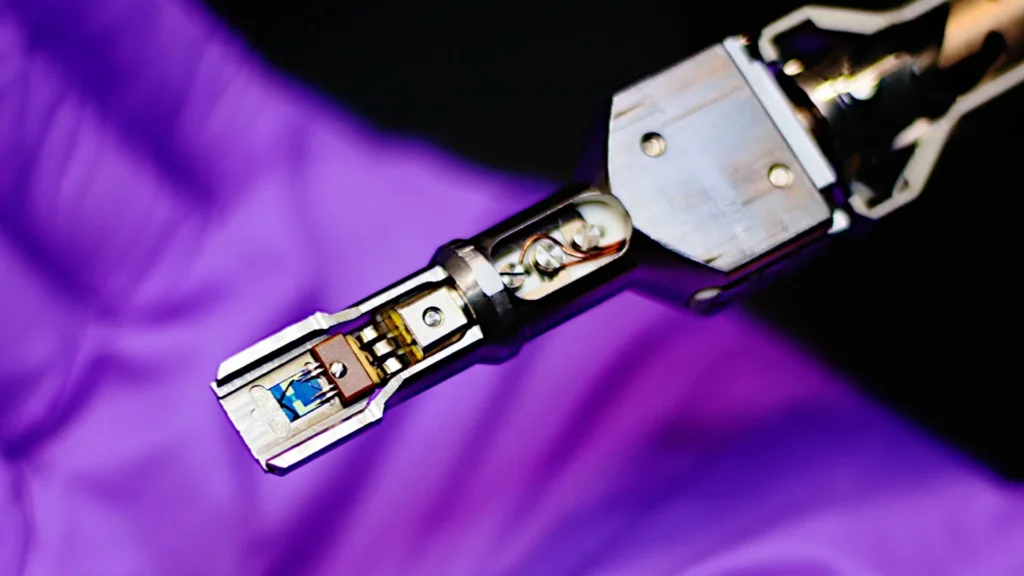
The core of the experimental observation relied on a sophisticated scanning transmission electron microscope (STEM). This instrument, equipped with a specialized heating holder, allowed the team to precisely control the temperature of the sample, gradually raising it above 1100 °C. STEM operates by focusing a beam of high-energy electrons onto the sample and detecting the electrons that pass through or are scattered. By scanning the beam across the sample and analyzing the transmitted or scattered electrons, STEM can generate images with atomic resolution, essentially allowing scientists to "see" individual atoms and their arrangements.
Observing a dynamic process like melting at atomic resolution generates an immense volume of data. Each image captures the positions of thousands of individual atoms, and tracking their movements, interactions, and structural reconfigurations across thousands of images over time would be an insurmountable task for human analysis. This is where artificial intelligence (AI) played a pivotal role.
According to Kimmo Mustonen, a senior author of the study from the University of Vienna, "Without the use of AI tools such as neural networks, it would have been impossible to track all these individual atoms." The research team trained a neural network using extensive sets of simulated data, teaching it to accurately identify atomic positions, track their trajectories, and analyze their local environments (e.g., bond lengths and angles). Once trained, this AI system efficiently processed thousands of high-resolution microscope images captured during the melting experiment. The AI’s ability to rapidly and precisely analyze this complex data stream was indispensable for identifying the subtle structural changes indicative of the hexatic phase.
A Narrow Window Reveals the Hexatic Phase
The AI-powered analysis yielded a remarkable discovery. The silver iodide crystal exhibited a clearly defined hexatic phase within a narrow temperature range, approximately 25 °C below its full melting point. In this intermediate state, the AgI atoms demonstrated characteristics of both a solid and a liquid. While the spacing between atoms became irregular, similar to a liquid, a partial orientational order persisted among their nearest neighbors, a trait typically associated with solids. This combination confirmed the hybrid nature of the hexatic phase as theorized.
Further corroboration came from electron diffraction measurements. By analyzing the patterns formed when the electron beam passed through the material, researchers could infer its atomic structure. The diffraction patterns confirmed the loss of long-range positional order but the retention of orientational order, providing strong experimental evidence for the existence of this intermediate state in atomically thin, strongly bonded materials. This marks a critical advancement, moving beyond observations in simplified model systems to real-world materials with complex chemical interactions.
Challenging Established Theories: A New Understanding of 2D Melting
Beyond the direct observation of the hexatic phase, the study uncovered an even more profound finding that challenges long-standing theoretical expectations. Earlier models, particularly the KTHNY theory, suggested that both phase transitions – from solid to hexatic, and from hexatic to liquid – should occur gradually, each involving the unbinding of different types of topological defects (dislocations for the solid-hexatic transition and disclinations for the hexatic-liquid transition).
However, the University of Vienna team observed a different behavior in silver iodide. While the transition from the solid state to the hexatic phase unfolded smoothly, as predicted, the subsequent transition from the hexatic phase to the fully liquid state was surprisingly abrupt. This sudden collapse of orientational order, reminiscent of a 3D material melting instantly, contradicted the theoretical expectation of a gradual second transition.
David Lamprecht from the University of Vienna and TU Wien, a main author of the study, alongside Thuy An Bui, also from the University of Vienna, remarked, "This suggests that melting in covalent two-dimensional crystals is far more complex than previously thought." This unexpected observation implies that current theoretical frameworks might need refinement to fully capture the intricate dynamics of phase transitions in real atomically thin materials, especially those with strong covalent or ionic bonds. The interplay between thermal fluctuations, defect generation, and chemical bonding appears to be more nuanced than previously modeled.
Broader Implications for Fundamental Physics and Materials Science
This pioneering research carries significant implications across several scientific disciplines:
- Fundamental Physics: The discovery challenges existing theories of phase transitions in low-dimensional systems. It necessitates a re-evaluation and potential refinement of models like the KTHNY theory to account for the abrupt hexatic-to-liquid transition observed in strongly bonded 2D crystals. This could lead to a deeper, more accurate understanding of statistical mechanics and the behavior of matter at its most fundamental scales.
- Materials Science and Engineering: A more precise understanding of how 2D materials melt is crucial for their practical application. Many advanced technologies, such as flexible electronics, atomically thin sensors, quantum devices, and high-performance catalysts, rely on the stability and specific properties of 2D materials under various temperature conditions. Knowing the exact melting pathway, including the existence and characteristics of intermediate phases, allows engineers to design more robust materials and processes, predicting their performance and stability in extreme environments. For instance, if a material undergoes an abrupt transition, it might be less stable at high temperatures than predicted by gradual transition models.
- The Power of AI in Scientific Discovery: This study stands as a powerful testament to the transformative potential of artificial intelligence in scientific research. The sheer volume and complexity of atomic-scale data generated by modern microscopy techniques are often beyond human capacity for analysis. AI, particularly machine learning algorithms like neural networks, can accelerate discovery by automating data processing, identifying subtle patterns, and extracting meaningful insights that would otherwise remain hidden. This interdisciplinary approach, combining advanced experimental techniques with sophisticated computational tools, represents a new paradigm for exploring the frontiers of materials science.
- Future Research Directions: The findings open up numerous avenues for future investigation. Researchers will likely explore other 2D materials to see if the abrupt hexatic-to-liquid transition is a general phenomenon or specific to silver iodide. Further theoretical work will be needed to develop new models that can accurately predict and explain the observed behavior. Moreover, the ability to control and manipulate these intermediate phases could lead to the creation of novel materials with unique, tunable properties, potentially unlocking new functionalities not yet imagined.
Jani Kotakoski, head of the research group at the University of Vienna, succinctly summarized the significance of the work: "Kimmo and his colleagues have once again demonstrated how powerful atomic-resolution microscopy can be." Indeed, this study not only unveils a long-sought-after state of matter but also illuminates the intricate and often surprising ways in which materials behave when confined to the atomic scale, pushing the boundaries of scientific knowledge and technological innovation. The journey from theoretical prediction to direct atomic-scale observation underscores the relentless pursuit of understanding that drives scientific progress.