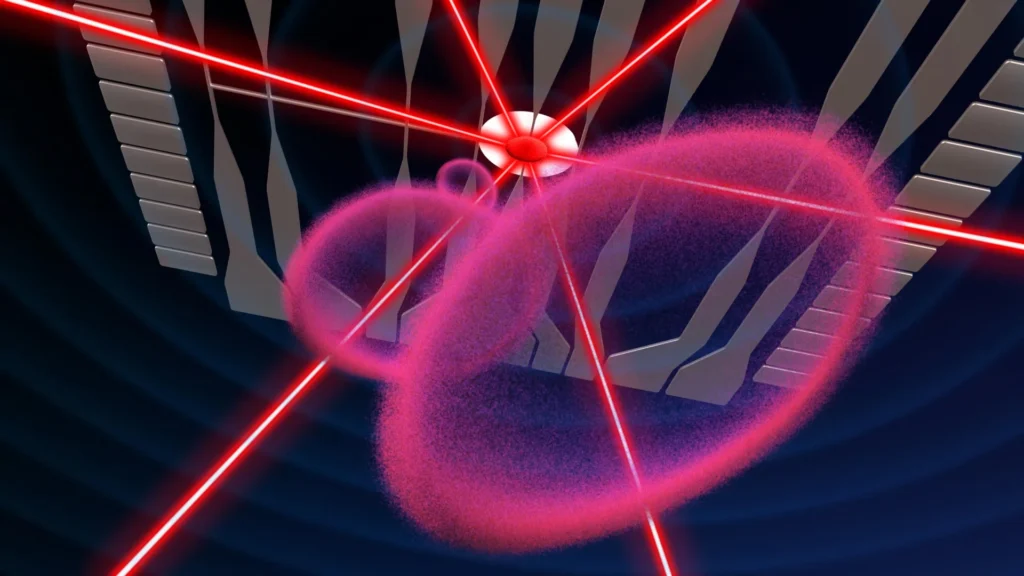
This milestone marks a significant leap forward in humanity’s quest to understand the universe at its most fundamental level, leveraging the unique microgravity environment of the International Space Station (ISS) to conduct experiments impossible to replicate with comparable precision and duration on Earth. The facility, known as the Cold Atom Lab (CAL), has resumed its groundbreaking work after receiving its fourth major upgrade since its initial installation in 2018, reinforcing NASA’s commitment to maintaining leadership in space-based quantum research.
Unveiling the Quantum Realm: Matter at its Most Peculiar
Quantum science delves into the perplexing behavior of matter and energy at unimaginably small scales, involving atoms, electrons, and photons (particles of light). While our everyday intuition pictures atoms as distinct, tiny spheres that collide, the quantum world operates under rules far stranger and more counterintuitive. At these extreme scales, atoms can shed their particulate nature, behaving instead like waves. They can exist in multiple locations simultaneously, a phenomenon known as superposition, and under specific conditions, even pass through one another, demonstrating properties that challenge classical physics.
Central to the CAL’s mission is the study of matter cooled to temperatures just a hair above absolute zero – the theoretical point where all atomic motion ceases. This extreme cold, reaching below minus 459 degrees Fahrenheit (minus 273 degrees Celsius), is not merely a technical feat; it is the gateway to unlocking quantum phenomena. At these frigid temperatures, atoms can coalesce into an extraordinary state of matter known as a Bose-Einstein Condensate, or BEC.
The Fifth State of Matter: Bose-Einstein Condensates
A Bose-Einstein Condensate represents a distinct, fifth state of matter, alongside the more familiar solids, liquids, gases, and plasma. Its existence was first theorized by Satyendra Nath Bose and Albert Einstein in the 1920s. Bose, a brilliant Indian physicist, developed a statistical method for counting identical particles that obey quantum rules, which Einstein then applied to atoms, predicting that at sufficiently low temperatures, a significant fraction of a gas would condense into the lowest possible quantum state, effectively behaving as a single, macroscopic quantum entity.
It took over 70 years for scientists to experimentally realize a BEC. In 1995, independent teams led by Eric Cornell and Carl Wieman at the University of Colorado at Boulder, and by Wolfgang Ketterle at MIT, successfully created BECs using rubidium atoms. This achievement, recognized with the Nobel Prize in Physics in 2001, opened a new frontier in quantum research.
Unlike individual subatomic particles, a BEC is a macroscopic quantum system, meaning it is much larger than its constituent atoms yet still governed by the laws of quantum mechanics. Its defining characteristic is that its atoms lose their individual identities and merge into a single "matter wave." On Earth, the effects of gravity limit the size and observation time of these delicate matter waves. However, the microgravity environment of low Earth orbit allows these quantum waves to expand significantly and persist for much longer durations, providing an unprecedented laboratory for their study.
Jason Williams, project scientist for the Cold Atom Lab at NASA’s Jet Propulsion Laboratory (JPL) in Southern California, which built and operates the facility, emphasizes the profound nature of these studies. "At the coldest temperatures, matter behaves drastically different from anything we have experienced," Williams stated. "The wavelike nature of matter dominates, and ultracold matter can behave in ways that are not only unexpected, but that also enable extremely precise measurements of time, gravity, and motion. The lab has lots of tools – especially with this latest upgrade – to let us probe the nature of the universe."
A Chronology of Cold Atom Lab’s Journey
The journey of the Cold Atom Lab to orbit began years before its launch. Conceived as an ambitious project to push the boundaries of quantum physics, CAL was designed to be a remotely controlled, compact atomic physics laboratory capable of operating autonomously aboard the ISS.
- 2012-2014: Initial design and development phases at NASA’s Jet Propulsion Laboratory, managed by Caltech. The challenge was to compress a room-sized laboratory filled with lasers, vacuum chambers, and optical equipment into a mini-refrigerator-sized module.
- May 21, 2018: CAL was launched aboard an Antares rocket on Northrop Grumman’s CRS-9 mission from NASA’s Wallops Flight Facility in Virginia.
- May 25, 2018: CAL arrived at the International Space Station and was installed in the ISS’s Kibo module.
- July 2018: CAL successfully produced the first Bose-Einstein Condensates in space, marking a historic achievement and immediately demonstrating the potential of microgravity for ultracold atom research.
- 2018-Present: CAL has been continuously operational, supporting five international research teams, conducting numerous experiments, and undergoing periodic software and minor hardware upgrades to enhance its capabilities.
- April 11, 2024: A new, significantly upgraded science module arrived at the space station aboard a Commercial Resupply Services mission, marking the fourth major hardware enhancement for the facility. This upgrade was crucial for expanding the range and sophistication of experiments that can be performed.
- May 2024: Following successful integration and testing, the upgraded Cold Atom Lab returned to full operational status, ready to continue its mission of probing the quantum universe.
The Upgraded Cold Atom Lab: How it Works and What’s New
The CAL, about the size of a mini-refrigerator, is a marvel of engineering, controlled remotely from Earth by scientists and engineers at JPL. At its heart lies a sophisticated collection of instruments housed within the science module. The recently installed upgrade represents a significant leap in its experimental capabilities.
The process of creating ultracold atoms in space is intricate and multi-staged:
- Atom Source: The experiment begins by heating strips of rubidium or potassium metal to temperatures as high as 750°F (400°C) inside a vacuum chamber. This process generates a rarefied gas of atoms.
- Laser Cooling: Researchers then employ precisely tuned lasers. These lasers are not used to heat, but rather to remove energy from the atoms. As atoms absorb and re-emit photons from the laser light, they slow down dramatically, a process known as Doppler cooling. Further refinements like Sisyphus cooling can push temperatures even lower. This initial cooling stage brings the atomic gas to temperatures significantly colder than deep space.
- Magnetic Trapping: After laser cooling, magnetic fields are utilized to trap the atoms, containing them in a specific region and preventing them from dispersing. These magnetic fields act as a "bottle" for the atoms.
- Evaporative Cooling: The final and most crucial cooling stage involves evaporative cooling. In this technique, the magnetic trap’s strength is gradually reduced, allowing the most energetic (hottest) atoms to escape. The remaining atoms re-thermalize at a lower temperature, leading to a dramatic drop in the overall temperature of the atomic cloud, bringing it to within nanokelvins of absolute zero, where a Bose-Einstein Condensate can form.
The latest enhancement, delivered on April 11, significantly boosts CAL’s capabilities. Among the most critical improvements is a redesigned magnetic trap. This new trap offers researchers unprecedented control over the shape and confinement of quantum gas clouds, allowing for novel investigations into their properties and behavior. Additionally, engineers introduced redesigned metal atom sources, which are more efficient and reliable at generating the gas clouds used in experiments.
Kamal Oudrhiri, project manager of the Cold Atom Lab at JPL, underscored the significance of these improvements. "It’s the closest thing we have to controlling the boundary of the quantum world," Oudrhiri said, referring to the ultralow temperatures achieved. "This new upgrade pushes that boundary even further."
Why Space is the Ultimate Quantum Laboratory
While scientists can and do study ultracold gases in laboratories on Earth, the space environment offers distinct and crucial advantages that elevate the scope of quantum experiments.
On Earth, gravity constantly pulls down on the delicate quantum gas clouds, causing them to sag and limiting the time they can be observed before dispersing. This "gravitational sag" typically restricts observation times to fractions of a second. In the microgravity environment of the ISS, this limitation is virtually eliminated. Quantum gases can be observed for significantly longer periods – up to several seconds – allowing researchers to study their evolution, interactions, and properties in unprecedented detail.
Furthermore, the absence of strong gravitational forces in orbit allows quantum gases to be cooled to even lower temperatures than achievable on Earth. This is because terrestrial experiments often have to contend with residual kinetic energy that prevents reaching the absolute coldest states without significant gravitational interference. The low-gravity environment also facilitates the formation of larger quantum waves and allows them to interact with gravity itself for extended periods, opening avenues for fundamental physics tests.
Ethan Elliott, deputy project scientist for Cold Atom Lab at JPL, highlights the pioneering nature of CAL. "As the first project to create Bose-Einstein condensates in orbit, we’re demonstrating that we can make quantum technology work reliably in space," Elliott stated. He draws a parallel to past scientific revolutions: "In the previous century, there was a quantum revolution that led to lasers, cellphones, and MRIs for medical imaging. We’re performing quantum 2.0 – direct manipulation of large quantum states – and we hope for similar gains in quantum tech by advancing this science in orbit."
Broader Impact and Implications: Advancing Quantum Technology in Space
The research conducted aboard the Cold Atom Lab extends far beyond mere academic curiosity. It lays the groundwork for a new generation of quantum technologies with profound implications for science, exploration, and everyday life. The "quantum 2.0" revolution that Elliott speaks of promises to leverage our enhanced understanding and control of quantum states to develop tools with unprecedented precision and capability.
Fundamental Physics: CAL enables critical tests of fundamental physical theories, including:
- Tests of the Equivalence Principle: By observing how ultracold atoms interact with the Earth’s gravitational field over extended periods, researchers can conduct highly precise tests of Einstein’s equivalence principle, a cornerstone of general relativity.
- Search for Dark Matter and Dark Energy: Anomalies in the behavior of ultracold atoms could potentially reveal signatures of dark matter or dark energy, two of the universe’s greatest mysteries.
- Understanding Quantum Entanglement: Further studies of BECs in microgravity can shed light on quantum entanglement and other non-local phenomena.
Quantum Sensors: One of the most promising applications stems from the development of matter-wave interferometers. These devices use the wavelike nature of atoms to perform incredibly precise measurements. In space, free from terrestrial noise and gravitational constraints, these sensors could achieve extraordinary sensitivity for:
- Gravity Mapping: Creating ultra-precise maps of Earth’s gravity field, which has implications for climate science, oceanography, and understanding geological processes. Such technology could also map gravity fields of other celestial bodies, like the Moon or Mars, crucial for future exploration.
- Navigation and Timing: Developing next-generation, highly accurate atomic clocks and navigation systems that are independent of GPS. This is particularly vital for deep-space missions where GPS signals are unavailable, enabling autonomous navigation with unprecedented precision.
- Acceleration and Rotation Sensing: High-precision accelerometers and gyroscopes for spacecraft, enhancing stability, control, and observational capabilities.
Quantum Computing: While CAL itself is not a quantum computer, the fundamental research into controlling and manipulating quantum states, especially large ensembles like BECs, provides invaluable insights that feed into the broader development of quantum computing architectures and algorithms. Understanding coherence and decoherence in complex quantum systems is paramount for building robust quantum computers.
Oudrhiri further articulated the strategic importance of CAL’s advancements: "This new hardware demonstrates NASA’s ability to maintain U.S. leadership in space-based quantum technologies while maturing future quantum instruments, such as matter-wave interferometers for fundamental physics missions, positioning, navigation, timing, and gravity sensing of Earth, the Moon, and beyond." This statement highlights a dual benefit: immediate scientific discovery and the long-term strategic development of technologies crucial for future space endeavors and national capabilities.
Management, Collaboration, and the Future
The Cold Atom Lab project is a testament to collaborative scientific endeavor. It is managed by Caltech in Pasadena, while NASA’s Jet Propulsion Laboratory is responsible for its design, construction, and ongoing operations. The project receives sponsorship from the Biological and Physical Sciences division within NASA’s Science Mission Directorate in Washington.
This division plays a critical role in supporting scientific discovery by leveraging the unique conditions of space – microgravity, radiation, vacuum – to conduct experiments that are simply not feasible on Earth. By studying biological and physical processes in these extreme environments, researchers gain fundamental knowledge that not only advances our understanding of the universe but also directly contributes to human exploration goals, enabling astronauts to travel farther and remain in space longer. Furthermore, many of these space-based investigations yield tangible benefits and technological advancements that improve life on Earth.
The successful upgrade and continued operation of the Cold Atom Lab represent more than just a technological achievement; they symbolize a sustained commitment to pushing the boundaries of human knowledge. By creating and manipulating matter at temperatures colder than any known natural environment, scientists aboard the ISS are unlocking the secrets of the quantum universe, promising not only profound scientific insights but also the development of revolutionary technologies that will shape the future of exploration, communication, and our understanding of reality itself. The CAL is a frontier laboratory, where the coldest matter in the cosmos reveals the hottest new science.