PI (Physik Instrumente), a global leader in high-precision motion control and nanopositioning solutions, has officially launched a dedicated low-temperature development program. This strategic initiative is specifically engineered to advance multi-axis nanopositioning systems, a critical enabling technology for the rapidly evolving field of quantum applications. The program represents a significant commitment to addressing the intricate and demanding requirements of quantum research and industrial deployment, where atomic-scale precision at ultra-low temperatures is paramount.
Historically, cryogenic motion solutions for scientific experiments often relied on relatively simpler configurations, typically involving stacked XYZ stages. While adequate for certain foundational tasks, the accelerating complexity of modern quantum experiments and emerging industrial quantum applications has rendered these conventional approaches insufficient. Contemporary quantum systems frequently necessitate sophisticated 5- and 6-degree-of-freedom (DOF) alignment systems. These advanced systems must not only accommodate significantly larger payloads but also support increasingly intricate optical configurations, all while operating within the extreme environmental conditions of cryostats and dilution refrigerators. The limitations of stacked stages, such as accumulated errors, lower stiffness, and larger footprints, have become clear bottlenecks in pushing the boundaries of quantum technology.
The Evolving Landscape of Quantum Technology and the Need for Precision
The global push towards realizing practical quantum computing, highly sensitive quantum sensing, and secure quantum communication has unveiled a profound technological gap in precision motion control. Quantum phenomena, such as superposition and entanglement, are exquisitely fragile and highly susceptible to environmental disturbances. To harness these phenomena, experimental setups must be meticulously controlled, often requiring temperatures mere fractions of a degree above absolute zero (below 4 Kelvin, and frequently in the millikelvin range). At these ultra-low temperatures, thermal noise, which can decohere quantum states, is significantly minimized, allowing quantum states to persist for longer durations.
However, operating mechanical systems in such extreme cryogenic environments presents a unique set of engineering challenges. Materials behave differently; lubricants typically used in standard conditions freeze or become ineffective; thermal expansion and contraction can lead to dimensional instability; and heat generation from active components must be strictly minimized to avoid warming the delicate quantum devices. Furthermore, the limited physical space within cryostats and dilution refrigerators necessitates exceptionally compact and efficient designs.
The demand for high-precision, multi-axis positioning within these confines stems from several critical applications:

- Quantum Computing: Accurate alignment of optical fibers to single-photon sources or detectors, positioning of superconducting qubits for inter-chip coupling, and precise manipulation of quantum dots for qubit manipulation and readout.
- Quantum Sensing: Calibration and stabilization of optical cavities, alignment of atomic traps, and precise placement of samples for ultra-sensitive magnetometers or gravimeters.
- Quantum Communication: Fine-tuning of optical components for entangled photon sources and receivers, ensuring optimal light coupling efficiency in fiber networks operating at cryogenic temperatures.
- Advanced Photonics: Assembly and testing of next-generation photonic integrated circuits, where feature sizes are on the nanometer scale and precise alignment is crucial for device performance.
These applications demand not only nanometer-scale resolution but also exceptional stability, repeatability, and the ability to control multiple degrees of freedom simultaneously.
PI’s Innovative Approach: Compact 6DOF Parallel Kinematics
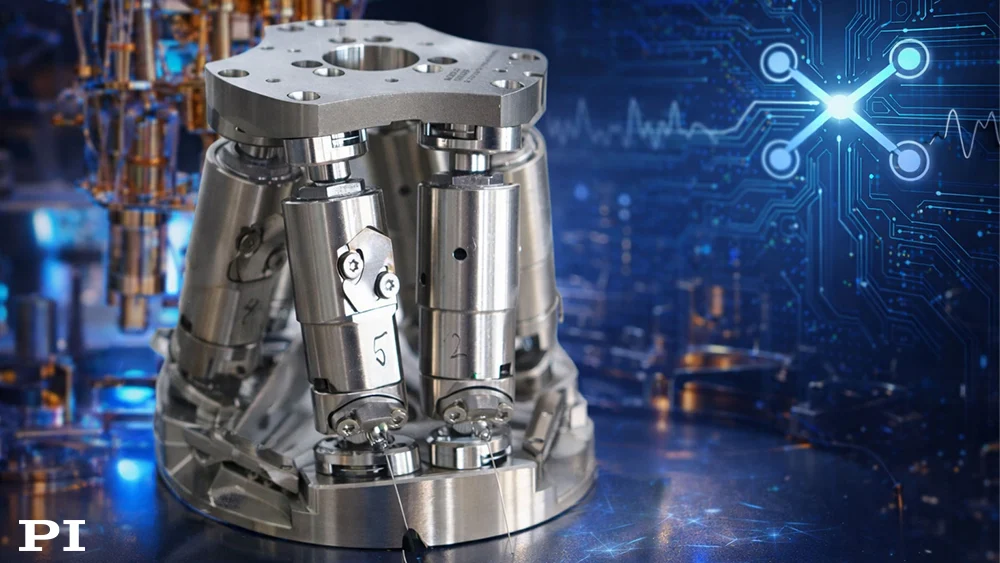
PI’s approach to overcoming these challenges is rooted in its established expertise in parallel kinematics, specifically leveraging compact 6-degree-of-freedom (6DOF) Hexapod systems. Unlike traditional serial kinematics (stacked stages where each axis moves independently on top of the previous), parallel kinematics feature a platform connected to a fixed base by multiple struts, all acting in parallel. This inherent design offers several critical advantages particularly suited for cryogenic environments:
- Compactness: The parallel design allows for a much smaller footprint and lower profile compared to stacked stages offering similar degrees of freedom, making them ideal for the constrained spaces within cryostats.
- Enhanced Stiffness and Stability: The interconnected structure distributes loads across multiple actuators, resulting in significantly higher stiffness and greater intrinsic stability, which translates to superior precision and less susceptibility to vibrations.
- Reduced Error Accumulation: In serial systems, errors from each stage accumulate. With parallel kinematics, all actuators contribute to the motion of a single platform, effectively reducing cumulative errors and improving overall positioning accuracy.
- Simultaneous Control of All Six Degrees of Freedom: A key advantage of Hexapods is the ability to precisely control X, Y, Z linear motion, as well as pitch, roll, and yaw rotations, all from a single, coordinated system. This enables complex alignment tasks to be performed more efficiently and accurately.
- Programmable Pivot Point: This feature allows the user to define the center of rotation anywhere in space, which is invaluable for aligning optical elements or samples without requiring physical repositioning of the entire setup. For instance, an optical beam can be precisely steered around a fixed point of interest.
- Low Inertia and Lower Energy Requirements: The optimized mass distribution and direct drive nature of piezoelectric actuators contribute to lower inertia, enabling faster response times and reduced power consumption, a crucial factor in thermally sensitive environments.
- Open Aperture: Many Hexapod designs feature a central opening, providing unimpeded optical access for light paths, imaging, or sample delivery, which is essential for numerous quantum optical experiments.
These systems are specifically designed to operate at temperatures below 4 Kelvin, a range encompassing liquid helium temperatures and the operating regimes of many superconducting and photonic quantum devices. Despite the extreme cold, they are engineered to support payloads of several hundred grams, accommodating a wide range of scientific instruments and optical components. They offer millimeter-scale travel ranges, providing sufficient adjustment capability for initial setup and fine-tuning, all while maintaining exceptional stability and repeatability crucial for reliable experimental results.
Piezo-Based Architecture: The Core of Cryogenic Precision
The fundamental actuation principle behind PI’s cryogenic nanopositioning systems is based on piezoelectric technology. Piezoelectric actuators leverage the inverse piezoelectric effect, where certain materials (piezoceramics) change shape when an electric field is applied. This direct conversion of electrical energy into mechanical displacement offers several distinct advantages for cryogenic applications:
- Minimal Heat Generation: Unlike conventional electromagnetic motors that generate significant heat through resistive losses in windings, piezoelectric actuators produce very little waste heat. This is paramount in cryogenic environments, where every milliwatt of heat can drastically affect the local temperature and the performance of quantum devices.
- Self-Locking Operation: Many piezo-based systems, especially those utilizing stick-slip or inertia drives, exhibit a self-locking characteristic when power is switched off. This means the position is held rigidly without continuous power consumption, further minimizing heat input and ensuring long-term stability in the absence of external control signals.
- Direct Drive and High Resolution: Piezoelectric actuators provide direct, frictionless motion with virtually unlimited resolution, limited only by the noise in the control electronics. This enables true nanometer and sub-nanometer positioning capabilities.
- Non-Magnetic Materials: The use of non-magnetic materials in the construction of these systems is critical for quantum applications. Many quantum devices, particularly superconducting qubits, are extremely sensitive to magnetic fields. Any magnetic interference from the positioning system could disrupt qubit coherence or alter device characteristics. PI’s commitment to non-magnetic construction ensures compatibility with these sensitive environments.
- UHV Compatibility: Ultra-High Vacuum (UHV) compatibility is another essential feature. Many cryogenic experiments operate in UHV conditions to prevent contamination of delicate samples and to ensure the longevity of the vacuum environment. The selection of UHV-compatible materials and manufacturing processes ensures that the nanopositioning systems do not outgas contaminants into the vacuum chamber.
Expansion of PI’s Expertise and Broader Impact

This development program is not an isolated effort but rather a significant expansion of PI’s long-standing work in motion technology for quantum research and cryogenic photonic systems. The company has a rich history of developing high-precision solutions for various scientific and industrial applications, and this initiative consolidates its position at the forefront of the quantum technology revolution.
The target industries for this advanced technology are broad and strategically important:
- Quantum Technology Industry: This includes academic research institutions, national laboratories, and commercial ventures actively developing quantum computers, quantum sensors, and quantum communication networks. The availability of reliable, high-precision cryogenic motion systems is a crucial enabler for accelerating research and transitioning laboratory prototypes into practical devices.
- Photonics Industry: The intersection of quantum mechanics and photonics is a fertile ground for innovation. Precision cryogenic motion is essential for manufacturing and testing advanced photonic integrated circuits, optical components for quantum information processing, and next-generation laser systems.
- Semiconductor Industry: While quantum technology is distinct from classical semiconductors, advancements in cryogenic environments can benefit certain aspects of semiconductor research, particularly in the characterization of novel materials at low temperatures, development of quantum dots, and advanced lithography techniques that might require cryogenic conditions.
Implications for the Future of Quantum Technology
The launch of PI’s cryogenic nanopositioning development program carries significant implications for the future trajectory of quantum technology. By addressing one of the most persistent and technically challenging bottlenecks – precision manipulation at ultra-low temperatures – PI is effectively lowering the barrier to entry for complex quantum experiments and accelerating the pace of innovation.
- Accelerated Research and Development: Researchers will be able to design and execute more complex experiments, explore novel quantum architectures, and characterize quantum devices with unprecedented precision and reliability. This will shorten development cycles and hasten the discovery of new quantum phenomena and applications.
- Enabling Scalability: As quantum systems grow in complexity, requiring more qubits or intricate optical networks, the need for multi-axis, highly stable positioning becomes even more critical. PI’s solutions pave the way for more scalable quantum device fabrication and integration.
- Commercialization of Quantum Devices: Reliable and robust cryogenic nanopositioning systems are essential for the eventual commercialization of quantum technologies. Industrial-grade components that can withstand demanding operational environments are vital for transitioning from laboratory prototypes to deployable quantum computers and sensors.
- Competitive Edge: For nations and companies investing heavily in quantum technology, access to such advanced enabling technologies provides a crucial competitive advantage in the global race for quantum supremacy.
- Cross-Disciplinary Impact: While primarily focused on quantum, the advancements made in cryogenic precision motion could have ripple effects in other scientific disciplines requiring extreme environmental control, such as astrophysics (e.g., for future space-based observatories or laboratory simulations of cosmic conditions), materials science (e.g., characterization of superconductors or novel 2D materials), and high-energy physics.
The program underscores a broader trend in high-tech industries: the increasing specialization and sophistication of foundational technologies. As fields like quantum computing mature, the demand for highly specialized, purpose-built components—such as cryogenic nanopositioning systems—will only intensify. PI’s proactive investment in this area positions it as a key enabler for the next generation of scientific discovery and technological innovation.
For more detailed information regarding PI’s innovative solutions and their applications in quantum technology and beyond, interested parties are encouraged to visit their official website at pi-usa.us. This program solidifies PI’s commitment to providing cutting-edge solutions that empower researchers and engineers to push the boundaries of what is possible in the quantum realm.