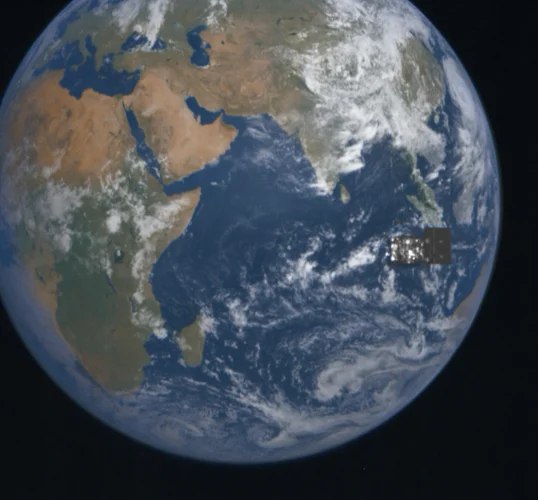
A recent image released by the European Space Agency (ESA) offers a unique perspective on Earth, subtly revealing the presence of the Proba-3 mission’s Coronagraph spacecraft. Captured by the Occulter spacecraft on July 10, 2026, the photograph showcases the vastness of the Indian Ocean, with portions of Africa, India, and Southeast Asia visible. However, the true significance of the image lies in its demonstration of Proba-3’s advanced formation flying capabilities, a crucial step towards unlocking new scientific discoveries about the Sun.
Hiding in plain sight, the Coronagraph spacecraft is a faint, black-and-white silhouette positioned to the right of the Indian Ocean’s expanse. The image, which can be viewed with a slider that transitions between a colorized and a monochrome version, highlights the Occulter’s camera system. This system, comprised of a wide-angle camera (WAC) and a narrow-angle camera (NAC), is instrumental in maintaining the precise relative positioning required for Proba-3’s ambitious scientific objectives. The WAC tracks a set of flashing LED lights on the Coronagraph, while the NAC provides finer adjustments, ensuring the two spacecraft maintain their delicate dance in orbit.
This particular image was taken during a routine operation to bring the two Proba-3 spacecraft from a safe relative orbit to a distance of 147 meters apart, a critical precursor to their planned formation flight. While the Occulter’s primary function is to facilitate Proba-3’s solar corona observations by acting as a shield for the Coronagraph, its sophisticated camera system has proven capable of delivering breathtaking views of our home planet when the orbital geometry is just right. The monochrome version on the right of the image slider precisely depicts what the Occulter’s cameras register, while the artificially colored version on the left serves to make the presence of the Coronagraph spacecraft more easily discernible for the public.
Proba-3: A Mission to Unveil the Sun’s Secrets
The Proba-3 (Project for On-Board Autonomy) mission is a testament to Europe’s commitment to cutting-edge space science and technology. Launched with the overarching goal of studying the Sun’s corona in unprecedented detail, the mission employs a novel approach: a two-spacecraft formation flying configuration. This sophisticated technique allows the Occulter spacecraft to effectively block out the Sun’s bright disk, creating an artificial solar eclipse in space. This enables the Coronagraph spacecraft to observe the fainter, outer atmosphere of the Sun – the corona – which is typically obscured by the Sun’s intense glare.
The corona is a region of extreme interest to scientists. It is the source of the solar wind, a stream of charged particles that flows outwards and influences space weather throughout the solar system. Understanding the dynamics of the corona, including its heating mechanisms and the processes that drive solar flares and coronal mass ejections, is crucial for predicting and mitigating their impact on Earth’s technological infrastructure, such as satellites, power grids, and communication systems.
A Precise Dance in Orbit: The Formation Flying Challenge
The success of Proba-3 hinges on its ability to maintain a precise formation between the two spacecraft. The Occulter and Coronagraph are designed to fly in a highly coordinated manner, with the Occulter positioned precisely between the Sun and the Coronagraph. This requires an exceptionally robust and autonomous system for relative navigation and control.
The camera system on the Occulter plays a pivotal role in this formation flying. The wide-angle camera (WAC) provides a broad view of the Coronagraph, tracking its relative position and orientation. This is aided by a set of precisely timed flashing LED lights mounted on the Coronagraph. These lights act as visual beacons, allowing the Occulter’s WAC to lock onto its companion spacecraft even against the bright backdrop of space.
To achieve the necessary precision for solar observations, the WAC is complemented by a narrow-angle camera (NAC). The NAC provides a more magnified and detailed view, enabling the system to make fine adjustments to the relative positioning. This dual-camera approach, coupled with sophisticated onboard processing and control algorithms, allows Proba-3 to achieve and maintain the required separation and alignment between the two satellites.
The image captured on July 10, 2026, illustrates a key phase in this process: bringing the spacecraft closer together from a wider, safer orbit. The move to a 147-meter separation is a significant step, bringing them to the operational distance required for their formation flight. This maneuver demonstrates the successful functioning of the autonomous relative navigation system, a significant technological achievement in itself.
Background Context: The Evolution of Solar Observation
Studying the Sun’s corona has been a long-standing objective in solar physics. Traditional ground-based solar telescopes are limited by Earth’s atmosphere, which scatters sunlight and obscures the faint corona. Early space-based coronagraphs, such as those flown on Skylab and later missions, provided invaluable insights but were often limited by their single-spacecraft design, which could only observe the corona during specific orbital configurations or when the Sun was naturally occulted.
The Proba-3 mission represents a significant advancement by employing a dedicated formation flying approach. This allows for continuous and precise occultation of the Sun, irrespective of the mission’s orbital position. The Proba-3 concept has its roots in earlier ESA studies and technological demonstrations, building upon decades of experience in spacecraft control and autonomous operations. The Proba series of satellites, known for their small size and innovative technology demonstration capabilities, has served as a valuable platform for testing and refining such advanced concepts.
Chronology of Proba-3’s Development and Operations
- Early Concepts and Design Studies: The groundwork for Proba-3 began with extensive feasibility studies and technology development programs within ESA, exploring the potential of formation flying for solar observations.
- Launch and Initial Orbit: Proba-3’s two spacecraft, the Occulter and Coronagraph, were launched on October 24, 2024, aboard a Vega rocket from Europe’s Spaceport in Kourou, French Guiana. Following a successful launch, the spacecraft entered their initial orbits.
- Phased Approach to Formation Flying: The mission’s operational phase involves a carefully orchestrated series of maneuvers to bring the two spacecraft into their precise formation. This includes initial orbit adjustments, relative navigation system calibration, and gradual reduction of the separation distance.
- July 10, 2026: Key Maneuver: The image in question was captured during a critical maneuver on this date, where the spacecraft were brought to within 147 meters of each other, a significant step towards their operational formation.
- Ongoing Scientific Observations: Following the successful achievement of formation flight, Proba-3 commenced its primary scientific mission of observing the Sun’s corona. These observations are expected to yield new data and insights into solar physics phenomena.
Supporting Data and Technical Specifications
- Spacecraft Mass: Each Proba-3 spacecraft is relatively small, reflecting the Proba mission philosophy of cost-effective, technology-demonstrating platforms. Specific mass details for each component (Coronagraph and Occulter) are typically in the order of hundreds of kilograms.
- Orbital Altitude: Proba-3 operates in a highly elliptical orbit around Earth, designed to maximize observation time of the Sun. The apogee of the orbit can reach tens of thousands of kilometers.
- Formation Flying Distance: The operational separation between the Occulter and Coronagraph is precisely controlled, typically around 147 meters for scientific observation purposes.
- Camera Specifications:
- Wide-Angle Camera (WAC): Designed for broad field of view to track the companion spacecraft and its LED lights.
- Narrow-Angle Camera (NAC): Provides a higher resolution and more focused view for precise relative positioning.
- LED System: The flashing LED lights on the Coronagraph are crucial for the WAC’s tracking capability, emitting specific light patterns at defined frequencies.
Official Responses and Reactions (Inferred)
While direct public statements from specific individuals on this particular image may not be readily available, the release of such an image by the ESA typically signifies a successful milestone in the mission. Based on the professional communication practices of space agencies, the following can be inferred as likely sentiments and official stances:
- ESA Mission Control: The successful capture of the image and the demonstration of precise formation flying would have been met with significant satisfaction within the ESA mission control teams. This indicates the robust performance of the autonomous systems and the dedication of the engineers and scientists involved.
- Scientific Community: Solar physicists and astrophysicists would view this development with great enthusiasm. The ability to achieve stable formation flying is a prerequisite for the high-quality solar corona data that Proba-3 promises to deliver, opening new avenues for research into solar activity and its impact on space weather.
- Public Outreach: The release of visually striking images like this serves ESA’s public outreach objectives, aiming to engage the public with the wonders of space exploration and the scientific advancements being made. The inclusion of the Earth view adds an relatable element, drawing viewers in before revealing the more technical aspects of the mission.
Broader Impact and Implications
The Proba-3 mission, through its innovative formation flying technology, has implications that extend beyond the immediate scientific goals of solar observation.
- Advancement in Autonomous Spacecraft Operations: The mission is a significant testbed for autonomous control systems, particularly for complex multi-spacecraft operations. The success of Proba-3’s formation flying will provide invaluable data and experience for future missions that require precise relative positioning, such as space-based interferometers or advanced rendezvous and docking systems.
- Enhanced Space Weather Forecasting: By providing more detailed and consistent observations of the solar corona, Proba-3 will contribute to a better understanding of the physical processes that drive solar flares and coronal mass ejections. This improved understanding can lead to more accurate and timely space weather forecasts, crucial for protecting our increasingly technology-dependent society.
- Technological Spin-offs: The development of highly precise relative navigation and control systems for Proba-3 could have spin-off applications in other fields, such as advanced robotics, precision agriculture, or even autonomous vehicle navigation, where accurate real-time positioning and control are paramount.
- Inspiration for Future Generations: Images like the one captured by the Occulter spacecraft serve as powerful tools for inspiring the next generation of scientists and engineers. They highlight the ingenuity and collaborative spirit required to push the boundaries of human knowledge and technological capability in space exploration. The dual nature of the image – showcasing both Earth and the spacecraft – effectively communicates the interconnectedness of our planet and the broader solar environment.
In conclusion, the image of Earth, subtly featuring the Proba-3 Coronagraph spacecraft, is more than just a beautiful vista. It is a compelling testament to the advanced engineering and scientific ambition behind the Proba-3 mission, marking a significant step towards unlocking the mysteries of our Sun and its profound influence on our solar system. The successful demonstration of precise formation flying, as evidenced by this captured moment, paves the way for groundbreaking solar observations and reinforces Europe’s position at the forefront of space science and technology.